

- Boolean Algebra Definition: Boolean algebra is a branch of mathematics focused on variables valued either 1 or 0, used primarily in digital circuit design.
- Core Operations: It revolves around three fundamental operations—AND, OR, and NOT—to handle logical operations in binary systems.
- Theorems and Laws: Boolean algebra includes critical theorems like De Morgan’s, which simplify the conversion between ANDs to ORs and vice versa, using complementation.
- Logical Diagram Representation: Expressions in Boolean algebra can be depicted through various logic gates, aiding in understanding circuit designs.
- Practical Application: Boolean algebra is essential for creating and simplifying digital circuits, proving its utility with each theorem and law.
What is Boolean Algebra?
Boolean algebra is an algebra of logic in which variables represent two states, commonly written as 0 and 1. George Boole developed this algebraic approach to logic in the nineteenth century and presented it fully in his 1854 book, “An Investigation of the Laws of Thought”.
Claude Shannon later showed how this form of logic could analyse relay and switching circuits. In that engineering context it is often called Switching Algebra. In digital electronics, it describes a circuit’s logic function and helps identify equivalent, simpler implementations.
Boolean symbols represent propositions, sets or two-state signals, depending on the application. The laws of Boolean algebra state relationships that remain true for every permitted value of their variables.
The identities and theorems in Boolean algebra let an expression be rewritten without changing its truth table. In the two-valued form used here, each variable has one of two values: 0 or 1.
Boolean algebra or switching algebra applies logical operations to values in a binary system. Its three basic operations are AND, OR and NOT.
Letters such as A, B and C commonly represent Boolean variables. Each variable in this two-valued treatment can be 0 or 1. The plus sign denotes OR, a dot or adjacency denotes AND, and an overbar denotes NOT.
A Boolean expression can be represented as a network of logic gates. Common symbols include an AND gate, OR gate, NOT gate, NOR gates, NAND gates, XOR gates and XNOR gates. Equivalent expressions produce the same output for every input combination.
The three basic operations are shown below.
AND Operation
OR Operation
Not Operation
Basic laws for Boolean Algebra
A . 0 = 0 for either value of A.
A . 1 = A for either value of A.
A . A = A for either value of A.
A . Ā = 0 for either value of A.
A + 0 = A for either value of A.
A + 1 = 1 for either value of A.
A + Ā = 1
A + A = A
A + B = B + A for all values of A and B.
A . B = B . A for all values of A and B.
The same laws extend to expressions containing more variables, as shown next.
Commutative Law for Boolean Algebra

The commutative law says that swapping the order of variables does not change the result of OR operations or AND operations. Thus A + B equals B + A, and A.B equals B.A.
Associative Laws for Boolean Algebra
The associative laws allow adjacent OR terms or adjacent AND terms to be regrouped without changing their order. They do not permit AND and OR to be regrouped across each other without applying another law.
Distributive Laws for Boolean Algebra
Boolean algebra has distributive identities for AND over OR and OR over AND. The second form differs from ordinary arithmetic distribution.
The following derivation proves the displayed identity by applying Boolean laws step by step: 
Proof:
Redundant Literal Rule

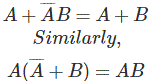
The identity A + ĀB = A + B can be checked with the following truth table.
| Inputs | Output | ||
| A | B | ĀB | A + ĀB |
| 0 | 0 | 0 | 0 |
| 0 | 1 | 1 | 1 |
| 1 | 0 | 0 | 1 |
| 1 | 1 | 0 | 1 |
| Inputs | Output | |
| A | B | A+B |
| 0 | 0 | 0 |
| 0 | 1 | 1 |
| 1 | 0 | 1 |
| 1 | 1 | 1 |
The two output columns match for all four input combinations, so the expressions are equivalent.
Absorption Laws for Boolean Algebra

The first absorption identity is A + A.B = A. The table checks both expressions for every value of A and B.
| Inputs | Output | ||
| A | B | AB | A+A.B |
| 0 | 0 | 0 | 0 |
| 0 | 1 | 0 | 0 |
| 1 | 0 | 0 | 1 |
| 1 | 1 | 1 | 1 |
The A and A+A.B columns are identical.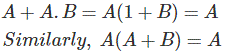
The dual absorption identity, A(A+B) = A, can be checked in the same way with a truth table.
| A | B | A+B | A.X(A+B) |
| 0 | 0 | 0 | 0 |
| 0 | 1 | 1 | 0 |
| 1 | 0 | 1 | 1 |
| 1 | 1 | 1 | 1 |
The A and A(A+B) columns are identical.
From De Morgan’s Theorem,
A truth table can verify each theorem by comparing both sides for every input combination.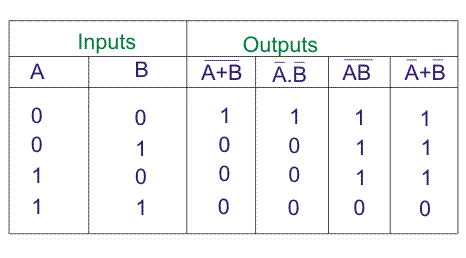

Examples of Boolean Algebra


De Morgan’s theorems provide a direct way to find the complement of a compound expression. Apply the following three operations to the expression under the complement bar.
- Identify the complete expression covered by the complement.
- Exchange every OR operation with AND and every AND operation with OR.
- Complement each literal to obtain the equivalent expression.
For the displayed expression,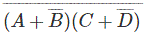 the first step identifies the expression within the outer complement, as shown here:
 . Next, exchange (+) with (.) and (.) with (+):
 Finally, complement each literal:
 This gives a form equivalent to the original complemented expression:
This result is the same as the one obtained by applying De Morgan Theorem directly.
The next worked example applies the same rules.
The alternate derivation is shown below.

A Boolean function can also be evaluated in a truth table.
Consider the following function.
Evaluate each term for all eight combinations of A, B and C, then combine the terms to obtain the final column.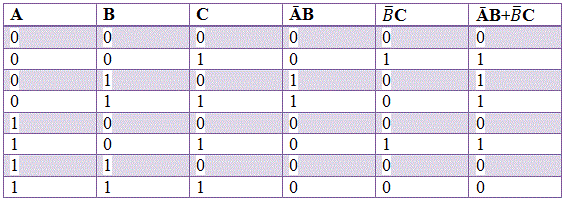
These examples apply several laws of Boolean algebra. De Morgan’s theorems provide the complement rules used in the worked expressions.


