

- OR Operation Definition: OR Operation is a logical operation used in Boolean algebra and electronics.
- Truth Table: The OR Operation truth table shows that the output is 1 if either or both inputs are 1.
- Boolean Algebra Symbol: The plus sign (+) is used to represent the OR Operation in Boolean algebra.
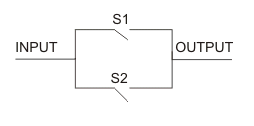
- Digital Circuit Application: In digital circuits, the OR Operation is like having two parallel switches where the signal flows if either switch is closed.
- Practical Understanding: Learning about OR Operation helps in understanding the workings of certain digital circuits and Integrated Circuits (ICs).
The OR operation combines Boolean values in Boolean algebra and in logic gates used within Integrated Circuits. An inclusive OR Operation produces 1 when either input or both inputs are 1. In algebraic notation, Boolean OR operation uses the plus sign, so Y = A + B. The Logical OR operation differs from arithmetic addition because 1 OR 1 equals 1. The truth table lists every two-input combination. In a Boolean OR operation, the only output-0 row has both inputs at 0.

For A = 0 and B = 0, the output Y is 0. For input pairs 0 and 1, 1 and 0, or 1 and 1, the output Y is 1.
In inclusive OR, the output is 0 only when every input is 0. One or more inputs at 1 produce an output of 1.
In an ideal positive-logic switch model, a closed conducting path represents 1 and an open path represents 0. Real logic circuits use specified voltage ranges for their 0 and 1 levels.
Two switches connected in parallel model OR behaviour. Current can reach the load when S1 is closed, S2 is closed, or both are closed. The path is open only when both switches are open. With closed = 1 and open = 0, the switch states follow the same four rows as the OR truth table.


