

- NAND Gate Definition: A NAND gate is defined as a logic gate that outputs a low signal only when all its inputs are high, otherwise, it outputs a high signal.
- Working Principle: The working principle of a NAND gate is the inverse of an AND gate; it produces a low output only when all inputs are high.
- Universal Gate: NAND gates are universal logic gates, meaning they can be used to create any other type of logic gate or Boolean function.
- Creating Other Gates: NAND gates can be used to create NOT, AND, and OR gates by arranging them in specific configurations.
- Circuit Diagram: The circuit diagram of a NAND gate includes an AND gate followed by a NOT gate, representing its logical function.
What is a NAND Gate?
A NAND gate (“not AND gate”) is a logic gate that produces a low output (0) only if all its inputs are true, and a high output (1) otherwise. Hence the NAND gate is the inverse of an AND gate, and its circuit is an AND gate followed by a NOT gate. Like an AND gate, a NAND gate may have two or more inputs and only one output.
The NAND gate performs the logical NAND operation. NAND gates are universal gates (along with NOR gates): any Boolean function can be built from NAND alone.


The basic logical construction of the NAND gate consists of an AND gate followed by a NOT gate.
The symbol of a NAND gate is the AND symbol with an inversion bubble on the output. That symbol is shown below.
In digital electronics, other logic gates include NOT gates, OR gates, NOR gates, XOR gates, XNOR gates.
NAND Gate Truth Table
NAND means “not AND”, so this gate’s output is the complement of a similar AND gate.
In a NAND gate, the output is only 0 when all inputs are 1. In all other cases, the output is 1.
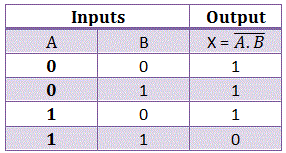
Hence, the truth table of a 2 input NAND gate can be represented as:

You can see that this is just the reverse of the truth table of an AND gate. The truth table of an AND gate is given below for reference:
Like an AND gate, a NAND gate can have more than two inputs, for example a 3-input or 4-input NAND gate.
A NAND gate is also referred to as a universal logic gate because every binary operation can be built from NAND gates alone.
The three basic binary operations are AND, OR and NOT. Every more complex binary operation is built from those three. The constructions below show each of them made from NAND gates only.
How To Make a NOT gate from NAND gates
We can make a NOT gate from a NAND gate.
When both inputs of a NAND gate are 0, the output is 1; when both inputs are 1, the output is 0. A NOT gate can be made from a NAND gate by connecting the inputs together.
Where X is either 1 or 0.
How To Make an AND gate from NAND gates
We can also make an AND gate from a NAND gate.
A NAND gate is an AND gate followed by a NOT gate. Inverting the NAND output cancels that extra NOT and leaves an AND gate. Thus a NOT gate followed by a NAND gate forms an AND gate.
In this case, we use the NOT gates realized from NAND gates, and we are showing the logic circuit below:
How To Make an OR gate from NAND gates
We can also make an OR gate from a NAND gate.
From De Morgan Theorem we know,
The above equation is a logical OR operation.
The above logic equation can be represented by gates as shown above, where inputs first inverted then passed through a third NAND gate.
The truth table of such circuit is,
Now, we have proved that all three basic binary operations can be realized by using only NAND gates.
Hence any other simple or complex binary operation can also be realized by using only NAND gates, which is why NAND is called a universal gate.


