- Switching Algebra Definition: Switching algebra is defined as a mathematical system for binary operations using only 1 and 0.
- Basic Operations: The primary operations in switching algebra are AND, OR, and NOT.
- Basic Laws: Fundamental laws in switching algebra include identities like A . 0 = 0 and A + 1 = 1.
- Truth Tables: Truth tables help prove the properties and laws of switching algebra.
- Simplification Methods: De Morgan’s theorem and other methods simplify complex Boolean expressions.
Boolean algebra, or switching algebra, operates on two values, usually written 0 and 1. AND and OR each combine two operands, while NOT complements one operand. These operations describe switching functions and digital logic.
In Boolean algebra, variables are commonly written as capital letters such as A, B and C. Each variable has a value of either 0 or 1.
The three basic Boolean operations are:
AND, which is 1 only when both inputs are 1;
OR, which is 1 when at least one input is 1;
NOT, which changes 0 to 1 and 1 to 0.
Basic identities in Boolean Algebra include:
A · 0 = 0 for either value of A.
A · 1 = A for either value of A.
A · A = A, the AND idempotent law.
A · Ā = 0, the AND complement law.
A + 0 = A for either value of A.
A + 1 = 1 for either value of A.
A + Ā = 1, the OR complement law.
A + A = A, the OR idempotent law.
A + B = B + A, the OR commutative law.
A · B = B · A, the AND commutative law.
The laws of Boolean algebra also apply to expressions with more than two variables.
Commutative Laws for Boolean Algebra

Associative Laws for Boolean Algebra

Distributive Laws for Boolean Algebra

Redundant Literal Rule

A truth table can verify A + ĀB = A + B by comparing both outputs for every input pair.
| Inputs | Output | ||
| A | B | ĀB | A + ĀB |
| 0 | 0 | 0 | 0 |
| 0 | 1 | 1 | 1 |
| 1 | 0 | 0 | 1 |
| 1 | 1 | 0 | 1 |
| Inputs | Output | |
| A | B | A+B |
| 0 | 0 | 0 |
| 0 | 1 | 1 |
| 1 | 0 | 1 |
| 1 | 1 | 1 |
The final columns match in all four rows, proving the identity for binary A and B.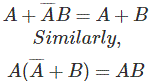
Absorption Laws for Boolean Algebra

The first absorption law, A + AB = A, is verified below.
| Inputs | Output | ||
| A | B | AB | A+A.B |
| 0 | 0 | 0 | 0 |
| 0 | 1 | 0 | 0 |
| 1 | 0 | 0 | 1 |
| 1 | 1 | 1 | 1 |
The A and A + AB columns have the same value in every row.
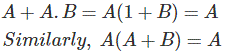
The second absorption law, A(A+B) = A, can also be checked with a truth table.
| A | B | A+B | A.X(A+B) |
| 0 | 0 | 0 | 0 |
| 0 | 1 | 1 | 0 |
| 1 | 0 | 1 | 1 |
| 1 | 1 | 1 | 1 |
The A and A(A+B) columns match in every row.
De Morgan’s Theorem
A truth table proves each law by showing that both expressions produce the same output for every input pair.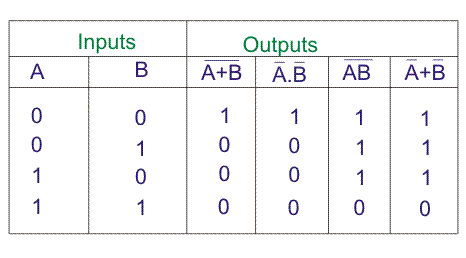

Examples of Boolean Algebra


De Morgan’s laws provide a direct way to find the complement of a compound Boolean expression. Apply the following three steps recursively from the outermost operation inward.
- Place a complement over the entire Boolean expression.
- Exchange every OR with AND and every AND with OR.
- Complement each literal, then remove any double complements.
For the first example,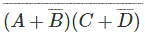 is placed under one outer complement:
 . Next, exchange each (+) with (·) and each (·) with (+):
 . Complement each literal and remove double complements:
 . The resulting expression is the complement of the original expression shown here:
This is the same result obtained by applying De Morgan Theorem directly.
A second example follows.
Apply the same method.

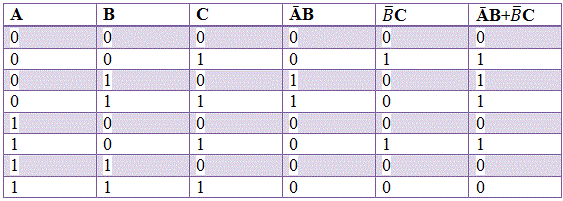
A truth table can also represent any Boolean function by listing every input assignment and its output.
Consider this Boolean function:
Evaluate it row by row in the truth table.