- Definition of De Morgan’s Theorem: De Morgan’s theorem is defined as a set of rules used to transform and simplify logical expressions in digital circuit design.
- Simplification of Logical Expressions: By using De Morgan’s theorem, conjunctions and disjunctions can be expressed in terms of each other through negation, simplifying complex logic.
- First Theorem: The first theorem states that the complement of the product of two variables equals the sum of their complements.
- Second Theorem: The second theorem states that the complement of the sum of two variables equals the product of their complements.
- Application in Digital Electronics: De Morgan’s theorem is widely used in Boolean algebra and digital electronics to simplify circuit designs and calculations.
What are De Morgan’s Laws?
De Morgan’s laws, also called De Morgan’s theorems, give two equivalence rules for Boolean logic. Named after the 19th-century British mathematician Augustus De Morgan, each rule moves a negation across an AND or OR operation while changing that operation to the other one.
In Boolean notation, conjunction means AND, disjunction means OR and negation means NOT.
The two logic rules are:
- The negation of an OR expression equals the AND of the negated terms.
- The negation of an AND expression equals the OR of the negated terms.
For sets, the same rules become:
- The complement of a union equals the intersection of the individual complements.
- The complement of an intersection equals the union of the individual complements.
Boolean operations are different from binary arithmetic, which includes binary addition, binary subtraction, binary multiplication and binary division. De Morgan’s laws transform logic expressions while preserving their truth values.
To apply De-Morgan’s theorems, first understand Boolean complements.
A Boolean complement reverses a truth value: the complement of 0 is 1, and the complement of 1 is 0. These values use the same symbols as the binary number system. If A = 0, then A’ = 1.
De Morgan’s Laws
The two identities in Boolean algebra support equivalent gate transformations in digital electronics. They apply to Boolean variables and to complete Boolean expressions.
Theorem 1:
The complement of the AND of two variables equals the OR of their individual complements.
For Boolean variables A and B, the first of De-Morgan’s laws is written as follows:
Theorem 2:
The complement of the OR of two variables equals the AND of their individual complements.
For Boolean variables A and B, the second identity is:
To move a complement across an expression with De-Morgan’s laws, use these two steps:
- In Boolean algebra, change each OR operator (+) under the complement to AND (·), or each AND operator (·) to OR (+).
- Complement each term that was inside the original operation.
The truth table verifies both identities for all four possible pairs of two Boolean variables:
| 1 | 2 | 3 | 4 | 5 | 6 | 7 | 8 | 9 | 10 |
| A | B | A’ | B | A+B | A.B | (A+B)’ | A’.B’ | (A.B)’ | A’+B’ |
| 0 | 0 | 1 | 1 | 0 | 0 | 1 | 1 | 1 | 1 |
| 0 | 1 | 1 | 0 | 1 | 0 | 0 | 0 | 1 | 1 |
| 1 | 0 | 0 | 1 | 1 | 0 | 0 | 0 | 1 | 1 |
| 1 | 1 | 0 | 0 | 1 | 1 | 0 | 0 | 0 | 0 |
The fourth column contains B’ values, although its protected header currently shows B.
In the first row, A = 0 and B = 0, so A’ = 1 and B’ = 1. Also, A + B = 0 and A·B = 0. Therefore, (A + B)’ and A’·B’ both equal 1. Likewise, (A·B)’ and A’ + B’ both equal 1.
Columns 7 and 8 match in every row, which verifies (A + B)’ = A’·B’. Columns 9 and 10 also match in every row, which verifies (A·B)’ = A’ + B’.
Because the truth table includes every possible input pair for A and B, the matching output columns establish both two-variable identities.
The first example replaces A’ + B’ with the equivalent expression (A·B)’:
The expression then reduces to 1: 
De Morgan’s theorem can also expose terms that Boolean absorption removes.
In the next example: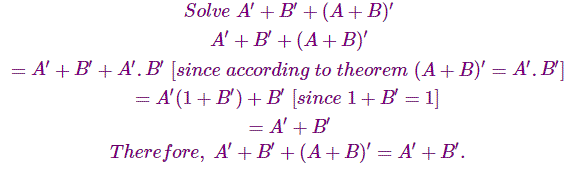
The De-Morgan’s laws substitution changes (A + B)’ to A’·B’, after which the expression reduces to A’ + B’.