- NOT Gate Definition: A NOT gate, also known as an inverter, is a basic digital logic gate that produces an output which is the opposite of its input.
- Symbol and Truth Table: The symbol for a NOT gate reflects its function of inverting the input signal, with a truth table confirming its consistent output inversion.
- Circuit Diagram: A simple bipolar transistor setup demonstrates the NOT gate’s working principle, where it inverts the input signal.
- Working Principle: The NOT gate operates by using a transistor to switch the electrical path based on the input; high input results in low output and vice versa.
- Practical Output Understanding: Practical Output Understanding
What is a NOT Gate?
A NOT gate, also called an inverter, flips its digital input signal: it outputs high (logical 1) when the input is low (logical 0) and low when the input is high. That logic function is not the same as a power inverter, despite the similar name. The symbol for a NOT gate shows this inversion.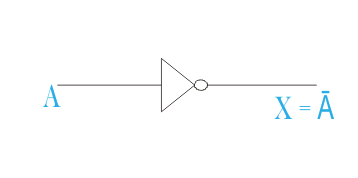
In a NOT gate, if the input variable is labeled A, the output will be Ā, where Ā is the inverse of A. A bar over the letter marks that complement. If A is 1, then Ā equals 0, and if A is 0, then Ā equals 1.
Truth tables list the output of a particular digital logic circuit for all the possible combinations of its inputs. The truth table of a NOT gate can be represented as:
Besides the NOT gate, other common logic gates include AND gates, OR gates, NAND gates, NOR gates, XOR gates and XNOR gates.
NOT Gate Transistor Circuit Diagram
A NOT gate can be realized with a single bipolar transistor. The transistor circuit diagram of a NOT gate (also known as a transistor inverter) is shown below: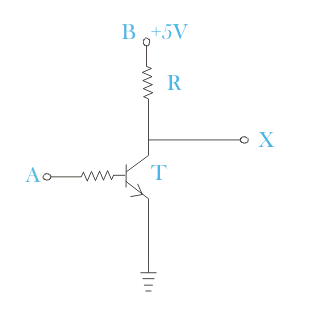
The transistor diagram above will be used to demonstrate how a NOT gate works.
How a NOT Gate Works
Let us examine the above transistor circuit when a high input voltage is applied, i.e. +5V.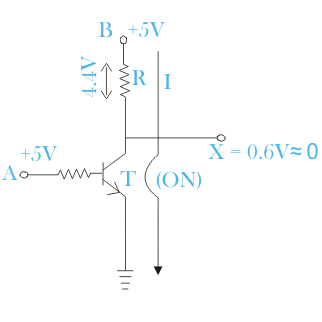
In this condition, the transistor T gets enough base potential to make it ‘ON’.
Once the transistor is ON, the supply voltage (+5V) finds a path to the ground through the resistor R. Ideally, the saturated transistor looks like a short, so almost all of the supply voltage drops across R. Consequently, almost no voltage appears at output X, so the output is low. In a real transistor a small collector-emitter voltage drop remains even when the device is ON.
That collector-emitter saturation voltage is typically about 0.2 V, not 0.6 V. 0.6 V to 0.7 V is the usual base-emitter drop. With a 5 V supply the resistor then drops about 4.8 V and the remaining 0.2 V at X is still treated as logical zero.
Now examine the case where input A = 0 V, so the transistor base is at 0 V or grounded.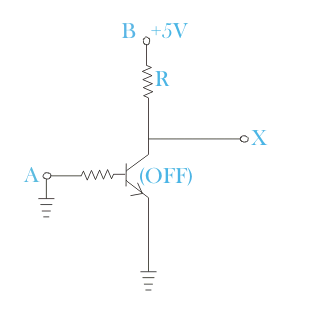
With the base at 0 V the transistor T is OFF, so the supply has no path to earth through the transistor. The output terminal then sits at the supply voltage, which is high or logical 1 when input A is low.
NOT Gate IC
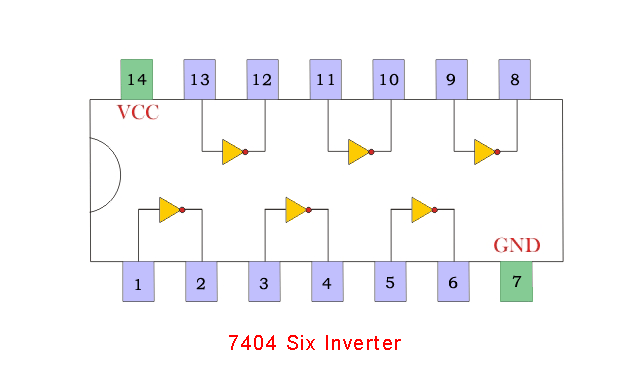
A common TTL NOT gate IC is the 7404 hex inverter. One 7404 contains six independent NOT gate circuits.