

- Electric Current Definition: Electric current is defined as the flow of charged particles—such as electrons or ions—through a conductor or space.
- Electric Current Formula: The flow rate of electric charge is calculated by dividing the change in charge by the change in time.
- Electric Current Units: The SI unit for current is the ampere (A), representing 1 coulomb of charge passing a point in 1 second.
- AC vs DC Current: Alternating current (AC) periodically reverses direction, while direct current (DC) flows in one direction.
- Current Measurement: Current is measured using devices like ammeters and galvanometers.
What is Electric Current?
Electric current is the net flow of charged particles (electrons, ions or holes) through a conductor or through space. Instantaneous current is how fast electric charge passes a surface: I = dQ/dt. Circuit symbols are I or i. The SI unit is the ampere (A).
In symbols,

The moving particles in an electrical conductor or in space are the charge carriers: electrons, holes or ions, depending on the medium.
Which carriers move depends on the medium:
- In a metal, the carriers are electrons.
- In semiconductors, electrons and holes both contribute.
- In an electrolyte, the carriers are ions.
- In a plasma (ionized gas), ions and electrons both move.
A voltage or potential difference across a closed path drives conventional current from the higher-potential node toward the lower. For a given ohmic resistance, larger voltage means larger current.
Equal potentials at two nodes means no current through a resistor joining them. In many circuits current is the result of voltage. Independent current sources and superconductors are exceptions to that slogan.
A current produces a magnetic field, which inductors, transformers, generators and motors use. In a resistive conductor the same current produces heating (I²R, joule heating), which is how an incandescent lamp makes light.
A time-varying current (and its associated fields) can radiate electromagnetic waves, which radio and other links use to carry information.
AC vs DC Current
By time behaviour, current is grouped as alternating current (AC) or direct current (DC).
AC Current
Alternating current reverses direction on a repeating cycle. “AC current” repeats the word current. Use AC or alternating current.
The polarity of i(t) changes at the waveform period (50 Hz or 60 Hz on utility mains).
A sine-wave AC starts at zero, rises to a peak, returns through zero then reaches the opposite peak and repeats.
The repeating wave can be sinusoidal, triangular, square or sawtooth.
What makes it AC is the periodic reversal (or zero-mean oscillation), not the exact shape.
Mains and most rotating machines produce a sine wave, as in the figure below.

An alternator (synchronous generator) is built to produce AC.
Utility supply to homes and industry is AC, mainly because transformers change voltage efficiently.
DC Current
Direct current does not reverse. “DC current” repeats the word current. Use DC or direct current. Steady DC is constant. Pulsating DC stays one polarity but its magnitude varies.
Unidirectional is another name for that one-way flow. A constant DC trace is below.

Sources include batteries, solar cells, fuel cells, thermocouples and commutator DC machines. A rectifier turns AC into DC (often with ripple unless filtered).
Electronics usually run from DC rails. HVDC transmission is the high-voltage exception: DC used at hundreds of kilovolts.
What is Electric Current Measured In (Current Units)?
The SI unit is the ampere (symbol A), a base unit, named for André-Marie Ampère.
One ampere is one coulomb per second (the coulomb is defined from the ampere: 1 C = 1 A·s). Since the 2019 SI revision the ampere is fixed by the elementary charge e, not by the old force-between-two-wires experiment. The 1 C/s relation still holds.

So A and C/s are the same quantity. Write C/s, not C/S (S is siemens).
Electric Current Formula
Circuit formulas (ohmic / DC or RMS on a resistor):
- I = V/R from Ohm’s Law
- I = P/V when P = V I
- I = √(P/R) when P = I²R
The same Ohm’s-law triangle is below. They do not replace I = dQ/dt.

Current Formula 1 (Ohm’s Law)
Ohm’s law:

Thus,


Example
A supply of  is across a
  resistance. Find the current in the resistor.

Solution:
Given: 
Ohm’s law:
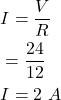
The current is  .
.
Current Formula 2 (Power and Voltage)
For DC (or average on a resistor), electrical power is P = V I.

So I = P/V when that product applies:

Here  means amperes.
Example
A supply feeds a  lamp. Find the current taken by the lamp, treating P = V I as valid at that operating point.

Solution:
Given: 
From I = P/V,
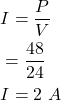
The lamp then draws .
Current Formula 3 (Power and Resistance, Ohmic Loss, Resistive Heating)
Start from 
Put Ohm’s law  into that product:

Then I = √(P/R) for a positive DC (or RMS) value:

Example
Find the current in a  ,
,  lamp using I = √(P/R).

Solution:
Given: 
Then
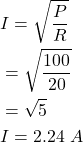
For that , lamp, √5 ≈ 2.236 so the current is  .
.
Dimensions of Current
If charge Q is taken as a dimension, I is  (that is Q/T). In SI, current is a base unit, so the dimension is I (or A), and charge is I T.
Current is coulomb per second, so
![\begin{align*} I = \frac{Q}{t} = \frac{[Q]}{[T]} = QT^-^1 = M^0L^0T^-^1Q \end{align*}](https://www.staging.electrical4u.com/wp-content/ql-cache/quicklatex.com-27f2e3b4d2f437ced4df080e97c125da_l3.png "Rendered by QuickLaTeX.com")
Conventional Current vs Electron Flow
Circuit diagrams use conventional current. Metals actually move electrons the other way.
In metals the mobile carriers are free electrons. An electric field is defined as the force per unit positive test charge, so electrons (negative) drift against E.
A voltage across a closed metallic path makes those electrons drift, which is a current.
Conventional current in the external circuit is drawn from the battery positive toward the battery negative, the direction a positive test charge would move.
In a metal the ion lattice stays put and electrons move. In a semiconductor both electrons and holes can contribute.
Positive carriers one way, or negative carriers the opposite way, give the same current sign. Circuits therefore pick one arrow: conventional current, independent of which carrier is moving.
Conventional current is the positive-carrier direction: higher potential to lower. Electrons drift from lower potential to higher. The two arrows are opposite, as in the figure below.

In short:
- Conventional Current: the positive-carrier arrow, from battery + through the load to battery −.
- Electron Flow: electrons drift from battery − through the load to battery +. Opposite to the conventional arrow.
The same directions on a battery circuit:

Convection Current vs Conduction Flow
Convection Current
A convection current here means charge transported through an insulating medium (liquid, gas or vacuum), not bound to a metal lattice. (In fluids, “convection” also means bulk motion of the medium.)
That path is not an ohmic metal, so it need not obey Ohm’s law. A vacuum tube is the usual example: electrons leave the cathode and cross the vacuum to the anode.
Conduction Current
Conduction current is charge drift in a material (metal, electrolyte, semiconductor). Ohm’s law holds only for ohmic materials over the stated range, not for every conductor.
Displacement Current
A resistor and a capacitor in parallel on source V (figure below) carry different kinds of current.

The resistor current, while V is applied, is

That is “conduction current.”
The capacitor branch current is nonzero only while its voltage is changing:
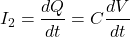
Maxwell called the ε dΦ_E/dt term “displacement current.”
No conduction charge crosses the ideal dielectric gap. Displacement current is still a real term in the Ampere-Maxwell law: it makes the magnetic field around a charging capacitor continuous with the conduction current in the wires.
How To Measure Current
Measuring current tells you load, heating and protection settings.
An ammeter reads current. Connect it in series with the path you want, never across the supply like a voltmeter.
A series ammeter on a resistor is shown below.

A galvanometer is a sensitive current detector. It shows polarity (direction) and a deflection related to current. A tangent galvanometer can be used as an absolute instrument (current from geometry and the Earth’s field). An ordinary panel meter is not that.
Clamp and Hall sensors read the magnetic field of the current so you need not open the conductor. Examples:
- Hall effect current sensor transducers
- Current transformer (CT) (ordinary iron CTs measure AC; DC needs a Hall or fluxgate CT)
- Clamp meters
- Shunt resistors
- Magneto resistive field sensors
Common Questions About Current
Short answers to common questions:
What Uses an Electromagnet to Measure Electric Current?
A moving-coil galvanometer uses a coil in a magnetic field (an electromagnet arrangement) so current in the coil produces torque.
A tangent galvanometer is the absolute type: I is found from the tangent of the deflection and the coil constants. Most galvanometers are secondary instruments, calibrated against a standard.
Inserting it still means opening the circuit, which is often inconvenient. Use a clamp meter or a shunt already in the panel when you cannot break the run.
How Does an Electric Current Produce a Magnetic Force?
A current-carrying conductor in a magnetic field feels a force F = I ℓ × B (charges moving in B).
Figure (a) is a wire with current. The field around the wire follows the right-hand grip rule (thumb along conventional current, fingers curl in B).