
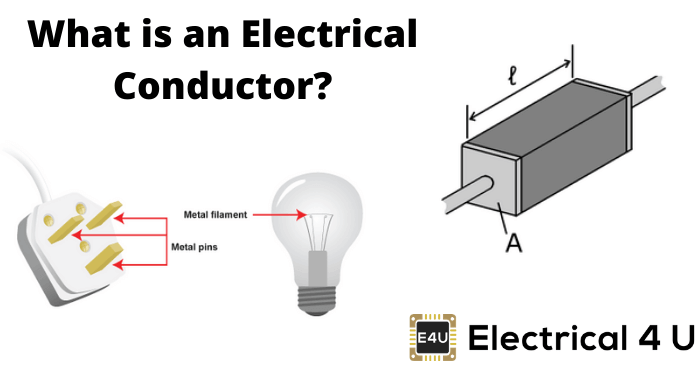
- Electrical Conductor Definition: An electrical conductor is defined as a material that permits the easy flow of electric charge primarily due to the movement of electrons.
- Conductivity Mechanics: The ability to conduct electric current depends on the free movement of electrons within the conductor’s conduction band.
- Types of Conductors: Conductors are either ohmic, adhering to Ohm’s law under normal conditions, or non-ohmic, showing variable resistance under different conditions.
- Physical Properties: Key properties of conductors include high conductivity, minimal energy gap between energy bands, and the presence of a metallic bond structure.
- Practical Applications: Electrical conductors are essential for creating electrical wiring, circuits, and sensors, demonstrating their fundamental role in technology and industry.
An electrical conductor is a material with mobile charge carriers and enough conductivity for a stated use. Metals such as copper, aluminium, silver and gold conduct through electrons. Electrolytes conduct through ions, while semiconductors can use electrons and holes. A wire’s resistance also depends on its length and cross-sectional area. When an electric field acts in the material, the mobile carriers acquire a net drift and produce current.
What is an Electrical Conductor?
A conductor allows electric charge to move through one or more directions under the relevant conditions. Material conductance is not the precise term: conductance describes a particular object or path. Bulk conductivity describes the material response, and resistivity is its reciprocal. The object’s resistance combines resistivity with geometry.
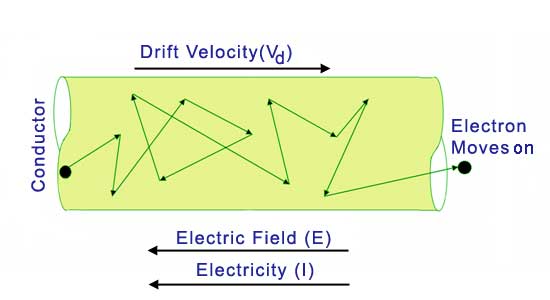
In a metal, mobile electrons are shared across many atoms. Their rapid thermal motion is mostly random, while an applied field produces a much smaller average drift velocity. A solid’s band structure comes from the allowed states of its atoms. In a metal, the highest occupied band is partially filled or bands overlap, so nearby unoccupied states are available. Exciting an electron from a valence band and leaving a mobile hole is a useful semiconductor model but is not the main description of ordinary metallic conduction.
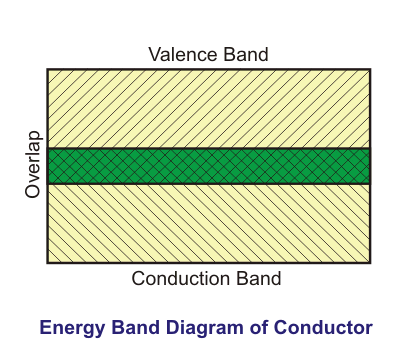
Metals, graphite, conductive polymers and ion-containing liquids can all carry electricity through different mechanisms. A simple valence-band and conduction-band diagram applies to solids, not to an electrolyte where positive and negative ions move through a solvent.
How Does a Conductor Conduct Current?
Electric current is charge flow per unit time. For an isotropic ohmic material under fixed conditions, local current density follows J = σE, where σ is conductivity and E is electric field. For a uniform two-terminal specimen, the corresponding relation is I = GV. The specimen’s conductance G depends on material and geometry. A voltage difference establishes the field, while material conductance should be read here as conductivity when discussing an intrinsic property.
In a DC metal circuit, electron drift is opposite to conventional current. In AC, both reverse direction with the field. Carrier scattering by lattice vibrations, impurities, defects and boundaries produces finite resistance and transfers energy to the material as heat. Object resistance measures opposition for the stated geometry and conditions; resistivity describes the corresponding bulk material property.

Current through a particular conductor depends on the following conditions:
- The applied voltage or electric-field distribution
- The path length, cross-sectional area and contact geometry
- The material, temperature and available carrier mobility
- Impurities, defects, interfaces, magnetic field and signal frequency where relevant
What are the Properties of Electrical Conductors?
A conductor’s useful properties depend on its carrier mechanism and operating conditions. The following statements need the listed qualifications:
- Conductors have comparatively high conductivity for the intended task. A particular short, thick specimen therefore has low resistance, while a long or thin specimen of the same material can have much more.
- They contain mobile charge carriers. These are mainly electrons in metals, ions in electrolytes and electrons or holes in semiconductors.
- A crystalline solid conductor has available electronic states near the occupied energy level. Metals commonly have a partially filled band or overlapping bands rather than a universally zero gap between two distinct bands.
- Metallic bonding explains many metal properties, but it does not describe ionic solutions, graphite or every conductive polymer.
- The electric field inside an ideal conductor is zero at electrostatic equilibrium. A real resistive conductor carrying steady current requires a nonzero internal field.
- Excess static charge lies on a conductor’s surface at electrostatic equilibrium. Mobile carriers still exist throughout the conducting material, and current can flow through its bulk.
- The field immediately outside an equilibrium conductor surface is perpendicular to that surface. A tangential component would move surface charge, so the condition does not describe a conductor during redistribution or every time-varying situation.
What are the Types of Electrical Conductors?
Ohmic and non-ohmic describe current-voltage behaviour over a stated range. They are not exhaustive material classes. Ohm’s law in its simple circuit form applies when current is proportional to voltage and relevant conditions such as temperature remain effectively constant.
Ohmic Conductors
An ohmic specimen has an approximately linear current-voltage curve over the specified operating range. Its resistance is then approximately constant for those conditions. Metal wires often behave this way over modest currents when self-heating is small. No real material is guaranteed to remain ohmic at every voltage, current density and temperature.

Examples under suitable conditions include silver, copper, aluminium and iron conductors.
Non-Ohmic Conductors
A non-ohmic device or specimen has a nonlinear current-voltage relation in the range being considered. Its static ratio V/I and differential slope dV/dI need not be the same. Nonlinearity can result from junction barriers, temperature change, field-dependent carrier density or other mechanisms. A nominal threshold is not an absolute no-current boundary, and negative differential resistance is a special case rather than a definition of non-ohmic behaviour.
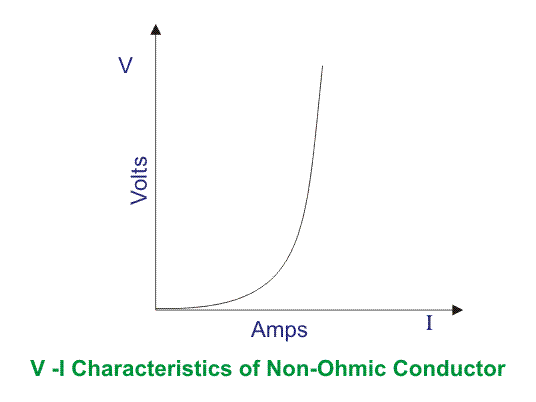
Examples include Diodes, incandescent lamp filaments, thermistors and LDRs. Each has a different physical cause for its nonlinear curve.
Examples of Electrical Conductors
Conductors can also be grouped by physical state and carrier mechanism. Their conductivity spans many orders of magnitude, so suitability depends on the application.
Solid Conductors
Solid conductors include metals, alloys, carbon forms, semiconductors and conductive composites. Conductivity can be direction-dependent in anisotropic materials.
- Metallic conductors: Metals and alloys conduct mainly through electrons. Pure silver and copper have high room-temperature conductivity, while alloying usually raises resistivity but can improve strength, corrosion resistance or stability. Copper, aluminium, gold, iron, brass and bronze serve different electrical and mechanical needs.
- Non-metallic conductors: Graphite, graphene, carbon nanotubes and conductive polymers can carry current through their electronic structures. Their conductivity depends strongly on direction, purity, processing, contacts and temperature.
Liquid Conductors
Liquids conduct through electrons in a liquid metal or through mobile ions in an electrolyte. The two mechanisms have different chemistry and electrode effects.
- Metallic conductors: Mercury is liquid at room temperature, and other metals conduct when molten. Liquid metals retain electronic conduction but differ in conductivity, reactivity, toxicity, vapour hazard and compatible container materials. Mercury requires strict hazard controls.
- Non-metallic conductors: Electrolytes contain mobile positive and negative ions. Conductivity depends on ion concentration, charge, mobility, solvent, temperature and electrode polarisation. Salt water and acid solutions conduct, while highly purified water has much lower conductivity.
Factors Affecting the Conductivity of Electrical Conductors
Conductivity is a material response under stated conditions. Resistance and conductance also include the specimen’s dimensions. The main influences are:
- Carrier density and mobility: Conductivity depends on how many mobile carriers are available, their charge and how readily they drift under an electric field. More carriers do not always compensate for lower mobility.
- Size and shape: For an ordinary uniform wire, R = ρL/A. Increasing length raises resistance and increasing area lowers it. These geometry changes do not change the bulk resistivity ρ or conductivity σ, apart from special surface and size effects at small scales.
- Temperature: In many normal metals, increased lattice vibration raises resistivity over a useful temperature range. Semiconductor carrier density and electrolyte ion mobility can produce different trends. Phase changes and superconducting transitions are separate cases.
- Impurities and defects: Solutes, vacancies, grain boundaries and dislocations commonly scatter electrons in metals. Deliberate dopants in a semiconductor can instead increase carrier density by many orders of magnitude. The net effect is material-specific.
- Frequency and field distribution: Alternating current can crowd towards a conductor surface through skin effect and towards or away from nearby conductors through proximity effect. This raises effective AC resistance. Circuit inductance adds reactance, and an alternating magnetic field can induce eddy currents. These effects should not be described simply as the bulk DC conductivity falling with frequency.
Applications of Electrical Conductors
Engineers select conductors by conductivity, allowable temperature, mechanical strength, mass, corrosion, contact behaviour, cost and manufacturing method. Typical uses include:
- Electrical wiring: Copper and aluminium conductors carry current between sources and loads. Insulation and protective devices limit shock and fault hazards. Cross-section is chosen from ampacity, voltage drop, short-circuit duty, installation method and mechanical requirements.
- Electrical circuits: Copper tracks, wires, connectors and component electrodes provide current paths. Components such as resistors intentionally add resistance, while capacitors store electric-field energy and inductors store magnetic-field energy. Their terminals still require conductive materials.
- Electrical machines: Copper or aluminium coils and windings create magnetic fields in motors, generators and transformers. Rotor bars, stator conductors, slip rings and armatures must meet current, thermal, mechanical and insulation requirements.
- Electrical sensors: Conductive electrodes and tracks connect sensing elements. Resistance-based resistors, thermocouples, photodiodes and piezoelectric sensors convert different physical effects into electrical signals. The sensing mechanism is more specific than conductivity alone.
Conclusion
An electrical conductor contains mobile charge carriers and has enough conductivity for a stated purpose. Electrons carry current in metals, ions carry it in electrolytes and electrons or holes carry it in semiconductors. Conductivity and resistivity describe material response, while a particular object’s conductance and resistance also depend on geometry. Temperature, composition, frequency, interfaces and field strength can all change the observed behaviour, so conductor selection must use data for the actual material and operating conditions.


