

- Sinusoidal Wave Signal Definition: A sinusoidal wave signal is defined as a periodic signal with a smooth and repetitive oscillation, based on the sine or cosine functions.
- Mathematical Characteristics: It can be expressed as y(t) = A sin(ωt + φ), where A is amplitude, ω is angular frequency, and φ is phase.
- Frequency and Period: The frequency is the number of cycles per second, while the period is the duration of one cycle, inversely related to frequency.
- Applications in Audio Systems: Sinusoidal signals help in recording and reproducing sound by converting sound waves to electrical signals and back.
- Importance in Signal Analysis: They are essential for breaking down complex signals into simpler sinusoidal components using Fourier series and Fourier transform.
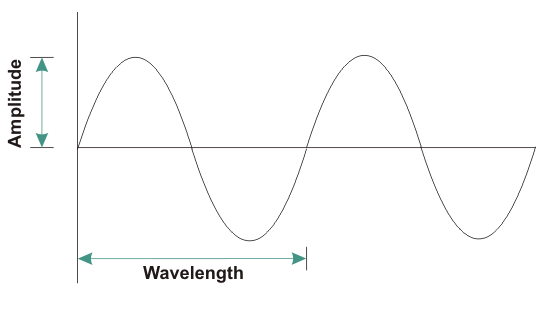
A sinusoidal wave signal varies as a sine or cosine function. A time sinusoid repeats at one frequency and is described by its amplitude and phase. A travelling sinusoidal wave also has a wavelength and propagation speed. Sinusoids are useful because linear time-invariant systems respond to each frequency independently and Fourier methods represent suitable signals in terms of frequency components.
What is a Signal?
A signal is a function that represents information about a physical quantity or data sequence. Its independent variable may be time, position or sample number. Examples include microphone pressure, room temperature, battery voltage and vehicle position. A signal may be continuous-time or discrete-time, and measured data also have units, uncertainty and a sampling method.
A graph shows signal value against its independent variable. For a room-temperature record, the horizontal axis may show time and the vertical axis temperature. Axis units and sampling interval are needed to interpret the graph.
A constant signal has the same value throughout the stated domain. A measured gravitational acceleration or battery voltage should not be treated as universally constant because it varies with conditions. Voice pressure and battery terminal voltage under changing load are time-varying examples.
A periodic signal satisfies x(t + T) = x(t) for a positive period T. A daily temperature record may show a 24-hour trend but does not normally repeat exactly, so it is only approximately periodic. A finite voice recording is generally aperiodic, although short voiced segments can be quasi-periodic.
What is a Sinusoidal Wave Signal?
A sinusoid is a periodic function whose value follows a sine or cosine. Sine and cosine forms are equivalent after a phase shift. An optional constant offset moves the centre line away from zero.
A sinusoidal wave signal can be expressed mathematically as:
y(t) = A sin(2πft + φ) = A sin(ωt + φ), where ω = 2πf.
where:
- y(t) is the signal value at time t
- A is the signed scale factor; |A| is the peak deviation from the centre line
- f is the cyclic frequency in hertz (Hz), where one hertz is one cycle per second
- ω = 2πf is the angular frequency in radians per second
- φ is the phase angle in radians; in this equation it is the argument at t = 0
Frequency and angular frequency express the same oscillation rate in different units. Phase specifies horizontal position relative to a reference sinusoid. For y(t) = A sin(ωt + φ) with positive ω, positive φ corresponds to a time advance of φ/ω. Changing the sign convention changes that interpretation.
One cycle advances the argument by 2π radians. The period T is the time for that advance and is the reciprocal of cyclic frequency:
T = 1/f = 2π/ω.
Wavelength applies when the sinusoid propagates through space. It is the distance between equal-phase points such as adjacent peaks. If phase speed is v and wave number is k, then:
λ = v/f = 2π/k. The expression 2π/ω is the period, not wavelength.
The sum of sinusoids at the same frequency is another sinusoid at that frequency, with a new amplitude and phase; complete cancellation is also possible. This phasor property and the behaviour of linear systems make sinusoids useful in Fourier series and Fourier-transform analysis.
Why are Sinusoidal Wave Signals Important?
Electrical engineering uses sinusoids as test signals, carriers, steady-state AC models and frequency-analysis components.
Audio Systems
Audio is a varying pressure waveform that normally contains many frequency components and transients. A microphone converts the complete acoustic waveform into an electrical signal; a speaker performs the reverse transduction. Engineers use sine tones to measure gain, distortion and frequency response. Electronic oscillators also generate tones for synthesis and test equipment.
Wireless Communication
A single-frequency plane electromagnetic wave has sinusoidal electric and magnetic fields. A real transmission has finite duration and modulation, so it occupies a frequency band rather than one ideal frequency. Radio systems encode information by varying carrier amplitude, frequency, phase or a combination of them. The receiver filters, samples and demodulates the received waveform.
Power Systems
Power systems are designed around a nominal sinusoidal AC frequency, although loads and converters add harmonics and transients. In those networks, transformers require time-varying magnetic flux and work best within their specified voltage, frequency and waveform limits; a perfect sine wave is not the reason transformation is possible. Raising transmission voltage reduces current and I²R conductor loss for a given power, but losses remain in lines and equipment.
Signal Analysis
Fourier series represent suitable periodic signals with harmonically related sinusoidal or complex-exponential components. The Fourier transform extends frequency-domain analysis to suitable aperiodic signals, often as a continuous frequency spectrum. Convergence and finite-energy or distribution conditions matter, so the claim does not apply without qualification to every possible function. The resulting spectrum supports analysis of harmonic content, power or energy distribution and bandwidth.
Summary
A time sinusoid is defined by amplitude, frequency and phase, with period T = 1/f = 2π/ω. Wavelength is a spatial property of a propagating wave and equals v/f or 2π/k. Sinusoids are useful building blocks for linear-system testing, AC steady-state analysis, communication carriers, audio measurement and Fourier representations of signals that meet the required mathematical conditions.


