

- Definition: A current-carrying conductor in a magnetic field is influenced by mutual forces between the conductor’s electromagnetic field and the external magnetic field.
- Electromagnetic Field Creation: A current through a conductor generates concentric magnetic flux lines, establishing an electromagnetic field around it.
- Right-Hand Rule: This rule shows the direction of magnetic flux lines around a current-carrying conductor using the orientation of the right hand.
- Fleming’s Left-Hand Rule: This rule helps determine the direction of the force exerted on a current-carrying conductor placed in a magnetic field.
- DC Motor Operation: The force acting on a current-carrying conductor in a magnetic field explains the rotation mechanism of a DC motor.
In 1820, Oersted observed that a compass needle deflected near a current-carrying conductor. This showed that electric current produces a magnetic field. In 1821, Faraday demonstrated electromagnetic rotation by making a current-carrying wire move around a magnet in a magnetic field.
A straight conductor carrying current I produces circular magnetic-field lines around the wire. For a segment of length l in an external field, the moving charge carriers also experience a force that is transferred to the conductor.
Use the right-hand grip rule to find the direction of the magnetic flux around the wire. Point the right thumb in the direction of conventional current; the curled fingers show the field direction.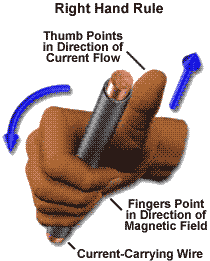
Now place the movable conductor between the poles of a horseshoe magnet with flux density  . The conductor length l lies within the external field and is perpendicular to it.
In this arrangement, the current direction and the external magnetic field are perpendicular. The angle between them is 90 degrees, so the force magnitude reaches its maximum value, F = IlB.
Two effects are present: the current produces a field around the conductor, and the permanent magnet supplies the external field.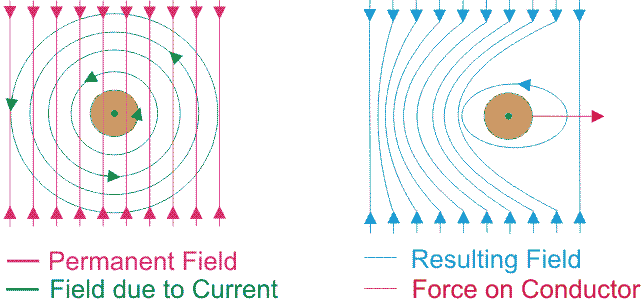
The external field acts on the moving charges that form current I. Their combined magnetic force is transmitted to the conductor. This force follows from the Lorentz force, not from literal repulsion between magnetic flux lines.
Let the force be  .
.
For a straight wire in a uniform field, the force is the cross product of current I times the length vector ( ) and the flux-density vector (
 ). The length vector points in the direction of conventional current. Thus,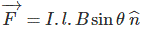
Here, θ is the angle between the length and field vectors, and  is a unit vector in the force direction. The magnitude is F = IlB sin θ, and the force is perpendicular to both current and field.
Fleming’s Left Hand rule gives the same direction as a motor-rule mnemonic. Hold the left thumb, index finger and middle finger mutually perpendicular. Point the index finger along the magnetic flux and the middle finger along conventional current; the thumb points along the force and motion.
Reversing either current or field reverses the force. In a current loop, forces on opposite sides form a couple and produce torque. This is the operating principle of a DC motor.


