

- Ohm’s Law Definition: Ohm’s Law states that the current through a conductor is proportional to the voltage across it and inversely proportional to its resistance.
- Understanding the Formula: The basic formula of Ohm’s Law, I = V/R, helps determine the current if the voltage and resistance are known.
- Visual Aids: The Ohm’s Law Triangle and Pie Chart are tools that simplify understanding the relationships between current, voltage, and resistance.
- Limitations: Ohm’s Law does not apply to nonlinear components or circuits where temperature and other physical conditions are not constant.
- Practical Applications: Ohm’s Law is crucial for designing electrical circuits, troubleshooting, and educational purposes, ensuring proper component functionality and safety.
What is Ohm’s Law?
Ohm’s law states that the current through an ohmic conductor is proportional to the voltage between its ends, if temperature and other physical conditions stay fixed.
That ratio V/I is the resistance R of the sample under those conditions.
In symbols Ohm’s law is

Write the constant of proportionality as resistance R:
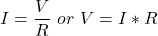
Where
- R is resistance in ohms (
 )
) - I is current in amperes (A)
- V is voltage across the sample in volts (V)
The same V = IR form holds for DC and for AC in a purely resistive circuit. With inductance or capacitance, use V = IZ instead.
The link between potential difference or voltage (V), current (I) and resistance (R) was published by the German physicist Georg Simon Ohm.
The SI unit of resistance, the ohm (), is named after him.
How Does Ohm’s Law Work?
For a metallic resistor at fixed temperature, more voltage means more current, in proportion.
A water-pipe picture makes the same three quantities easier to picture.
Two common analogies are below.
Analogy 1
Picture a tank above ground with a hose at the bottom, as in the image below.

- Water pressure (pascals) stands for voltage.
- Flow rate (litres per second) stands for current (coulombs per second).
- A narrow aperture in the pipe stands for a resistor.
Flow through that aperture is proportional to the pressure drop across it.
In the same way, current through a resistor is proportional to the voltage across it.
Pipe resistance depends on length, bore and the pipe wall. Tank height sets pressure (the voltage analog), not resistance.
Electrical resistance likewise depends on length, cross-section and the conductor metal (and on temperature).
Analogy 2
The sketch below pairs a pumped water loop with an electric circuit.

If pressure is fixed and the restriction rises, flow falls.
If voltage is fixed and resistance rises, the flow of electric charge (current) falls.

If the restriction is fixed and pump pressure rises, flow rises.
If resistance is fixed and voltage rises, current rises.

Ohm’s Law Formula
The same law can be solved for V, I or R.
Known two of the three, the third follows. That is the usual circuit arithmetic for ohmic parts.
Known I and R give voltage:


Known V and R give current:


Known V and I give resistance:


Ohm’s Law Formula for Power
Instantaneous power into a two-terminal part is voltage times current. For a resistor that is also the heat rate.
(1) 
Substitute  in that power equation:
(2) 
P = I²R is Joule heating in a resistor.
Or substitute  :
:
(3) 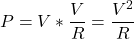
Those two forms give resistor heat from V and R, or from I and R.
If power is known as well, you can also solve for R.
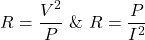
Any two of P, V, I and R fix the other two for an ohmic resistor (DC or RMS on AC with a resistor).


The Limitations of Ohm’s Law
Ohm’s law is not a universal device law. It fails when R is not constant.
- Ohm’s law does not cover every non-metal. Silicon carbide, for example, is written
 with K and m constants and m<1.
 - These parts do not have one constant R:
- nonlinear resistors
- capacitors and Capacitance
- semiconductor junctions
- vacuum tubes
- electrolytes
- some Carbon resistors
- Arc Lamps
- Zener diode
Nonlinear here means I is not proportional to V, so a single R does not describe the device.
- Metallic conductors follow the law at a fixed temperature. If temperature changes, R changes and the simple V/I ratio moves.
- Diodes and transistors conduct strongly in one polarity. They are not described by one R for both directions.
Ohm’s Law Triangle
Cover the quantity you want on the triangle. The other two give the formula.

Ohm’s Law Pie Chart
The pie chart puts the same V, I, R and P formulae in one disc.

Ohm’s Law Practice Problems
Example 1
In the circuit below, 4 A flows through 15 Ω. Find the voltage.

Solution:
Given Data:  and
and 
Ohm’s law gives:
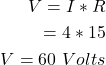
The voltage is 60 V.
Example 2
In the circuit below, 24 V is applied across 12 Ω. Find the current.

Solution:
Given Data:  and
and 
Ohm’s law gives:
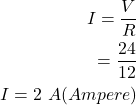
The current is 2 A.
Example 3
In the circuit below, 24 V drives 2 A through an unknown resistor. Find R.

Solution:
Given Data: and 
Ohm’s law gives:

The unknown resistance is  .
.
Applications of Ohm’s Law
Typical uses of Ohm’s law:
- Find the unknown one of V, I and R in an ohmic circuit.
- Estimate the voltage drop across a resistor in an electronic circuit.
- Size a DC ammeter shunt: the shunt voltage is I times its resistance.


