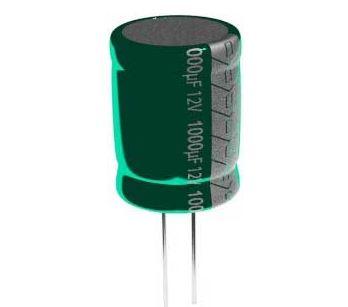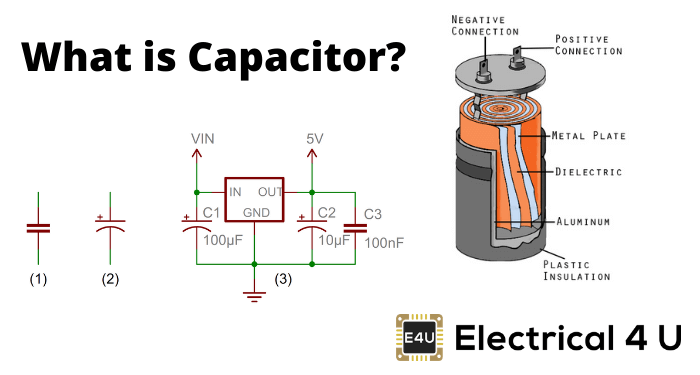
- Capacitor Definition: A capacitor is a basic electronic component that stores electric charge in an electric field.
- Basic Structure: A capacitor consists of two conductive plates separated by a dielectric material.
- Charge Storage Process: When voltage is applied, the plates become oppositely charged, creating an electric potential difference.
- Capacitance Definition: Capacitance is the ability of a capacitor to store charge per unit voltage.
- Factors Influencing Capacitance: Capacitance depends on the plate area, the distance between plates, and the dielectric material’s permittivity.
What is a Capacitor?
Capacitors are common passive electronic components. Together with resistors and inductors, they control voltage, current, timing, filtering and energy transfer in an electrical circuit. A capacitor separates equal and opposite electric charge on two conductors and stores energy in the electric field created by the applied voltage.
A basic capacitor consists of two conductors separated by a dielectric material or vacuum. The conductors may be flat plates, rolled foils, deposited films or another geometry.
When a voltage source is connected across an initially uncharged capacitor, current in the external circuit transfers electrons between its terminals. The conductor connected to the positive source terminal loses electrons and becomes positively charged, while the other conductor gains electrons and becomes negatively charged.
The dielectric blocks normal conduction between the plates while becoming polarised by the electric field. Real dielectrics have small leakage current and a maximum field before breakdown.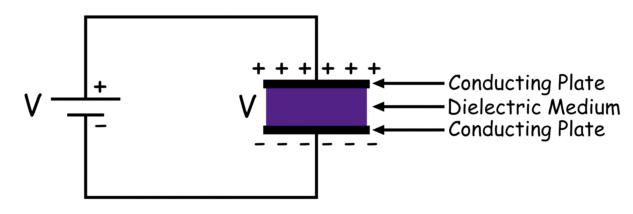
The separated charges establish an electric potential difference between the conductors.
Charging time is set by the surrounding circuit. Current, resistance, inductance and the source characteristics determine how quickly the capacitor voltage can change.
In a simple series RC circuit driven by a constant DC source, the capacitor voltage rises exponentially towards the value of the voltage source, with time constant RC. Other circuits can produce different waveforms.
What is Capacitance?
Capacitance relates the magnitude of charge Q on either conductor to the potential difference V between them. For an ideal linear capacitor, C = Q/V.
The SI unit of capacitance is the farad (F). One farad equals one coulomb per volt. Practical components often use microfarad, nanofarad or picofarad values.
For a linear capacitor with fixed geometry and dielectric, charge is directly proportional to voltage.
Here Q is the magnitude of charge on either conductor, and V is the potential difference.
C is the constant of proportionality called capacitance.
For an ideal parallel-plate capacitor with negligible edge effects, capacitance depends on plate overlap area, plate separation and the permittivity of the dielectric medium.
In this equation, ε is the permittivity of the dielectric medium, A is the overlapping plate area and d is the perpendicular separation. Real capacitors also include fringing fields, tolerances, losses, leakage and voltage limits.