
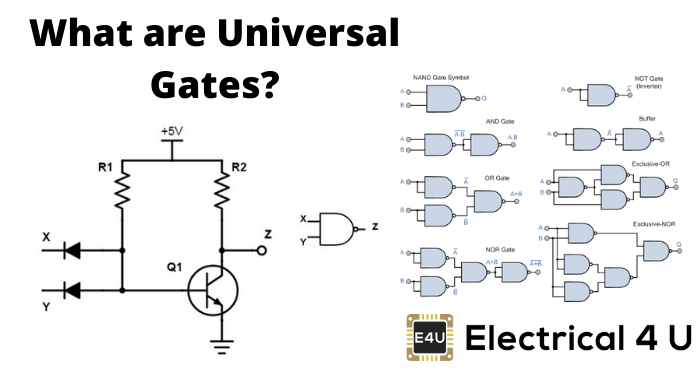
- Universal Gate Definition: A universal gate is a logic gate that can execute any Boolean function alone, making it fundamental in digital circuits.
- NAND Gate as Universal: Using only NAND gates, one can create AND, OR, and NOT gates, highlighting its universal property.
- NOR Gate as Universal: NOR gates alone can replicate AND, OR, and NOT operations, confirming its status as a universal gate.
- Economical Fabrication: Universal gates like the NOR gate are more cost-effective and simpler to produce than other logic gates.
- Circuit Design Flexibility: The ability to implement any basic gate using either NAND or NOR gates offers significant flexibility and efficiency in circuit design.
What are Universal Gates?
A universal gate is a single gate type that can build every Boolean function. The two standard examples are the NOR gate and the NAND gate. Either family alone can realise AND, OR, NOT and any larger expression.
In static CMOS that also matches how chips are built: NAND and NOR are the natural complex gates. An AND gate is usually a NAND plus an inverter, not an AND primitive. An OR gate is usually a NOR plus an inverter.
Other gates such as AND gates, NOT gates and OR gates are not universal on their own. combined, those three can implement every switching function. Alone, none of them can. That is why they are not called universal gates, unlike NAND and NOR.
If you want to try these gates on a bench, some best Arduino starter kits include 74-series NAND or NOR chips. That is not true of every kit.
The rest of this page shows how NAND and NOR each build the three basic gates, which is why they are called universal gates.
NAND Gate As A Universal Gate
The diagram below is a two-input NAND gate. The first block is an AND gate. The bubble on the output is a NOT.
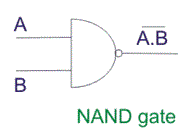
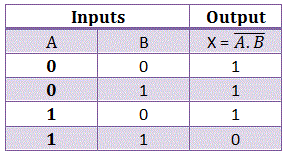
In a NAND gate the inputs first go through AND. The AND result is then inverted. That inverted result is the NAND output. The truth table of a two-input NAND is below.
That table is for a two-input NAND with inputs A and B. The output is 0 only when both inputs are 1.
The same NAND can make the other basic gates. Tie both inputs together and NAND becomes NOT.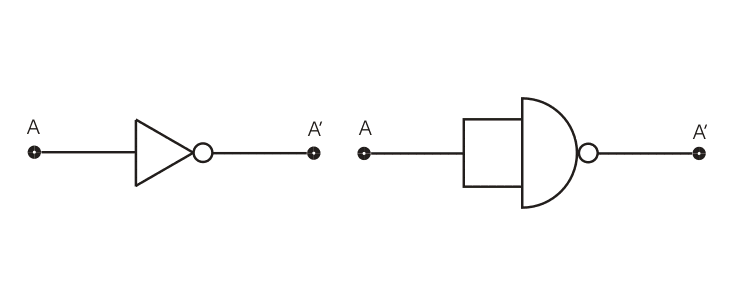
That figure is a NAND wired as a NOT, with the ordinary NOT symbol beside it.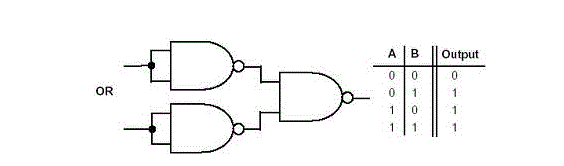
The figure above is an OR gate built from NAND gates: invert each input with a NAND, then NAND those results. The OR truth table sits beside the drawing.
AND is a NAND followed by a NAND used as an inverter.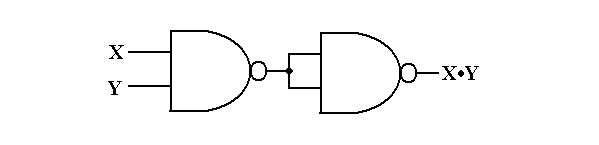
The figure above is that AND. NOT, OR and AND can all be built from NAND alone, so NAND is a Universal Gate.
NOR Gate As A Universal Gate
NOR is dual to NAND. NOR alone can also form AND, OR and NOT.
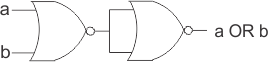
The figure above is OR built from NOR: a NOR followed by a NOR used as an inverter. The output matches a single OR. The wiring is the dual of AND-from-NAND.

The figure above is AND from NOR gates: invert each input with a NOR, then NOR those results. The same pattern, swapped, builds OR from NAND. NOT from NOR is next.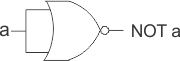
The figure above is a NOR with both inputs tied, which is NOT. The same tie-inputs trick makes NOT from NAND.
NOR alone can therefore build AND, OR and NOT, so it is also a universal gate.


