

Key learnings:
- 3-Phase System Definition: A 3-phase AC system is defined as an electrical system used globally for efficient power generation, transmission, and motor operation
- Efficiency in Power Transmission: The 3-phase system uses less conductor material and provides smoother power output, leading to more efficient and economical power transmissio
- Advantages in Electric Motors: 3-phase induction motors are self-starting, have a higher power to weight ratio, and are more cost-effective than single-phase motors.
- Cost-Effective Transformers: 3-phase transformers are smaller, lighter, and cheaper to install and transport compared to single-phase transformers.
- Reduced Ripple Factor: DC rectified from a 3-phase supply has a lower ripple factor, reducing filtering needs and overall converter costs, showcasing the advantages of 3-phase over single-phase systems.
A three-phase AC system uses three voltages 120° apart. Utilities use it for power generation, power transmission, distribution and electric motors because a balanced three-phase circuit carries more power for a given conductor mass and gives nearly constant instantaneous power. Many homes still take a single-phase service from that network.
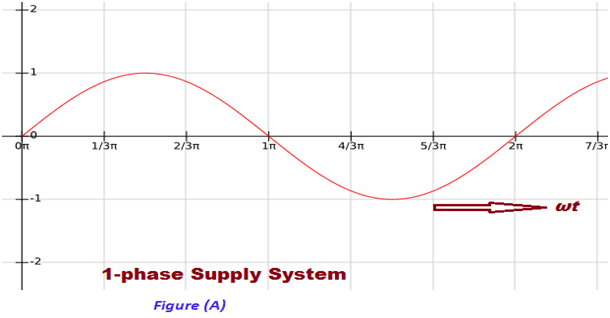
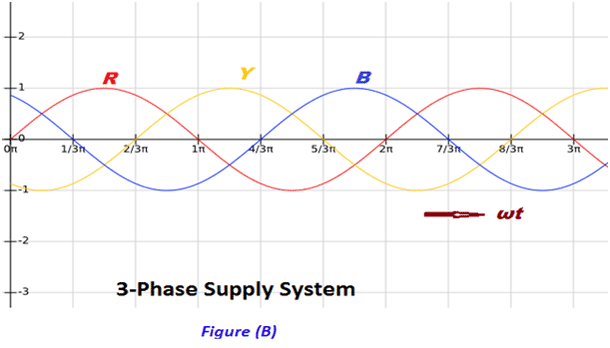
A Three phase system has these advantages over a single-phase system:
- For the same rating, a 3-ø alternator has a higher power-to-weight ratio than a single-phase machine. The same Electric Power is therefore generated in a smaller, lighter frame, which usually costs less to build, ship and install and needs less plant floor.
- For the same electric power transmission rating, distance and line loss, a 3-ø three-wire line uses about three-quarters of the conductor metal of a comparable 1-ø two-wire line, so it is cheaper in conductor.
- Compare instantaneous power from a single-phase supply and a 3-ø supply at unity power factor. Figure (C) is the single-phase power at unity power factor. Figure (D) is the 3-ø power.
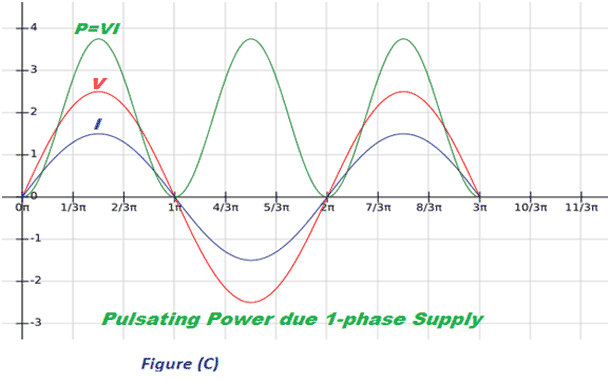
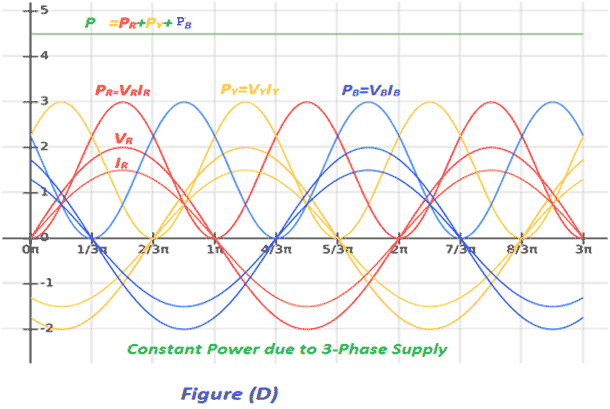
- The waveforms in figures (C) and (D) show why. In a balanced 3-phase system the instantaneous power is constant, so shaft torque is smooth. In a 1-ø system the instantaneous power pulses twice per cycle, which produces torque pulsation.
- A three phase induction motor also has a higher power-to-weight ratio than a single phase induction motor of the same mechanical rating, so the three-phase induction motor is smaller, cheaper to ship and easier to install.
- A three-phase induction motor is self-starting because the three-phase currents produce a rotating magnetic flux of constant magnitude. A 1-ø induction motor is not self-starting on its main winding alone, because that flux pulsates. The extra starting winding or capacitor raises the cost of the 1-ø motor.
- A three-phase motor of a given rating often runs at a higher power factor than a comparable single-phase motor, because it has no auxiliary winding drawing extra reactive current.
- A 3-phase transformer of a given rating is smaller and lighter than a 1-ø transformer of the same power, which usually cuts material cost and eases transport and installation of transformer.
- If one unit of a three-transformer bank fails, the other two can run in open delta and still feed a reduced 3-phase load. A single 1-ø transformer has no equivalent open-delta fallback. That bank arrangement, not every three-limb three-phase core, is what gives the extra backup path.
- A 3-phase system can supply a 1-ø load from line to neutral or line to line. A 1-ø supply cannot feed a three-phase load without a converter or extra phase-shifting equipment.
- Unfiltered DC from a three-phase six-pulse bridge has a ripple factor of about 4.2%. Unfiltered DC from a 1-ø full-wave rectifier has a ripple factor of 48.2%. The three-phase output therefore needs less filtering, which usually cuts converter cost.
For generation, transmission and motors, a 3-phase system uses less conductor and gives smoother torque than a 1-ø system. House services can remain single-phase without changing that line design.


