

- Transformer Definition: A transformer is a passive device that transfers electrical energy from one circuit to another using electromagnetic induction.
- Working Principle: The working principle of a transformer involves mutual induction between coils to transfer electrical energy.
- Core Function: The core of a transformer provides a path with low reluctance, essential for efficient flux linkage between the windings.
- Voltage Conversion: Depending on the turns ratio between the primary and secondary windings, a transformer can either step up or step down the voltage.
- Inrush Current Impact: The inrush current is the initial surge of electricity experienced when a transformer is switched on, affecting its immediate performance.
What is a Transformer?
Working Principle of Transformer
The working principle of a transformer is Mutual induction between two or more windings. Changing current in one coil induces voltage in the other, so energy moves from one circuit to the next.
Transformer Theory
Feed one winding from an alternating source. The alternating current in that winding produces a flux that keeps changing in size and direction around the coil.
Place a second winding nearby and part of that alternating flux links it. Because the flux keeps changing, the flux linkage in the second coil also changes.
By Faraday’s law of electromagnetic induction, that changing linkage induces an EMF in the second winding. Close the secondary circuit and a current flows. That is the working principle of a transformer.
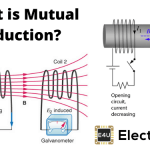
The next figure uses electrical symbols. The winding that takes electrical power from the source is the primary winding, marked ‘First Coil’.

The winding that delivers the output voltage by mutual induction is the secondary winding, marked ‘Second Coil’.
A unit that raises voltage from primary to secondary is a step-up transformer. A unit that lowers voltage from primary to secondary is a step-down transformer.
The voltage rise or fall follows the relative number of turns on the primary and secondary sides.
More primary turns than secondary turns lowers the voltage: a step-down unit.
Fewer primary turns than secondary turns raises the voltage: a step-up unit.
The diagram is an ideal transformer. In open air only a small part of the first coil’s flux links the second coil, so the secondary current in a closed load is tiny and hard to measure.
The induced EMF depends on how much flux links the second winding. Almost all of the primary flux should reach the secondary. A core type transformer does that by giving both windings a shared low-reluctance path.

The purpose of the transformer core is that low-reluctance path: it carries as much primary flux as possible into the secondary winding.
The first surge of current when the unit is switched on is the transformer inrush current.
The next video shows the same action in motion:
Transformer Parts And Construction
A transformer has three main parts:
- Primary Winding of Transformer
- Magnetic Core of Transformer
- Secondary Winding of Transformer
Primary Winding of Transformer
It produces magnetic flux when it is connected to an electrical source.
Magnetic Core of Transformer
The magnetic flux from the primary follows this low-reluctance path, links the secondary winding and closes a magnetic circuit.
Secondary Winding of Transformer
Primary flux through the core links this winding. The coil is also wound on the same core and supplies the output of the transformer.


sir / mam i want to know about the dot convention.. in transformer. Kindly include this topic I shall be highly grateful
Here is an article about transformer dot convention. I hope that helps Shivangi!