

- Three Phase Circuit Definition: A three-phase circuit is defined as a system where three electrical phases are used together, each 120 degrees apart, to provide continuous power.
- Star Connection: A star connection includes three phase wires and one neutral wire, ideal for long-distance power transmission due to its ability to handle unbalanced currents.
- Delta Connection: A delta connection uses three wires without a neutral wire and is better suited for short-distance transmission, but it can struggle with unbalanced currents.
- Voltage and Current Differences: In a star connection, the line voltage is √3 times the phase voltage, while in a delta connection, the line voltage is the same as the phase voltage.
- Advantages of Three Phase Circuit: Three-phase circuits are more efficient, use less conductor material, and provide a more stable power supply than single-phase circuits.
There are two common AC systems in electric circuits: single-phase and three-phase. In a single-phase circuit, current flows out on one live conductor and back on the neutral, so the power that can be sent is limited. Both generation and load can be single-phase, and that arrangement was used for a long time.
Polyphase systems were developed in the 1880s so more than one voltage wave could be generated, sent and used together. A three-phase circuit is the usual polyphase case: three phases leave the generator and reach the load.

Each phase is 120 electrical degrees from the other two, so a full cycle is split into three equal parts. With a balanced load the three waves overlap so the total instantaneous power does not fall to zero. The sinusoidal waves for a three-phase system show that split.
Each phase can also feed a single-phase load. Take one phase of the three phase circuit and the neutral as the return to complete that single-phase circuit.
Why Three Phase is Preferred Over Single Phase?
Three-phase has several practical gains over single-phase. The same three-phase set can supply three single-phase circuits. Generation is still a rotating machine; the stator coils are placed for a 120o displacement. For the same power, voltage and loss, a three-phase line uses about 75% of the conductor of a two-wire single-phase line. Instantaneous power in single-phase falls to zero twice per cycle. In a balanced three-phase system the sum of the three phases is steady at the load.
A three-phase circuit has three voltage sources inside the generator, 120 electrical degrees apart. Three single-phase sources with that displacement form a three-phase set. If the three voltages are in phase with each other, the system is not three-phase and a three-phase motor will not produce a proper rotating field.
For the same power, a three-phase machine is usually smaller than a single-phase machine. A three-phase transformer still works by linking flux, but it can handle more power for a given transformer mass than a single-phase unit of the same kVA class.
In a three phase circuit, windings are connected in two ways:
- Star connection
- Delta connection
There is also an open delta connection that uses two single-phase transformers to feed a three-phase load. It is a reduced-capacity stand-in (about 58% of a closed three-unit delta), not a normal first choice.
Star Connection
In star connection there are four wires: three phase conductors and a fourth neutral taken from the star point. Star (wye) is used where a neutral is needed, for example on a four-wire power transmission or distribution circuit. Balanced and unbalanced current then matter.
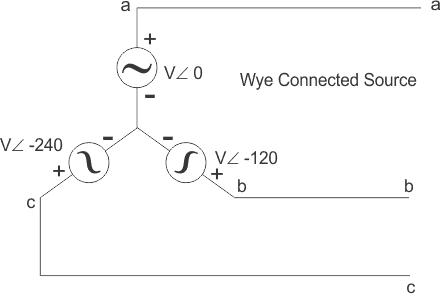
Equal current in all three phases is a balanced set. Unequal phase currents are unbalanced. With a balanced load, the three currents sum to zero at the star point so the neutral carries none. With unbalanced load, the residual current returns on the neutral. That path keeps the phase-to-neutral voltages from drifting; it does not by itself protect a transformer from overload.
The star connection is shown below-
In star connection, the line voltage is √3 times the phase voltage. Line voltage is the voltage between two phases. Phase voltage is the voltage from one phase to the neutral. Line current equals phase current in star. The relation is
Delta Connection
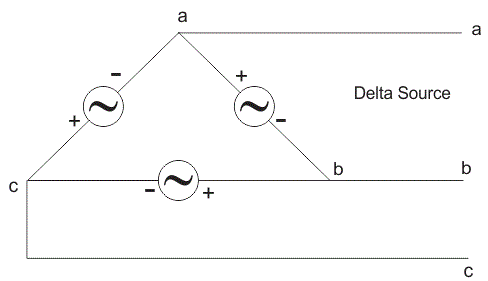
In delta connection there are three wires and no dedicated neutral. Delta is common on motors and on some transformer windings. There is no fourth conductor for residual current, so a ground return is not a substitute for a system neutral.
In delta connection, the line voltage equals the phase voltage. The line current is √3 times the phase current. The relation is
In a three-phase circuit, star and delta connection can be arranged in four different ways:
- Star-Star connection
- Star-Delta connection
- Delta-Star connection
- Delta-Delta connection
For the same line voltage and line current, the three-phase power is the same in star and in delta. The power in a three phase circuit can be calculated from the equation below,
The factor of 3 appears because there are three phases, and PF is the power factor. Lagging reactive power on a three-phase feeder is often supplied locally with capacitors.


