
- Voltage Sensor Definition: A voltage sensor is a device that measures voltage in an object, handling both AC and DC types.
- Working Principle: Voltage sensors function by converting the input voltage into a variety of outputs such as analog signals or audible alerts.
- Types of Voltage Sensors: There are mainly two types—capacitive and resistive, each suited for different applications and characteristics.
- Circuit Diagram Insights: Understanding circuit diagrams of voltage sensors helps in grasping how they function and are connected.
- Practical Applications: Voltage sensors are essential in electronics for detecting power issues and ensuring safe operations.
What is a Voltage Sensor?
A voltage sensor measures and monitors voltage levels within an object, detecting either AC or DC voltage. It takes in the voltage itself and outputs various forms such as switch states, analog voltage signals, current signals or audible signals.
Sensors are devices that sense, identify and react to certain types of electrical or optical signals. The implementation of voltage sensor and current sensor techniques has become an excellent alternative to the conventional current and voltage measurement methods.
Types of Voltage Sensors
This article discusses the voltage sensor in detail. A voltage sensor can determine, monitor and measure the supply of voltage, working at AC level, DC level or both. Its input is the voltage itself, while its output can take many forms: analog voltage signals, switches, audible signals, analog current levels, frequency or even frequency-modulated outputs.
That is, some voltage sensors provide sine or pulse trains as output, while others produce amplitude-modulation, pulse-width-modulation or frequency-modulation outputs.
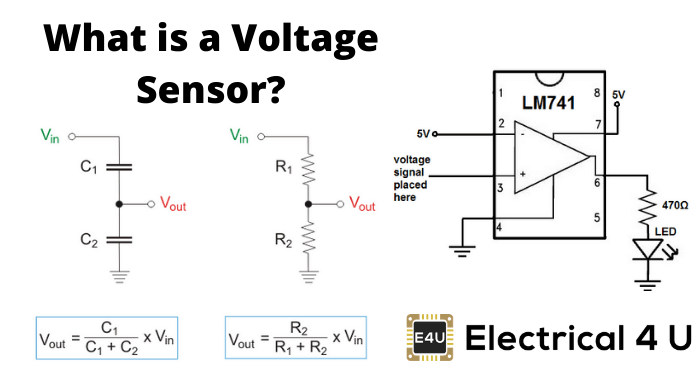
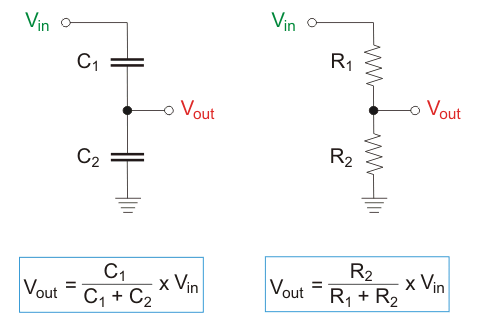
In voltage sensors, measurement is based on a voltage divider. Two main types of voltage sensor are available: the capacitive type voltage sensor and the resistive type voltage sensor.
Capacitive Voltage Sensor
A capacitor consists of two conductors, known as plates, separated by a non-conductive material.
This non-conductive material, called a dielectric, conducts no steady current; however, when an AC voltage is applied across the plates, electrons move toward or away from each plate in step with the opposite plate, so an alternating current appears to pass across the capacitor.
The field between the plates completes a full AC circuit without any wired connection. That is how a capacitor works.
Next consider voltage division in two series-connected capacitors. In series circuits, the highest voltage develops across the component with the highest impedance. For capacitors, capacitance and impedance (capacitive reactance) are always inversely proportional.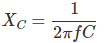
The relation between voltage and capacitance is:

Q → Charge (Coulomb)
C → Capacitance (Farad)
XC → Capacitive reactance (Ω)
f → Frequency (Hertz)
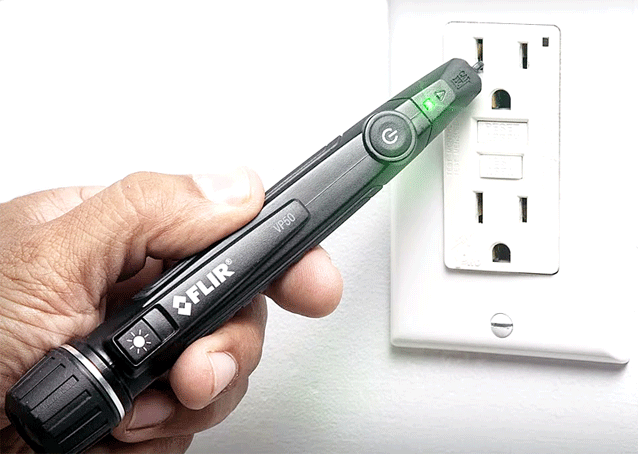
From these two relations we can state clearly that the highest voltage accumulates across the smallest capacitor. Capacitor voltage sensors work on this simple principle. Consider holding the sensor and placing its tip near a live conductor.
Here, the high-impedance sensing element joins a series capacitive coupling circuit.
The sensor tip now forms the smallest capacitor coupled to the live voltage. The whole voltage therefore develops across the sensing circuit, which detects it and turns the light or buzzer indicator on. This is the principle behind the non-contact voltage sensors you use at home.
Resistive Voltage Sensor
Two ways exist for converting the resistance of the sensing element into a voltage. The simplest method applies a supply voltage to a resistor divider circuit made up of the sensor and a reference resistor, represented below.
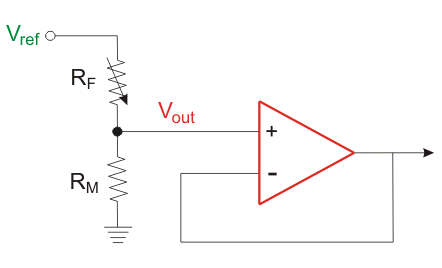
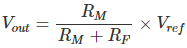
The voltage across the reference resistor or sensor is buffered before being sent to the amplifier. The output voltage from the sensor can be calculated as follows:
A drawback of this circuit is that the amplifier amplifies the entire voltage across the sensor. A more effective approach amplifies only the voltage changes caused by resistance changes in the sensor, achieved with a resistance bridge.
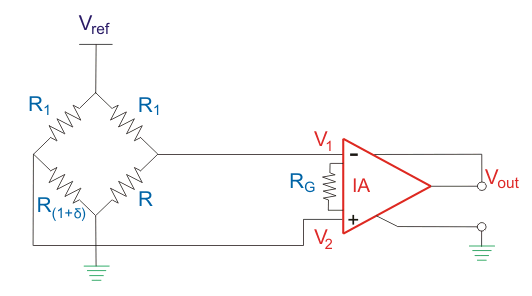
Here, the output voltage is
When R1 = R, then the output voltage becomes approximately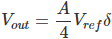
A → Gain of instrumentation amplifier
δ → Change in the resistance of the sensor, which is analogous to some physical action
In these equations, the gain must be set high because only the voltage change due to the change in the sensor’s resistance is being amplified.
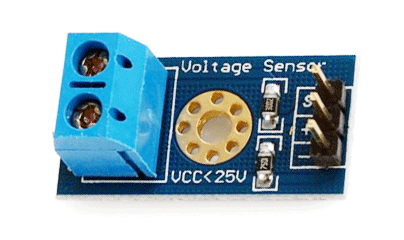
Advantages of Voltage Sensors Over Conventional Measuring Techniques
The advantages of voltage sensors include:
- Small in weight and size
- Personnel safety is high
- The degree of accuracy is very high
- Non-saturable
- Wide dynamic range
- Eco-friendly
Voltage and current measurement can also be combined into one compact physical device of small dimensions.
Applications of Voltage Sensors
The applications of voltage sensors include the following:
- Power failure detection
- Load sensing
- Safety switching
- Temperature control
- Power demand control
- Fault detection
Voltage sensors are included in many of the best Arduino starter kits, as they are very useful in many electronics projects.


