

- Resistivity Definition: Resistivity is defined as a material’s property that opposes the flow of electrical current.
- Factors Affecting Resistance: Resistance depends on length, cross-sectional area, material nature, and temperature.
- Unit of Resistivity: The unit of resistivity is Ω-m in the MKS system and Ω-cm in the CGS system.
- First Law of Resistivity: Resistance increases with the length of the substance.
- Second Law of Resistivity: Resistance decreases with a larger cross-sectional area.
Resistivity or Coefficient of Resistance
Laws of Resistance
Resistivity is the material property that opposes current. The resistance of a given piece of that material still depends on the following factors,
- Length of the substance.
- Cross sectional area of the substance.
- The nature of material of the substance.
- Temperature of the substance.
Four laws of resistance relate those factors to R and let you find the resistivity or specific resistance of the material.
First Law of Resistivity
The resistance of a substance is directly proportional to its length. The electrical resistance R of a substance is
Where L is the length of the substance.
A longer sample gives electrons a longer path and more collisions, so fewer electrons pass in a given time and the current falls. Resistance therefore rises with length, and the relation is linear.
Second Law of Resistivity
The resistance of a substance is inversely proportional to its cross-sectional area. Electrical resistance R of a substance is 
Where A is the cross-sectional area of the substance.
Current depends on how many electrons cross a section per unit time. A larger section lets more electrons through, so the current rises. For a fixed voltage, more current means less electrical resistance, and that relation is linear.
Resistivity
Combining these two laws we get,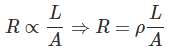 Where ρ (rho) is the proportionality constant and is the resistivity or specific resistance of the material of the conductor or substance. If L = 1 and A = 1, then R = ρ. So the resistance of a sample of unit length and unit cross-section equals its resistivity or specific resistance. Resistivity is also the resistance between opposite faces of a unit-volume cube of that material.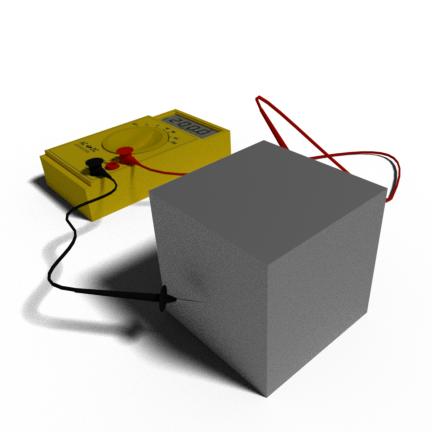
Third Law of Resistivity
The resistance of a substance is directly proportional to the resistivity of the material it is made from. Resistivity is not the same for every material. It depends on free-electron count, atom size, bonding and other details of the structure. A high-resistivity material produces a high resistance in a given sample, and the relation is linear.
Fourth Law of Resistivity
Temperature changes the resistance of a substance. In metals, heat increases lattice vibration, so electrons scatter more and resistance rises. In many nonmetals, higher temperature frees more carriers from covalent bonds and reduces resistance.
State the temperature whenever you quote the resistance of a substance.
Unit of Resistivity
The unit of resistivity follows from its equation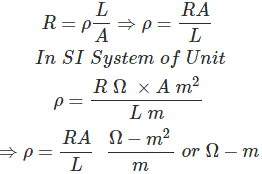
The unit of resistivity is Ω-m in the SI (MKS) system and Ω-cm in the CGS system, and 1 Ω-m = 100 Ω-cm.
List of Resistivity of Different Commonly Used Materials
| Materials | Resistivity in μ Ω – cm at 20oC |
| Aluminium | 2.82 |
| Brass | 6 to 8 |
| Carbon | 3k to 7k |
| Constantan | 49 |
| Copper | 1.72 |
| Gold | 2.44 |
| Iron | 12.0 |
| Lead | 22.0 |
| Manganin | 42 to 74 |
| Mercury | 96 |
| Nickel | 7.8 |
| Silver | 1.6 |
| Tungsten | 5.51 |
| Zinc | 6.3 |


