
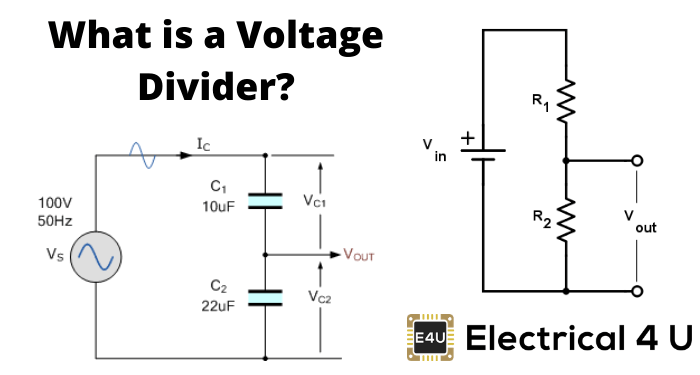
- Voltage Divider Definition: A voltage divider is a simple circuit that creates a part of its input voltage as output, using two resistors in series.
- Circuit Components: The circuit includes two resistors connected in series with a voltage source, splitting the input voltage.
- Unloaded Equation: With no current flowing out, the output voltage depends on the ratio of the resistors.
- Loaded Condition: Adding a load resistor changes the output voltage calculation because of the parallel resistance.
- Applications: Voltage dividers are used for logic level shifting, sensor measurement, and reducing high voltages for safe measurement.
What is a Voltage Divider?
A voltage divider produces an output that is a fraction of its input voltage. The simplest form uses two series resistors. AC circuits can use two series passive components represented by impedances. A voltage source drives the series path, and the output is measured across one element.
This circuit is also called a potential divider. In the unloaded resistor case, the same current flows through both resistors, so each voltage drop follows its share of the total resistance. The voltage divider calculator applies this basic relation.
Circuit of Voltage Divider
A simple voltage divider consists of two series resistors across a source, with the output node at their junction. The drawings below use different layouts for the same electrical connections.
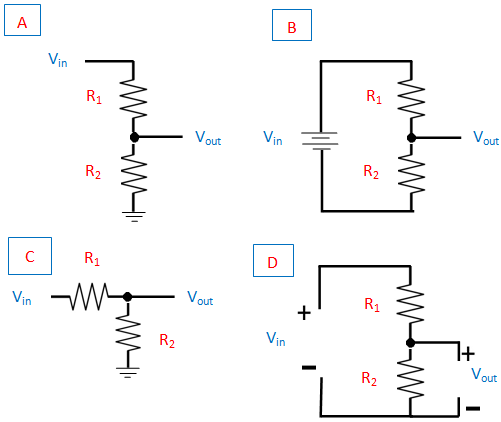
In the figure, (A) and (B) use compact and expanded layouts. Drawings (C) and (D) change only the resistor orientation, not the circuit topology.
All four drawings are electrically equivalent. R1 connects from the input voltage source to the output node, while R2 connects from the output node to the reference node. Vout is the voltage across R2.
The output value follows the resistor ratio only when the source and connected load do not change that ratio materially.
Equation of Voltage Divider in Unloaded Condition
The general unloaded voltage divider below contains two series impedances, Z1 and Z2. Depending on the signal and circuit model, these can represent resistors, uncoupled inductors or capacitors. The impedance expression applies in sinusoidal steady state or in the Laplace domain.
The circuit output is measured across impedance Z2 relative to the reference node.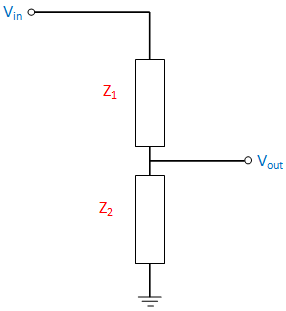
With the output open-circuited, no load current leaves the divider node. The same series current flows through both impedances:
Ohm’s law then gives the voltage across Z2:
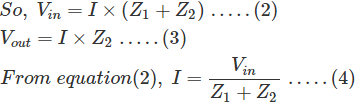
Substituting the series current into the output expression gives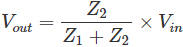
This is the unloaded divider equation.
The voltage transfer ratio is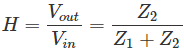
For two ideal capacitors in series, the impedance ratio gives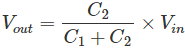
An ideal capacitive divider responds to AC and transients but blocks steady DC after charging. Practical designs also need voltage-rating, leakage, initial-condition and discharge-path analysis.
For an inductive divider with negligible mutual coupling between the inductors, the ideal AC relation is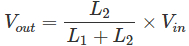
At steady DC, ideal inductive reactance is zero, so winding resistance and the transient response determine the voltages. At AC, use each winding’s full impedance, not inductance alone when resistance, coupling or core losses matter.
A first-order low-pass RC filter is a frequency-dependent divider formed by a resistor and capacitor.

C → Capacitance
R → Resistance
XC → Capacitive reactance
ω → Angular frequency
j → Imaginary unit
With the output across the capacitor, the voltage ratio is
RC is the time constant τ. Source and load impedance alter this ideal transfer function.
Voltage Divider Under Loaded Condition
In a loaded voltage divider, load resistor RL connects across R2. The lower leg becomes an equivalent Req, giving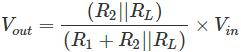
Because R2 and RL are in parallel, their equivalent resistance is lower than either branch alone.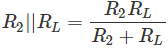
The diagram below shows the loaded circuit.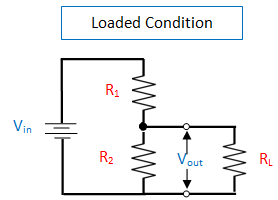
Applications of Voltage Divider
Voltage dividers can scale sensor outputs, set bias or feedback thresholds and attenuate signals for a high-impedance input. A passive divider is not a general-purpose power supply or bidirectional logic-level translator.
Multimeters use switched input-divider networks, while a Wheatstone bridge compares the outputs of two divider branches. The instrument input resistance forms part of the voltage divider calculation.
A resistor divider can create a bias or reference node when the following circuit draws negligible current. Otherwise, buffer the node or use a voltage reference or regulator designed to supply the load.
A resistive divider can also attenuate a signal over the frequency range where parasitic capacitance and source or load impedance remain negligible.
Resistive dividers suit DC and low-frequency measurement when their voltage, power, tolerance and insulation ratings are adequate. High-voltage capacitive dividers and compensated probes are specialized networks whose geometry, protection and calibration include stray and load capacitance. Never connect a basic low-voltage divider directly to a hazardous source.


