

- Flux Definition: Flux is defined as any effect that travels through a surface or substance, used in various scientific fields.
- Magnetic Flux: Magnetic flux measures the number of magnetic field lines through a surface, with its unit as Weber.
- Electric Flux: Electric flux quantifies the electric field lines passing through a surface, measured in voltmeters.
- Luminous Flux: Luminous flux represents the amount of visible light energy emitted per second, with the unit Lumen (lm).
- Radiant Flux: Radiant flux, or energy flux, indicates the total energy emitted per second from a source, measured in Watts.
What Is Flux?
Flux has several related meanings in physics and engineering. In vector calculus, it measures how much of a vector field crosses an oriented surface. The surface normal sets the sign: a field component in the normal direction contributes positively, while the opposite direction contributes negatively.
In transport problems, the word flux often means a vector rate per unit area, such as mass flux or heat flux density. Its direction shows the direction of transport.
The flux of that vector through a chosen surface is a scalar surface integral of its normal component. It may be positive, negative or zero and depends on the field, surface and orientation.
The English word flux comes from the Latin fluxus, meaning flow. Newton used the related term fluxion for a time-varying quantity in his notation for calculus, but modern scientific uses of flux are defined by their individual fields.
Types of Flux and Flux Density
Common uses of the term include:
- Magnetic flux
- Electric flux
- Luminous flux
- Radiant flux
- Heat flux density
- Mass flux
- Momentum flux
- Acoustic intensity or acoustic power flux density
The definitions and units differ, so the physical quantity must be named rather than using flux alone.
Magnetic Flux
Magnetic flux is the oriented surface integral of magnetic flux density B over an open or closed surface. Drawn field lines can help show the sign and relative magnitude, but flux is not a literal count of lines. Its SI unit is the weber (Wb), and a legacy CGS unit is the maxwell. The magnetic-flux symbol is commonly ΦB.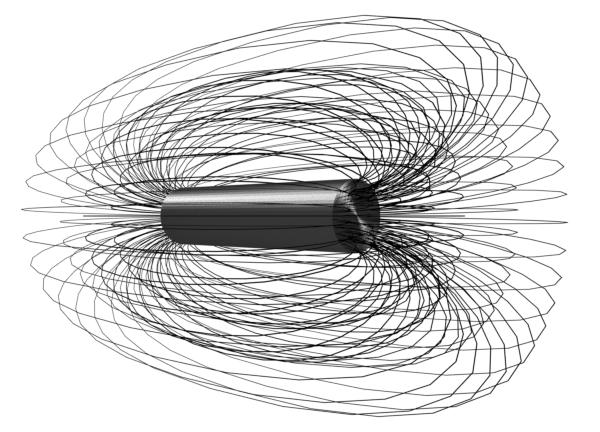
Electric Flux
Electric flux is the oriented surface integral of electric field E. A diagram of electric field lines is a visual aid, not the definition. The SI unit is volt metre (V·m), equivalent to N·m²/C, and the common symbol is ΦE.
Luminous Flux
Luminous flux is radiant power weighted by the standard photopic visual-sensitivity function. It measures the perceived light output for light-adapted human vision. The SI unit is the lumen (lm; normally styled lm).
Radiant Flux or Radiant Power
Radiant flux is the total radiant energy emitted, transferred or received per unit time. Its SI unit is the watt (W), equivalent to joule per second, and its usual symbol is Φe.
Heat Flux Density
Heat flux density is the rate of heat transfer through a surface per unit area. Its SI unit is W/m2. A normal component may be written qn; total heat-transfer rate through a surface is measured in watts.
Mass Flux
Mass flux is mass flow rate per unit area normal to the flow. Its SI unit is kg/(m2·s), equivalent to kg·m⁻²·s⁻¹. Symbols vary by discipline and include J or a mass-flux vector.
Momentum Flux
Momentum flux is the rate at which momentum crosses a unit area. Its SI dimensions equal force per area, so it is expressed in N/m2 or pascals. In fluids, momentum flux is represented by a tensor because both transport direction and momentum component matter.
Acoustic Intensity
Acoustic intensity is sound power transmitted per unit area in a specified direction. Its SI unit is W/m². Total acoustic power through a surface is the surface integral of intensity and is measured in watts.


It is my intention to use the natural magnetic force available to drive against gravity with meaning full induced magnets.
The next generation should look into environmentally (green power) for the future.