

- Voltage Drop Definition: Voltage drop is the reduction in electrical potential along a circuit’s path, mainly due to resistance and reactance in the components.
- Calculation Formula: The voltage drop calculation formula involves Ohm’s law, which uses resistance, current, and impedance values to determine the decrease in voltage.
- DC Circuits Example: In DC circuits, voltage drop is directly proportional to the resistance and current, illustrated by a series resistor example.
- AC Circuits Complexity: AC voltage drop calculations include impedance, which combines both the resistive and reactive properties of the circuit.
- Circular Mils Usage: Circular mils measure the wire’s cross-sectional area, which is crucial for accurate voltage drop calculation in electrical installations.
What is Voltage Drop?
Voltage drop is the decrease in electrical potential along a current’s path inside an electrical circuit, simply put a “drop in voltage“. It occurs because internal resistance in components such as the power source, passive elements, conductors and connectors dissipates part of the supplied energy.
Voltage drop across an electrical load governs how much supplied power becomes useful energy there. Calculate this drop with Ohm’s law, which ties it to resistance and current.
Voltage Drop in Direct Current Circuits
In direct current circuits, resistance alone causes the drop. Consider a DC circuit with a source and two series-connected resistors, each adding its share to the total voltage drop.
Each element has a specific resistance that determines how much energy it receives and loses. Measuring the voltage at the first resistor shows a value below the supply voltage, because the connecting wire has consumed part of it.
Measuring the voltage across each resistor gives the energy that resistance consumes. As the current flows from the DC supply through the wire toward the first resistor, the conductor resistance already dissipates some of the source energy.
To verify the voltage drop, apply Ohm’s law and Kirchhoff’s circuit law, summarised below.
Ohm’s law states
V → Voltage Drop (V)
R → Electrical Resistance (Ω)
I → Electrical Current (A)
For DC closed circuits, Kirchhoff’s circuit law also serves the voltage drop calculation:
Supply Voltage = Sum of the voltage drops across every component of the circuit.
Voltage Drop Calculation of a DC Power Line
Take a 100 ft power line as an example, so two conductors give 2 × 100 ft. Let the electrical resistance be 1.02Ω/1000 ft and the current be 10 A.
Voltage Drop in Alternating Current Circuits
In AC circuits, Resistance (R) is joined by a second opposition to the flow of current: Reactance (X), which comprises XC and XL. Resistance and reactance together form the Impedance (Z).
XC → Capacitive reactance
XL → Inductive reactance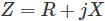
The value of Z depends on factors such as magnetic permeability, insulation and the AC frequency.
Mirroring Ohm’s law for DC circuits, the AC form reads
E → Voltage Drop (V)
Z → Electrical Impedance (Ω)
I → Electrical Current (A)
IB → Full load current (A)
R → Resistance of the cable conductor (Ω/1000ft)
L → Length of the cable (one side) (Kft)
X → Inductive Reactance (Ω/1000f)
Vn → Phase to neutral voltage
Un → Phase to phase voltage
Φ → Phase angle of the load
Circular Mils and Voltage Drop Calculation
A circular mil is a unit of area describing the circular cross-section of a wire or conductor. The voltage drop in circular mils is given by
L → Wire length (ft)
K → Specific Resistivity (Ω-circular mils/foot)
P → Phase constant (2 for single-phase, 1.732 for three-phase)
I → Electrical current (A), with A denoting the wire’s cross-sectional area in circular mils
Voltage Drop Calculation of Copper Conductor from Table
The voltage drop of a copper wire (conductor) follows from
where f is the factor taken from the standard table below.
| SIZE OF COPPER CONDUCTOR | FACTOR, f | ||
| AWG | mm2 | SINGLE-PHASE | THREE-PHASE |
| 14 | 2.08 | 0.476 | 0.42 |
| 12 | 3.31 | 0.313 | 0.26 |
| 10 | 5.26 | 0.196 | 0.17 |
| 8 | 8.37 | 0.125 | 0.11 |
| 6 | 13.3 | 0.0833 | 0.071 |
| 4 | 21.2 | 0.0538 | 0.046 |
| 3 | 0.0431 | 0.038 | |
| 2 | 33.6 | 0.0323 | 0.028 |
| 1 | 42.4 | 0.0323 | 0.028 |
| 1/0 | 53.5 | 0.0269 | 0.023 |
| 2/0 | 67.4 | 0.0222 | 0.020 |
| 3/0 | 85.0 | 0.019 | 0.016 |
| 4/0 | 107.2 | 0.0161 | 0.014 |
| 250 | 0.0147 | 0.013 | |
| 300 | 0.0131 | 0.011 | |
| 350 | 0.0121 | 0.011 | |
| 400 | 0.0115 | 0.009 | |
| 500 | 0.0101 | 0.009 | |


