
- Hartley Oscillator Definition: A Hartley oscillator is defined as a type of harmonic oscillator that generates radio frequency waves using a distinctive LC circuit.
- Frequency Determination: The frequency of a Hartley oscillator is governed by the components of its tank circuit, particularly the inductors and the capacitor.
- Circuit Configuration: Its circuit typically includes a single capacitor in parallel with two series inductors or a tapped inductor, essential for its tuning capability.
- Feedback and Phase Shift: Critical to its function, the oscillator employs a feedback mechanism that introduces a 180-degree phase shift, necessary for sustaining oscillations.
- Applications and Limitations: Hartley oscillators are versatile in frequency range (20 kHz to 30 MHz), but are generally not suitable for low-frequency applications due to the size of the required inductors.
What is a Hartley Oscillator?
A Hartley oscillator is a harmonic LC oscillator. An LC network of capacitors and inductors sets its frequency. It is usually tuned in the radio-frequency band, so it is often called an RF oscillator.
Hartley Oscillators were invented in 1915 by American engineer Ralph Hartley.
The tank is one capacitor in parallel with two inductors in series, or one tapped inductor. Feedback is taken from the tap between those inductors.

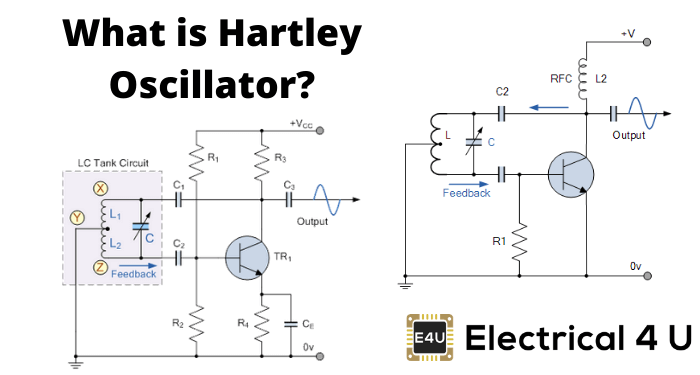
A circuit diagram for a Hartley Oscillator is shown below in Figure 1:
Here the RC is the collector resistor while the emitter resistor RE forms the stabilizing network. Further the resistors R1 and R2 form the voltage divider bias network for the transistor in common-emitter CE configuration.
Next, the capacitors Ci and Co are the input and output decoupling capacitors while the emitter capacitor CE is the bypass capacitor used to bypass the amplified AC signals. All these components are identical to those present in a common-emitter amplifier which is biased using a voltage divider network.
However, Figure 1 also shows one more set of components viz., the inductors L1 and L2, and the capacitor C which form the tank circuit (shown in the red enclosure).
When the power supply is switched on, the transistor begins to conduct, increasing the collector current (IC) that charges the capacitor (C).
Once fully charged, the capacitor (C) begins to discharge through the inductors L1 and L2, initiating the damped oscillations in the tank circuit.
The oscillating current in the tank circuit generates an AC voltage across inductors L1 and L2, which are 180 degrees out of phase due to their grounded connection points.
Further from the figure, it is evident that the output of the amplifier is applied across the inductor L1 while the feedback voltage drawn across L2 is applied to the base of the transistor.
Therefore, the amplifier’s output is in-phase with the tank circuit’s voltage, replenishing the energy it loses, while the feedback to the amplifier is out-of-phase by 180 degrees.
The feedback voltage, already 180 degrees out-of-phase with the transistor, receives an additional 180-degree phase shift from the transistor’s action.
Hence the signal which appears at the transistor’s output will be amplified and will have a net phase-shift of 360o.
At this state, if one makes the gain of the circuit to be slightly greater than the feedback ratio given by
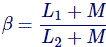
(if the coils are wound on the same core with M indicating the mutual inductance)
then the circuit generates the oscillator that can be sustained by maintaining the circuit’s gain to be equal to that of the feedback ratio.
This causes the circuit in Figure 1 to act as an oscillator as it would then satisfy both the conditions of the Barkhausen criteria.
The frequency of such an oscillator is given as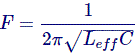
Where,
Hartley oscillators are available in many different configurations including series-or shunt-fed, common-emitter or common-base configured, and BJT (Bipolar Junction Transistor) or FET (Field Effect Transistor) amplifier based.
Further, it is to be noted that the transistor-based amplifier section of Figure 1 can even be replaced by an amplifier of any other kind like that of an inverting amplifier formed by an Op-Amp as shown by Figure 2.
The working of this kind of oscillator is similar to that of the one shown earlier. However, here, the oscillator’s gain can be individually adjusted using the feedback resistor Rf due to the fact that the gain of the inverting amplifier is given as -Rf / R1.
From this, it can be noted that, in this case, the gain of the circuit is less dependent on the circuit elements of the tank circuit.

This increases the stability of the oscillator in terms of its frequency.
Hartley Oscillators are advantageous as they are easy-tunable circuits with very few components including a capacitor and either two inductors or a tapped coil.
This results in a constant amplitude output throughout its typical textbook range from 20 kHz to 30 MHz. It is a poor fit at low frequency because the inductor becomes large and the circuit bulky.
Further, a Hartley Oscillator’s output has high harmonics content in it and hence does not suit the applications that require pure sine wave.


