- Mutual Induction Definition: Mutual induction is when a coil gets an induced EMF due to a changing current in a nearby coil.
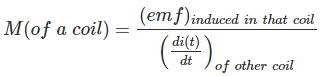
- Mutual Inductance: Mutual inductance is the ratio of induced EMF in one coil to the rate of change of current in an adjacent coil.
- Time Varying Current Effects: A time-varying current in one coil can induce EMF in another coil, creating mutually induced EMF.
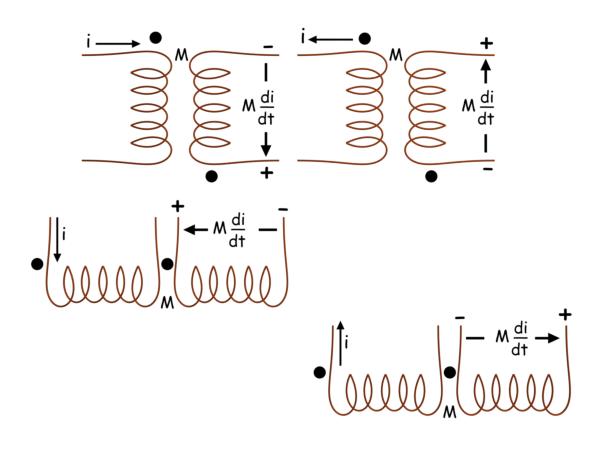
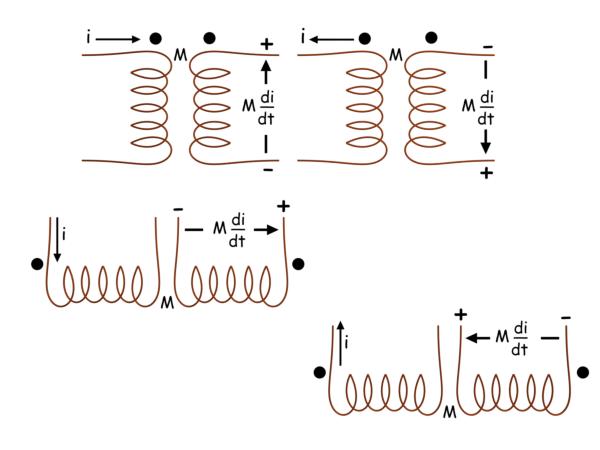
- Dot Convention: The dot convention shows the polarity of mutually coupled coils, helping determine if the induced EMF is additive or subtractive.
- Coefficient of Mutual Induction: Represented as “M”, it shows how efficiently one coil induces EMF in another coil through their mutual flux linkage.
Definition of Mutual Induction
Mutual induction is the production of an emf in one circuit when changing current in another circuit changes the magnetic flux linked with it.
Definition of Mutual Inductance
Mutual inductance, M, relates the emf induced in one coil to the rate of change of current in the other. Its value depends on the coil geometry, relative position and magnetic material. Its SI unit is the henry.
Mutual Induction
A changing current in a coil changes both its own flux linkage and any flux that links a nearby coil. The first effect produces self-induced emf across the coil or inductor. The linked portion of the field produces emf in the neighbouring coil. This second effect is mutual induction, and the resulting voltage is a mutually induced emf. When both coil currents vary, a winding’s terminal voltage contains self-inductance and mutual-inductance terms. Their algebraic signs depend on the chosen current references and dot convention.
Coefficient of Mutual Induction or Mutual Inductance
Consider one coil with self inductance L1 and a second coil with self inductance L2. Start with the ideal case of a low-reluctance core and complete coupling, where all flux produced by either coil links the other. Real windings have some leakage flux, which is handled later through the coupling coefficient. 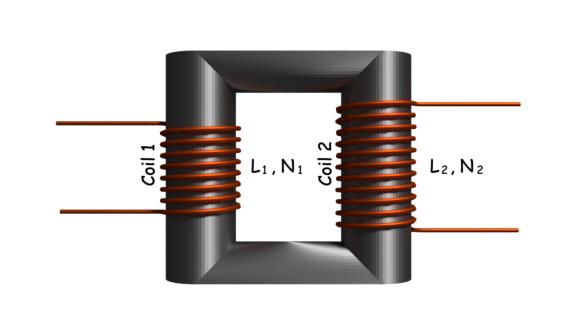
First apply a time-varying current to coil 1 while coil 2 is open-circuited. Coil 1 then has a self-induced emf.

Next leave coil 1 open and vary the current in coil 2. Flux from coil 2 that links coil 1 induces an emf in coil 1, as shown here: 
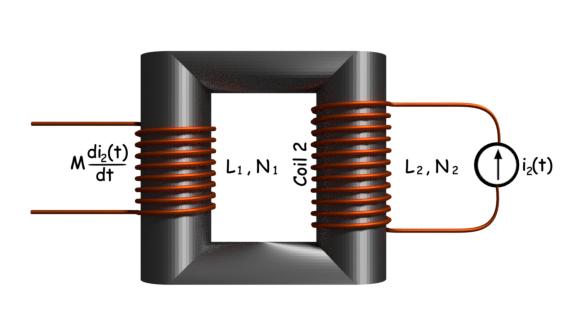
Here, M is the mutual inductance. If both currents vary, coil 1 has a self-induced term caused by its own current and a mutual term caused by current in coil 2. Its resultant emf is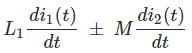
The mutual term is additive or subtractive according to the reference directions and winding polarity. For fixed geometry, M can be written as 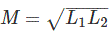
Complete flux coupling is an ideal limit. In a real pair of coils, only part of the flux from each winding links the other. The coupling coefficient k describes this fraction, with a magnitude from zero to one, and the mutual inductance is M = k√(L₁L₂). 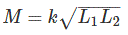
Dot Convention
The dot convention marks terminals that have corresponding instantaneous polarity for mutual induction. If current enters the dotted terminal of one winding, the mutually induced voltage in the other winding is positive at its dotted terminal under the usual voltage reference. If current leaves the dotted terminal, that induced polarity reverses. This rule determines whether mutual-voltage terms add to or subtract from the self-voltage terms.