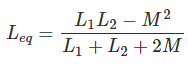
- Equivalent Inductance Definition: Equivalent inductance is the total inductance of inductors connected in series or parallel, combining their self-inductance and mutual inductance.
- Series Inductors: The equivalent inductance of series inductors is the sum of all individual inductances, similar to series resistors.
- Parallel Inductors: In parallel inductors, the reciprocal of the equivalent inductance is the sum of the reciprocals of the individual inductances.
- Mutual Inductance in Series: Mutual inductance in series inductors can either add to or subtract from the total inductance based on the polarity of the inductors.
- Mutual Inductance in Parallel: For parallel inductors, mutual inductance affects the equivalent inductance, and its impact is determined by the direction of the magnetic fields.
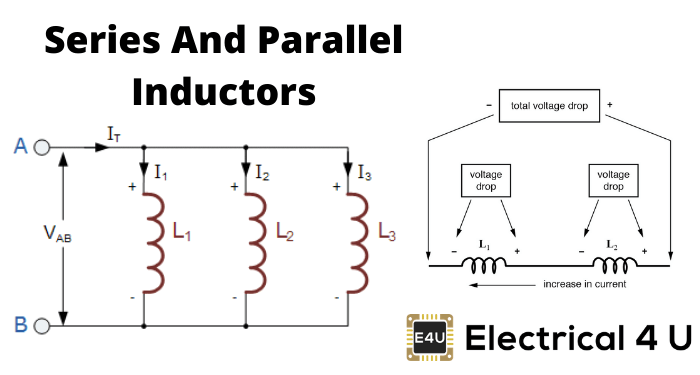
When inductors are connected in series, and mutual inductance can be ignored, the equivalent inductance is the sum of the individual inductances. Series resistance of series-connected resistors uses the same addition rule.
For inductors that share flux, add or subtract the mutual inductance between those inductors.
The effective inductance of each coil then includes both self-inductance and mutual inductance.
Mutual inductance is added to or subtracted from self-inductance based on the polarity of the inductors.
The later sections show how that mutual term is added or subtracted.
If mutual inductance is neglected, the equivalent inductance of series-connected inductors is

When inductors are connected in parallel, and mutual inductance can be ignored, the reciprocal of the equivalent inductance is the sum of the reciprocals of the individual inductances.
Parallel resistance of parallel-connected resistors uses the same reciprocal rule. Mutual inductance is added or subtracted in the same polarity sense when the coils share flux.
The parallel mutual-inductance case is treated later. If mutual inductance is neglected,

An inductor is a passive circuit element. The next sections derive the equivalent inductance of series-connected and parallel-connected inductors.
Adding Inductors in Series
Take n inductors connected in series as shown below.
Label the coils as follows.
the inductance of inductor 1 and voltage drop across it is L1 and v1, respectively,
the inductance of inductor 2 and voltage drop across it is L2 and v2, respectively,
the inductance of inductor 3 and voltage drop across it is L3 and v3, respectively,
the inductance of inductor 4 and voltage drop across it is L4 and v4, respectively,
the inductance of inductor n and voltage drop across it are Ln and vn, respectively.
Apply Kirchhoff’s Voltage Law. The total voltage drop (v) across the series combination of the inductors is
The voltage drop across an inductor of inductance L can be expressed as,
Where i is the instantaneous current through the inductor.
Because the inductors are in series, the same current i flows in each coil. The KVL equation then becomes
Rewrite that as
Leq is the equivalent inductance of the series combined inductors. Hence,
So the equivalent inductance of series-connected inductors, with no mutual inductance, is the arithmetic sum of the individual inductances.
Adding Inductors in Parallel
Take n inductors connected in parallel, as shown below.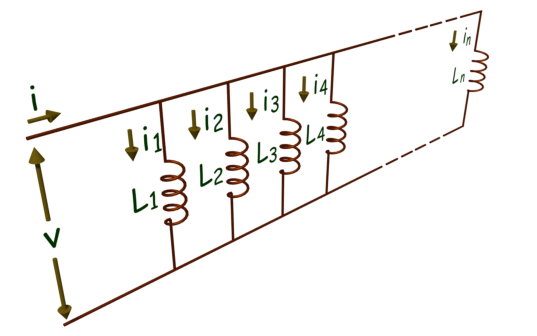
Label the coils as follows.
the inductance of inductor 1 and current through it is L1 and i1, respectively,
the inductance of inductor 2 and current through it is L2 and i2, respectively,
the inductance of inductor 3 and current through it is L3 and i3, respectively,
the inductance of inductor 4 and current through it is L4 and i4, respectively,
the inductance of inductor n and current through it is Ln and in, respectively.
Apply Kirchhoff’s Current Law. The total current (i) entering the parallel combination of the inductors is
The current through an inductor of inductance L can be written as
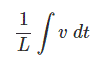
Where v is the instantaneous voltage across the inductor.
Because the inductors are in parallel, the voltage drop across each coil is the same voltage v. The KCL equation then becomes
Rewrite that as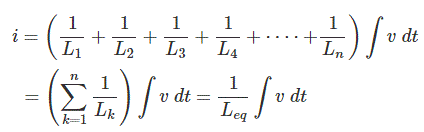
Leq is the equivalent inductance of the parallel combined inductors. Hence,
So the reciprocal of the equivalent inductance of parallel-connected inductors, with no mutual inductance, is the arithmetic sum of the reciprocals of the individual inductances.
Effect of Mutual Induction in Series Connected Inductors
When coils sit close enough for flux from one to link another, mutual induction is present. For series inductors that share flux, include mutual inductance in the equivalent inductance.
Use the dot convention. Each inductor is marked with a dot at one end.
Current that enters the dotted terminal of one inductor induces a voltage in the other inductor with positive polarity at that second inductor’s dotted terminal. The next figure shows one series case.

Because the inductors are in series, the same current flows in both coils.
When current enters the dotted terminal of inductor 1, it also enters the dotted terminal of inductor 2.
Inductor 2 will induce the voltage across inductor 1 with positive polarity at the dotted end of inductor 1.
Current that enters the dotted terminal of inductor 1 induces a voltage across inductor 2 with positive polarity at the dotted end of inductor 2.
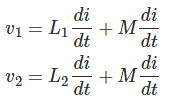
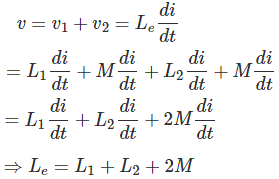
Both mutually induced EMFs then sit in the same sense as the self-induced EMFs, so mutual inductance is added to the self-inductances when you form the equivalent inductance.
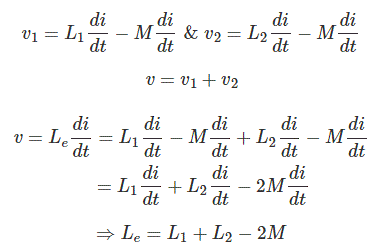
In the second series example below, the dot marks are opposite. Current enters the dotted terminal of one inductor and leaves the dotted terminal of the other.
The mutually induced EMF then opposes the self-induced EMF. The equivalent inductance of that combination is

Effect of Mutual Induction in Parallel Connected Inductors
The same rule applies to parallel inductors. In the first parallel example, both dots sit on the same side of the two coils.
When current enters the dotted terminal of inductor 1, the EMF induced in inductor 2 is positive at the dotted end of inductor 2.
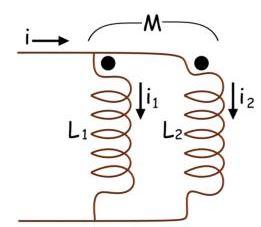
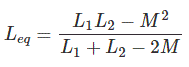
When current enters the dotted terminal of inductor 2, the EMF induced in inductor 1 is positive at the dotted end of inductor 1. The equivalent inductance is
When two parallel inductors are dotted as in the next figure, the equivalent inductance is