- Capacitor Charging Definition: Charging a capacitor means connecting it to a voltage source, causing its voltage to rise until it matches the source voltage.
- Initial Current: When first connected, the current is determined by the source voltage and the resistor (V/R).
- Voltage Increase: As the capacitor charges, its voltage increases and the current decreases.
- Kirchhoff’s Voltage Law: This law helps analyze the voltage changes in the circuit during capacitor charging.
- Time Constant: The time constant (RC) is crucial for understanding the rate at which the capacitor charges.
Let us connect one capacitor of capacitance C in series with a resistor of resistance R. We also connect this series combination of capacitor and resistor with a battery of voltage V through a push switch S.
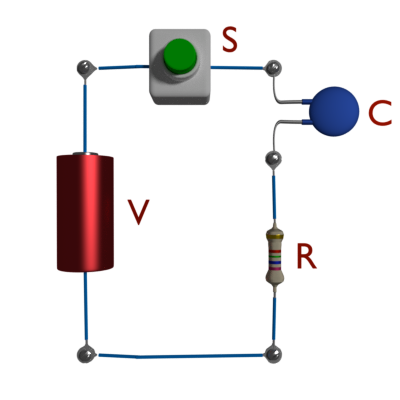
Assume the capacitor is initially uncharged. When the switch is pressed, the capacitor behaves like a short circuit since there is no voltage across it. The charge starts to accumulate, and the current in the circuit is limited only by the resistance R.
So, the initial current is V/R. Now gradually the voltage develops across the capacitor, and this developed voltage is opposite in polarity to that of the battery. As a result, the current in the circuit gradually decreases. When the voltage across the capacitor becomes equal and opposite to the voltage of the battery, the current becomes zero. The voltage increases gradually across the capacitor during charging. Let us consider the rate of increase of voltage across the capacitor as dv/dt at any instant t. The current through the capacitor at that instant is
Applying Kirchhoff’s Voltage Law in the circuit at that instant, we can write,

Integrating both sides, we get,
Now, at the time of switching on the circuit, the voltage across the capacitor was zero. That means v = 0 at t = 0.
Putting these values in the above equation, we get
After getting the value of A, we can rewrite the above equation as,

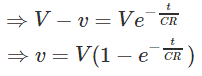
Now, we know that,
This is the expression for the charging current I during the process of charging.
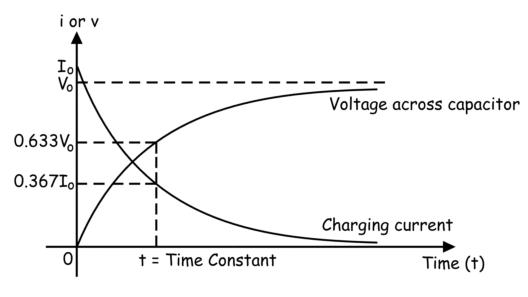
The current and voltage of the capacitor during charging are shown below.
Here in the above figure, Io is the initial current of the capacitor when it was initially uncharged at switching on the circuit, and Vo is the final voltage after the capacitor gets fully charged.
Putting t = RC in the expression of charging current (as derived above), we get,
At time t = RC, the charging current drops to 36.7% of its initial value (V / R = Io) measured when the capacitor was completely uncharged. This period is known as the time constant for a capacitive circuit with capacitance C (farads) and resistance R (ohms). The voltage across the capacitor at the time constant is: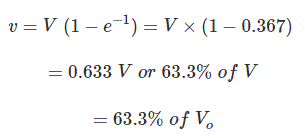
Here Vo is the voltage finally developed across the capacitor after it is fully charged, and it is the same as the source voltage (V = Vo).