

- Doping Definition: Doping is the process of adding impurities to a semiconductor to change its conductive properties.
- Donor Impurities: Donor impurities are pentavalent atoms added to semiconductors, contributing extra free electrons, creating n-type semiconductors.
- N-Type Semiconductor: An n-type semiconductor has excess free electrons as majority charge carriers, introduced by donor impurities.
- Acceptor Impurities: Acceptor impurities are trivalent atoms added to semiconductors, creating excess holes, forming p-type semiconductors.
- P-Type Semiconductor: A p-type semiconductor has excess holes as majority charge carriers, introduced by acceptor impurities.
A small amount of impurity to a semiconductor contributes free electrons or holes and so changes how the semiconductor conducts. That process is doping. A pentavalent donor (atoms with five valence electrons) replaces a host atom. Four valence electrons form bonds with neighbours. The fifth electron is only weakly bound and can become a free negative carrier.
Older textbooks put that donor ionization energy in the range 0.01 eV (electron volt) to 0.05 eV. Ioffe NSM values for silicon are about 0.045 eV for phosphorus, 0.054 eV for arsenic and 0.043 eV for antimony. Germanium shallow donors sit near 0.01 eV, so almost all of those fifth electrons are free at room temperature. Antimony, phosphorus and arsenic are the usual pentavalent donor impurities, which add negative carriers and produce an n-type semiconductor.
N Type Semiconductor
Donor atoms in a semiconductor do not shrink the host energy gap. They add discrete levels just below the conduction band, because the impurity atoms are far apart and interact little. The textbook figures 0.01 eV in germanium and 0.05 eV in silicon are those donor ionization energies at room temperature, not a new host gap. At 300 K nearly every fifth donor electron occupies the conduction band. The extra electrons raise recombination, so the hole density falls.
The hole density in an n-type crystal is therefore lower than in the same volume of intrinsic semiconductor at the same temperature. Excess electrons raise the recombination rate above that of the pure crystal, so fewer holes remain.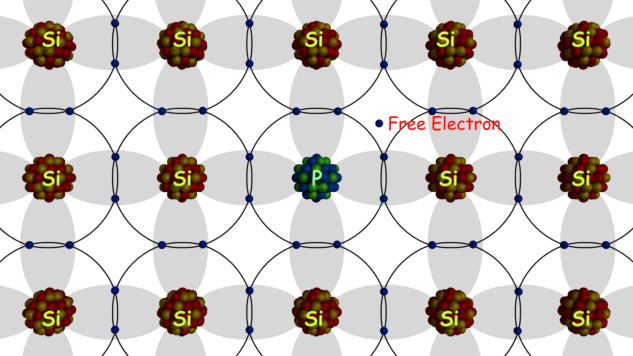
P Type Semiconductor
A trivalent impurity does the opposite. It replaces a host atom and has only three valence electrons, so one neighbour bond is short of an electron and a hole appears. Those three (3) valence electrons bond to three neighbouring host atoms. The missing fourth electron is a hole in the crystal, so the atoms are called acceptor impurities or p-type impurities, and the semiconductor they dope is a p-type semiconductor.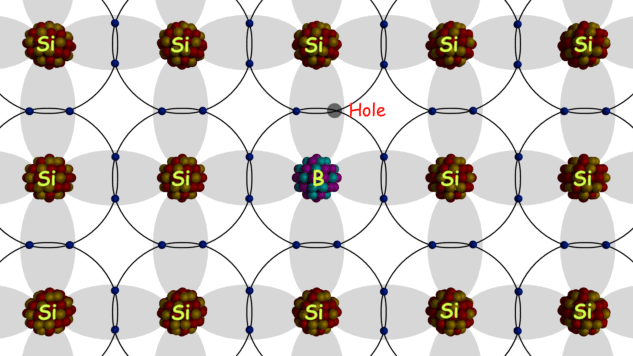
The acceptor adds a discrete level just above the valence band. The gap to that level is small, so a valence electron can occupy it with little extra energy and leave a hole behind. Ioffe NSM puts boron in silicon at about 0.045 eV, close to the old 0.05 eV teaching figure.
An n-type crystal still contains holes. Thermal generation still produces electron-hole pairs at room temperature. Extra donor electrons raise recombination, so the hole density falls while the free-electron density rises. In an n-type semiconductor electrons are therefore the majority carriers and holes the minority carriers. In a p-type semiconductor holes are the majority charge carriers and electrons the minority carriers. Equilibrium still obeys np = ni squared.


