- Photovoltaic Cell Defined: A photovoltaic cell, also known as a solar cell, is defined as a device that converts light into electricity using the photovoltaic effect.
- Working Principle: The solar cell working principle involves converting light energy into electrical energy by separating light-induced charge carriers within a semiconductor.
- Role of Semiconductors: Semiconductors like silicon are crucial because their properties can be modified to create free electrons or holes that carry electric current.
- Junction Importance: The junction between n-type and p-type semiconductors forms a depletion layer that is essential for the cell’s ability to generate voltage.
- Electricity Production: Solar cells produce electricity by generating a voltage from the separation of electrons and holes created by light exposure.
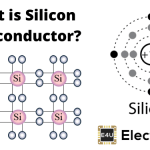
A solar cell converts light into electrical energy through the photovoltaic effect. When a suitable semiconductor absorbs a photon with enough energy, it can create a mobile electron and a corresponding hole. A complete device must then separate and collect these carriers. The photovoltaic cell is the basic unit that performs this conversion. Silicon is widely used because it is abundant, well understood and compatible with mature manufacturing. Each silicon atom has four valence electrons that form covalent bonds in a tetrahedral crystal lattice. Incident light can be reflected, transmitted or absorbed. Only the absorbed portion can generate carriers in the cell.
Carrier generation depends on photon energy, not on a minimum light intensity. A photon with energy equal to or greater than silicon’s band gap can excite an electron from the valence band to the conduction band. This leaves a hole in the valence band and creates one mobile electron-hole pair. Higher irradiance supplies more photons per unit area and can therefore generate more pairs. The free electrons and holes must survive long enough to reach the contacts of the photovoltaic cell. The cell’s junction and contacts separate these light-generated electrons and holes and allow them to supply an external circuit.
Adding a small concentration of a pentavalent dopant such as phosphorus creates n-type silicon. Four of each phosphorus atom’s five valence electrons participate in bonds with neighbouring silicon atoms, while the fifth occupies a weakly bound donor state.
At room temperature, many donor electrons gain enough thermal energy to enter the conduction band. Each released electron leaves a fixed, positively ionised donor atom, so the material remains electrically neutral overall. Mobile electrons are the majority carriers and can conduct current through the semiconductor. Introducing controlled impurities is called doping, and the impurities are dopants. A dopant that supplies an electron is a donor, and donor-doped silicon is called n-type silicon.
A trivalent dopant such as boron creates p-type silicon. A boron atom has one fewer valence electron than silicon, so it introduces an acceptor state associated with a missing electron in the bonding structure. A nearby electron can fill that state, leaving a mobile hole elsewhere.
A hole behaves as a positive charge carrier because neighbouring valence electrons can move successively into the unfilled bond. The apparent hole then moves through the lattice in the opposite direction. Holes are the majority carriers in a trivalent-doped semiconductor, called p-type silicon, while the fixed ionised acceptors carry an equal negative charge overall.
In an n-type semiconductor, electrons are the majority carriers and holes are minority carriers. In a p-type semiconductor, holes are the majority carriers and electrons are minority carriers. Both regions remain electrically neutral away from their junction.
The p-n junction provides the built-in potential needed for a silicon solar cell. When p-type and n-type silicon are joined, electrons diffuse from the n side into the p side and holes diffuse from the p side into the n side. Carriers that cross the junction recombine near it. This uncovers fixed negative acceptor ions on the p-type semiconductor side and fixed positive donor ions on the n-type semiconductor side. The region depleted of mobile majority carriers widens until its electric field produces drift currents that balance diffusion at thermal equilibrium.
The fixed negative charge on the p side and fixed positive charge on the n side form the depletion region. Their electric field points from the n side towards the p side. This field creates a built-in potential that opposes further majority-carrier diffusion while allowing the equilibrium drift and diffusion currents to balance.
When silicon absorbs an above-band-gap photon, an electron can move into the conduction band and leave a hole in the valence band. This photogeneration occurs throughout the illuminated active region. Some pairs recombine, while others reach the junction or a selective contact and are collected.
Electron-hole pairs generated near the depletion region are separated by the built-in field. Electrons move towards the n-type side and holes move towards the p-type side. Pairs generated outside the depletion region can still contribute when minority carriers diffuse to the junction before recombination. Under illumination, electrons collected on the n-type semiconductor side and holes collected on the p-type side create a voltage between the contacts. Connecting a load gives electrons an external path from one contact, through the load and back to the other contact. Continuous absorption and carrier collection sustain the current.
The resulting potential difference depends on the semiconductor, device design, light level, temperature and load. An illuminated crystalline-silicon cell commonly has an open-circuit voltage of roughly 0.5 to 0.7 V, rather than one fixed value. A photovoltaic cell or solar cell delivers useful power only when both voltage and current are present at its terminals.