

- Mobility of Charge Carrier Definition: Mobility of charge carriers is defined as the ratio of drift velocity to the applied electric field in a conductor.
- Drift Velocity Factors: Drift velocity depends on the electric field intensity and the conductor’s mobility.
- Electron Movement in Metals: In metals, electrons move freely, not tied to specific atoms, resembling an electron gas.
- Electric Field Effect: Applying an electric field accelerates electrons, but their velocity is limited by collisions with ions.
- Current Density Calculation: Current density is the current per unit area, calculated using electron concentration and drift velocity.
Mobility of a charge carrier is the ratio of drift velocity to the applied electric field in a conductor. Drift velocity is set by that field and by the metal’s mobility of charge carriers. Different metals therefore have different drift speeds in the same field.
In a metal the valence band is not completely filled, so some electrons can move. Those electrons are not bound to one of the atoms and travel through the lattice.
No single electron stays with one atom. The free electrons wander from site to site. The classical picture is a three-dimensional array of ions with a swarm of free electrons, the Drude electron gas. Electrons travel, then change direction when they collide with ions. The mean free path is the average distance between those collisions. With no external electric field, the random motion has no net drift and no current.
Apply an electric field of Ε volt per metre across a piece of metal. The field accelerates the free electrons. Collisions with much heavier ions stop that speed from growing without limit. At each collision the electron loses kinetic energy, then accelerates again in the field. After a short time the electrons settle at a steady Drift velocity v metres per second. In this linear (ordinary-field) picture that speed is proportional to Ε. High-field semiconductors can saturate and need a different model.
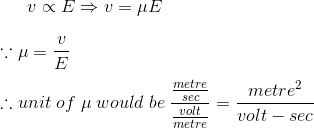
Here μ is the constant of proportionality, the mobility of the electrons. It says how readily those electrons move in the metal. Steady drift plus random thermal motion then gives a net flow opposite to the electric field, because the electron charge is negative.
That net flow is an electric current. Current density J is the current through a conductor per unit area perpendicular to the flow.
J = current density = current per unit area of conductor. More precisely, it is the current through a conductor of unit cross-sectional area when that current is uniformly distributed.
If the electron concentration is n per cubic metre,
nv is the number of electrons crossing unit area per unit time.
The charge that crosses unit area per unit time is then e n v coulombs. That quantity is the current density.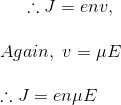
Again for the conductor of unit dimension, cross-sectional area A = 1 m2, length L = 1 m, applied electric field E = V/L = V/1 = V (V is applied voltage across the conductor). Current I = J and resistance R = ρ = 1/σ, where ρ is resistivity and σ is conductivity of the conductor.


