

- Intrinsic Semiconductor Definition: An intrinsic semiconductor is defined as a pure semiconductor without any impurities, also known as an undoped or i-type semiconductor.
- Common Materials: Silicon (Si) and Germanium (Ge) are the most common intrinsic semiconductors.
- Conduction at 0K: At absolute zero (0K), intrinsic semiconductors act as insulators because there are no free charge carriers.
- Thermal Excitation: At room temperature, thermal energy breaks some covalent bonds, generating free electrons and holes, which enable conduction.
- Charge Carrier Movement: Under an electric field, electrons and holes move in opposite directions, resulting in current flow through the semiconductor.
A Semiconductor conducts less than a metal and more than an insulator. The comparison is with conductors and insulators. A chemically pure crystal is an Intrinsic Semiconductors, also called undoped or i-type. Silicon (Si) and germanium (Ge) are the usual Group IV examples. Si is atomic number 14 and Ge is 32, so their configurations are 1s2 2s2 2p6 3s2 3p2 and 1s2 2s2 2p6 3s2 3p6 4s2 3d10 4p2.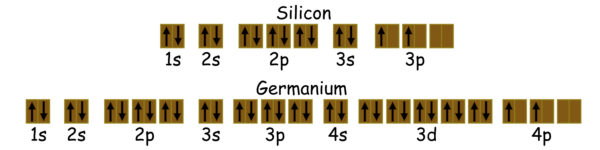
Each atom has four valence electrons. Those electrons set how the crystal conducts.
Figure 1 is a two-dimensional sketch of the silicon lattice. Germanium bonds the same way. Each valence electron pairs with a neighbour to form a covalent bond.
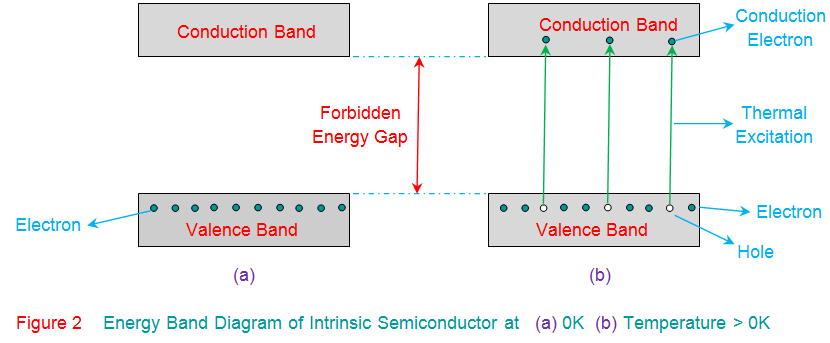
After pairing, intrinsic semiconductors have no free carriers at 0 K. The valence band is full and the conduction band is empty. No electron can cross the gap, so the crystal is an insulator.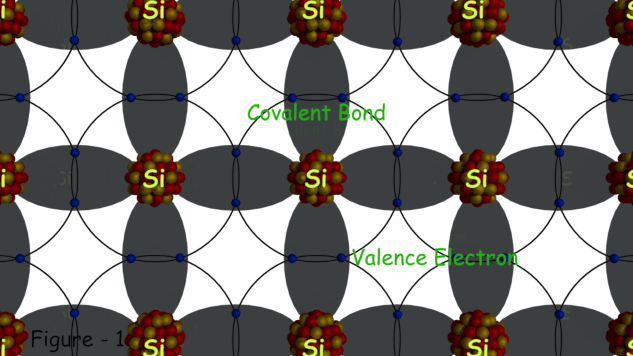
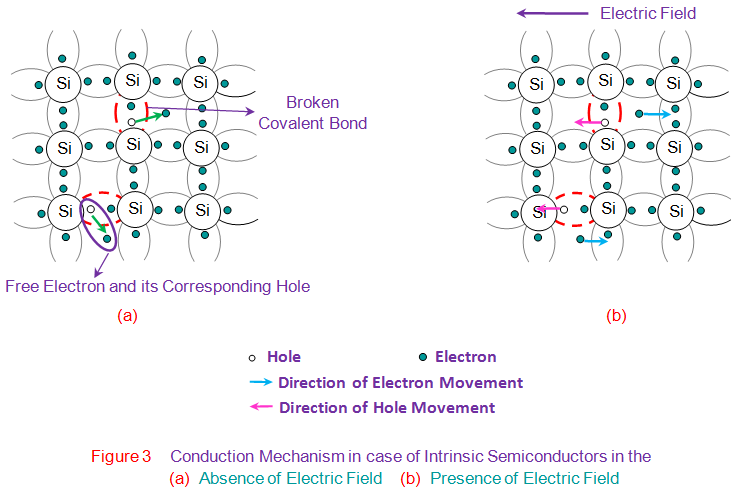
At room temperature a few bonds break (Figure 3a). Those electrons enter the conduction band (Figure 2b) and leave holes in the valence band. Those thermal pairs are the intrinsic carriers that let the material conduct a little.
Room-temperature conductivity is still low because the carrier count is small. Heat breaks more bonds and more electrons enter the conduction band, so conductivity rises. In an intrinsic crystal the electron density ni always equals the hole density pi.
An electric field makes those pairs drift in an intrinsic semiconductor. Electrons move against the field. Holes move with it (Figure 3b). The two motions are opposite. When an electron leaves one atom it leaves a hole; a neighbour electron fills that hole and leaves a new hole behind. That is hole motion the other way. Both motions add to the current.
Mathematically the charge carrier densities in intrinsic semiconductors are given by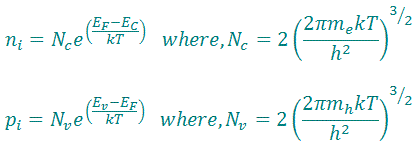
Here,
Nc is the effective densities of states in the conduction band.
Nv is the effective densities of states in the valence band. is the Boltzmann constant.
T is the temperature.
EF is the Fermi energy.
Ev indicates the level of valence band.
Ec indicates the level of conduction band. is the Planck constant.
mh is the effective mass of a hole.
me is the effective mass of an electron.


