- Atom Definition: An atom is defined as the smallest unit of matter that retains the properties of an element.
- Nucleus Composition: The nucleus contains protons and neutrons and is the core where most of an atom’s mass is concentrated.
- Electron Dynamics: Electrons orbit the nucleus in energy levels, with their arrangement influencing the chemical properties of the atom.
- Quantum Theory: Modern atomic theory explains atoms using quantum mechanics, describing electrons as both particles and probabilistic waves.
- Valence Electrons: The electrons in the outermost shell determine an atom’s reactivity and are crucial for chemical bonding.
In 1808, English chemist John Dalton published a chemical theory of the atom. It explained why elements combine in fixed whole-number ratios and why mass is conserved in ordinary chemical reactions. Its main historical postulates can be summarised as follows.
- Matter consists of atoms, which Dalton treated as indivisible units of each chemical element.
- Dalton treated atoms of one element as alike and atoms of different elements as different.
- Atoms of different elements combine in whole-number ratios to form compounds.
- An ordinary chemical reaction rearranges atoms without changing one element into another.
- Atoms are conserved during ordinary chemical reactions.
Modern evidence changed several of these postulates. Atoms contain smaller particles, and nuclear reactions can transform nuclei. Isotopes of one element have the same proton number but different neutron numbers and masses. Allotropes do not refute atomic theory; they show that one element can form different structures and bonding arrangements.
Modern atomic theory developed through experiments and quantum mechanics, not by simply combining Rutherford’s atomic model and Bohr’s atomic model. An atom is the smallest particle that still characterises a chemical element. A neutral atom consists of two broad regions:
- A compact nucleus
- A surrounding electron distribution
Nucleus of Atom
The nucleus is typically tens of thousands of times smaller in diameter than the whole atom and contains more than 99.9% of its mass. Ordinary nuclei contain two types of nucleon:
- Protons
- Neutrons
Proton
A proton has positive elementary charge, about 1.602 × 10⁻¹⁹ coulomb. The number of protons in an atomic nucleus is its atomic number and identifies the element.
Neutron
A neutron has zero net electric charge and a mass slightly greater than a proton.
A nucleus has positive net charge because of its protons. Proton and neutron counts determine the nuclide, while nuclear structure determines properties such as stability, spin and radioactive decay. Most atomic mass resides in the nucleus.
Electrons
An electron has negative elementary charge, about -1.602 × 10 – 19 coulomb. Quantum mechanics describes electrons through states and probability distributions around the nucleus. Several practical points follow:
- A neutral atom has the same number of electrons and protons. Losing or gaining electrons forms a positive or negative ion.
- Electrons occupy quantum states grouped into shells and subshells; they do not travel in fixed classical orbits.
- Electrostatic attraction binds electrons to the positive nucleus, while quantum mechanics determines the allowed energies and spatial distributions.
- Electron binding energy depends on nuclear charge, shielding, subshell and the other electrons. Inner electrons are generally harder to remove than valence electrons.
- The following aluminium image is a simplified shell diagram rather than a literal picture of electron paths.

- Ionisation energy is the energy needed to remove an electron from a specified atom or ion. Successive ionisation energies usually rise, and a large increase occurs after all valence electrons have been removed. Exact values come from the complete electronic configuration rather than distance alone.
- Principal shells use n = 1, 2, 3 and 4, historically labelled K, L, M and N. A larger n does not by itself fix the energy ordering of every subshell in a multielectron atom.
- A principal shell can contain at most 2n2 electrons, where n is the principal quantum number. This capacity counts all orbitals in that shell; it does not predict the order in which neutral-atom ground states fill.
| Shell number | Historical shell label | Principal quantum number n | Maximum shell capacity (2n2) |
| 1 | K | 1 | 2 × 12 = 2 |
| 2 | L | 2 | 2 × 22 = 8 |
| 3 | M | 3 | 2 × 32 = 18 |
| 4 | N | 4 | 2 × 42 = 32 |
- The capacity formula 2n2 does not impose an eight-electron maximum on every outer principal shell. Ground-state calcium has configuration 1s² 2s² 2p⁶ 3s² 3p⁶ 4s², often grouped as 2, 8, 8, 2. The formula 2n2 gives capacity, while the 4s subshell fills before 3d in this neutral ground state because orbital energy depends on the atom’s full electronic structure. The following figure is a simplified shell count.
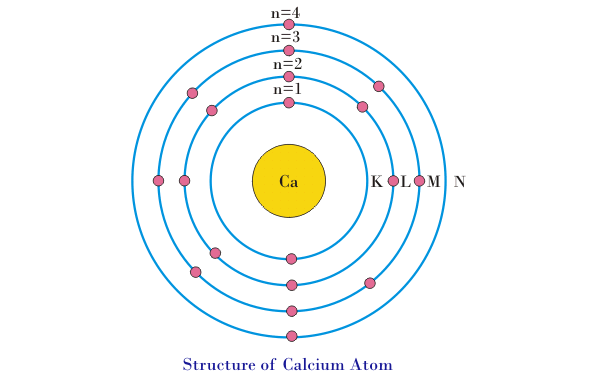
- Valence electrons are the electrons that participate most directly in chemical bonding and ion formation. The octet rule is a useful main-group pattern, not a universal stability law. Helium has a filled two-electron 1s shell, and heavier noble gases can form compounds under suitable conditions.
- Valence electrons are often easier to remove than core electrons. Heating or an electric field supplies energy, but electron emission or ionisation occurs only when the relevant energy and material conditions are met.
- Valence configurations strongly influence bonding and electrical behaviour, together with crystal structure, temperature, defects and neighbouring atoms.
- Each principal shell contains subshells identified by s, p, d and f. Their orbital angular-momentum quantum number l has values from 0 to n – 1. A subshell contains 2l + 1 orbitals, and each orbital can hold at most two electrons. Therefore, a subshell can hold 2(2l + 1) electrons.
| Subshell | Symbol | Quantum number l | Maximum electron capacity 2(2l + 1) |
| s | s | 0 | 2(2 × 0 + 1) = 2 |
| p | p | 1 | 2(2 × 1 + 1) = 6 |
| d | d | 2 | 2(2 × 2 + 1) = 10 |
| f | f | 3 | 2(2 × 3 + 1) = 14 |
- The n = 1 shell contains the 1s subshell, which contains one orbital.
- The n = 2 shell contains 2s and 2p subshells.
- The n = 3 shell contains 3s, 3p and 3d subshells.
- An s subshell contains one orbital, a p subshell three orbitals and a d subshell five orbitals. Each orbital can hold at most two electrons with opposite spin projections.
- Ground-state configurations generally fill available lower-energy states first, subject to the Pauli exclusion principle and Hund’s rule. The familiar filling order is approximate and has exceptions such as chromium, copper, niobium, molybdenum, ruthenium, rhodium, palladium and silver.
The following examples use simplified diagrams. The verified ground-state configurations are stated in the accompanying text.
Atomic Structure of Aluminum having 13 Electrons

Atomic Structure of Copper having 29 Electrons

Neutral copper has an argon core followed by the ground-state configuration 3d¹⁰ 4s¹. This is an exception to a simple uncorrected filling sequence.
Atomic Structure of Silver having 47 Electrons
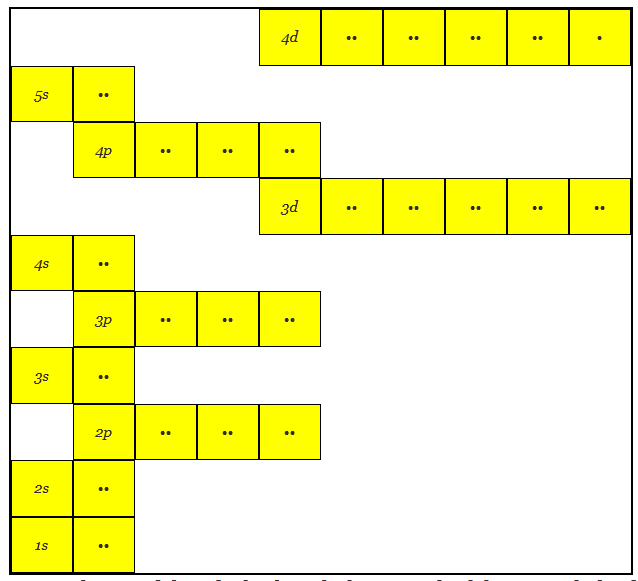
Neutral silver has a krypton core followed by the ground-state configuration 4d¹⁰ 5s¹. Orbital energies depend on occupancy and the complete atom, so one fixed s-before-d ordering is insufficient.
Modern Atomic Theory
Modern atomic theory is a quantum-mechanical theory, far beyond Dalton’s chemical model. quantum theory represents an electron with a quantum state whose wavefunction predicts measurement probabilities. The phrase wave particle duality describes measurement results that show particle-like and wave-like behaviour. Orbitals mathematically represent probability distributions for electron position and other observables.