

- Binary Multiplication Definition: Binary multiplication is a process of multiplying binary numbers, following specific rules for each bit.
- Fundamental Steps: There are four basic steps in binary multiplication that guide the process from start to finish.
- Example Calculation: Multiplying binary numbers involves step-by-step multiplication of bits and summing the results.
- Rules of Multiplication: Multiplying by 0 results in 0, and multiplying by 1 gives the original number.
- Applications: Binary multiplication is essential for digital electronics, such as creating the truth table for an AND gate.
How to Multiply Binary Numbers
Binary arithmetic has four basic operations: binary addition, binary subtraction, binary multiplication and binary division.
This guide explains unsigned binary multiplication with the same partial-product method used for long decimal multiplication.
The binary number system uses only 0 and 1. A one-bit product is therefore either 0 or 1.
The four one-bit rules for binary multiplication are 0 × 0 = 0, 0 × 1 = 0, 1 × 0 = 0 and 1 × 1 = 1. For multi-bit values, form one partial product for each multiplier bit, shift it left by that bit’s position and add the partial products.
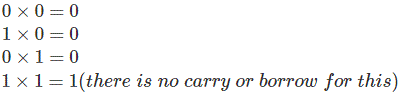
The long-multiplication procedure matches the decimal procedure, but each partial product is especially simple. A multiplier bit of 0 produces an all-zero row, while a multiplier bit of 1 copies the multiplicand.
The next example shows the alignment and addition of those rows.
Let the two binary numbers be A = 1001 and B = 101. In decimal, they are 9 and 5, so A × B should equal 45, or 101101 in binary.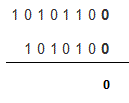
Start with the least significant bit of B. It is 1, so multiplying every bit of A by it produces the first partial product 1001.
The individual one-bit operations are shown here: 
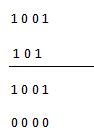
The next multiplier bit is 0, so its partial product is 0000. This row has a one-place shift because the bit has weight 2, although the shift does not change an all-zero value.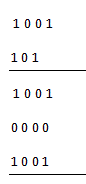
The leftmost multiplier bit is 1 and has weight 4, so copy A and shift it two places left to obtain 100100.
Use binary addition to sum the aligned partial products: 001001 + 000000 + 100100 = 101101.
The binary multiplication result agrees with the decimal check, 9 × 5 = 45. In digital electronics, the one-bit multiplication truth table matches an AND gate. A multi-bit multiplier needs several one-bit products plus circuits that shift and add them. Multiplying unsigned values of m and n bits can require as many as m + n product bits, so the output width must be chosen deliberately.


