- Zener Diode Definition: A Zener diode is defined as a diode that works in reverse bias for voltage regulation and stabilization.
- Voltage Regulation: Zener diodes keep voltage constant when the reverse bias voltage reaches the Zener breakdown voltage.
- Experiment Steps: To find the Zener breakdown voltage, connect the circuit, increase reverse bias voltage, and record current and voltage readings.
- Breakdown Voltage: The Zener breakdown voltage is the point where the current spikes and the voltage stays constant in reverse bias.
- Different Zener Diodes: Repeat the above experiment with different Zener diodes to find those with the desired breakdown voltage for proper voltage regulation.
This Zener diode experiment finds the reverse breakdown voltage by raising bias in steps and plotting current against voltage. The Zener diode is used as Zener diodes for voltage regulation and voltage stabilisation because, once reverse bias reaches the Zener breakdown voltage, the voltage across the device stays near that level while current rises. Below breakdown the reverse current is small. The graph of voltage vs current of a diode is called its characteristic.
The reverse curve below is the characteristic this lab plots. 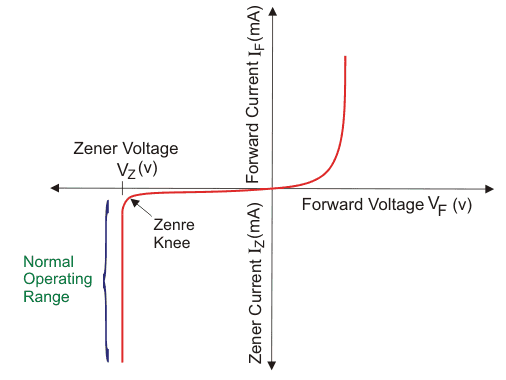
Here Vz is the Zener breakdown voltage. The experiment finds the Zener breakdown voltage and draws the characteristics of Zener diode. Regulation needs a part whose breakdown is close to the wanted voltage across the Zener diode. Follow the circuit diagram below. A series resistor must limit current so the wattage is not exceeded.
We need the following equipment:
- Zener diode
- Milliammeter
- Voltmeter
- Variable DC supply
- Resistors
Connect the circuit as shown in the diagram. First plot the reverse-bias curve. Increase the reverse bias in small steps, noting the ammeter and voltmeter readings. There are two ammeters: A1 with the Zener diode and A2 with a resistance 3.3k Ω resistor. When the current in A1 rises sharply, note the voltmeter reading. That voltage is the Zener breakdown voltage. Continue increasing the reverse bias voltage; the diode voltage stays near breakdown, with a small slope, while the current increases. Record the readings and tabulate the current and voltage values.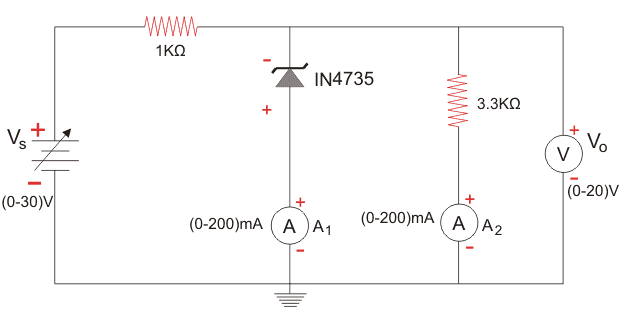
Repeat the experiment by connecting the Zener diode in forward bias. Record the current and voltage readings.
| Voltage | Current |
Fill the table with the measured pairs, then draw the graph. That plot is the characteristic curve of the Zener diode. Note the reverse-bias point at which the current increases rapidly. The voltage at this value is the Zener breakdown voltage. Record this voltage separately.
Different Zener diodes have different breakdown voltages. Choose a Zener diode with a breakdown voltage close to the desired voltage. The same steps give that breakdown voltage for the part on the bench.