

- Zener Diode Definition: A Zener diode is a special type of diode that allows current to flow in reverse when a set voltage, called Zener voltage, is exceeded.
- Working Principle: The zener diode working principle involves a voltage-triggered breakdown that allows it to conduct electricity in reverse, providing a stable voltage regardless of input changes.
- Voltage Regulation: Zener diodes are essential for maintaining consistent voltage in electronic circuits, ensuring devices operate under stable conditions.
- Zener Breakdown vs. Avalanche Breakdown: Zener breakdown is a controlled, sharp breakdown at a lower voltage compared to the more gradual avalanche breakdown.
- V-I Characteristics: The Voltage-Current (V-I) characteristics for a Zener diode graphically show the sharp increase in current at the Zener voltage, defining its function in circuits.
Working Principle of Zener Diode
A Zener diode is a heavily doped PN junction diode used in reverse bias. Raise the reverse voltage and the depletion layer of that diode grows. A small reverse saturation current still flows from minority carriers until breakdown.
At a high enough reverse voltage the electric field gives minority carriers enough energy to knock more electrons free. Those new carriers repeat the collisions. The depletion layer then floods with free electrons and the diode conducts. That chain is avalanche breakdown. It is the usual mechanism in diodes rated above about 6 V.
Impact ionization is avalanche breakdown. A second process, quantum tunneling, is Zener breakdown. When a PN junction is heavily doped, the density of impurity atoms is high. The depletion layer is then thinner than in a lightly doped diode at the same reverse voltage. Tunneling dominates below about 5 V.
That thin layer has a steep field. At the Zener voltage, electrons leave covalent bonds and the junction conducts. A catalogue zener diode is doped so this knee sits at a chosen value. Above that knee the diode clamps the voltage from the voltage source, while current is set by the series resistor and the load. Many parts rated above about 6 V actually avalanche or use both mechanisms. The useful result is the same: a nearly constant reverse voltage for regulation.
Zener Diode Circuit
A Zener Diode in circuit is one diode placed in reverse bias, as below.
The circuit symbol of a Zener diode is also shown below.
Characteristics of a Zener Diode
The plot below is the V-I curve of a zener diode.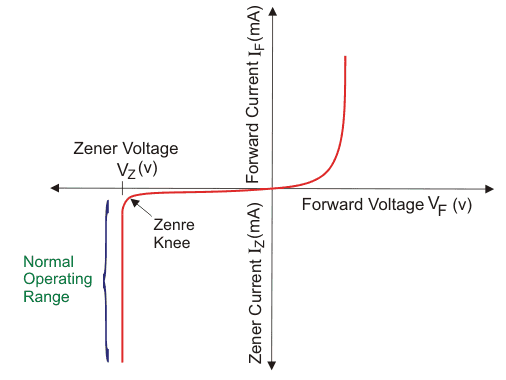
Forward bias looks like an ordinary diode. In reverse bias, once the voltage passes Vz the current rises sharply. That knee is the Zener voltage used for regulation.


