

- Zener Diode Definition: A Zener diode is a special type of diode that allows current to flow in reverse without damage when the voltage exceeds a certain threshold known as the Zener breakdown voltage.
- Characteristics of Zener Diode: This diode’s key feature is its ability to handle reverse voltage up to a certain limit, known as the Zener breakdown voltage, beyond which it conducts large currents without being destroyed.
- Voltage Regulation: Zener diodes are crucial in maintaining steady voltage levels, making them essential for voltage stabilizers and protective circuits.
- Symbol and Identification: The symbol for a Zener diode is distinct, featuring a diode pointing in the reverse direction, which helps in easy identification in circuit diagrams.
- Operational Advantage: Unlike ordinary diodes, Zener diodes regain their original depletion region after the removal of the reverse voltage, a characteristic that prevents damage and prolongs their operational life.
The characteristics of a Zener diode are its forward and reverse current-voltage curves, especially the reverse knee. Ordinary diodes mainly conduct when forward biased, with a small voltage drop. In reverse they pass only a tiny current until breakdown voltage. Uncontrolled breakdown can destroy a rectifier.
The Zener diode is rated to run in reverse breakdown within its power limit. That reverse knee is the characteristic used for regulation.
Zener diodes are more heavily doped than ordinary diodes, so low-voltage types have a thin depletion region. Applying voltage above the Zener breakdown voltage (typically about 2.4 to 200 volts in catalogues) makes the junction conduct in reverse. Parts below about 5 V use Zener tunneling; higher voltages are mostly avalanche, still sold as Zener diodes. The difference from a rectifier is the rating: a Zener is made for continuous breakdown within its wattage. A rectifier also recovers if it is not overheated. Thermal runaway, not a vanished depletion layer, is what destroys either part.
Here is the Zener diode symbol
Let us now look at the Zener diode characteristic: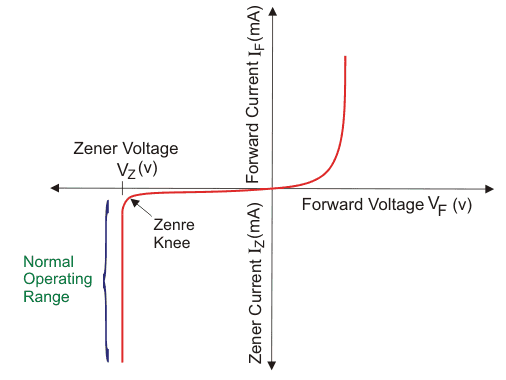
A graph of current through vs the voltage across the device is called the characteristic of Zener diode. The first quadrant is the forward biased region. Here the Zener diode acts like an ordinary diode. When a forward voltage is applied, current flows through it. But due to higher doping concentration, higher current flows through the Zener diode at a given forward voltage. In the third quadrant the reverse curve is shown. The Zener breakdown voltage is the reverse bias voltage after which a much larger current starts flowing through the Zener diode. Here in the diagram, VZ refers to the Zener breakdown voltage. Until the voltage reaches Zener breakdown level, a tiny amount of current flows through the diode. Once the reverse bias voltage becomes more than the Zener breakdown voltage, a much larger current starts flowing through the diode. The voltage stays near the Zener breakdown value, but the current through the diode increases when the input voltage gets increased, limited by the source and any series resistor. The junction recovers when the reverse voltage is removed, if it was not overheated. The Zener diode is still destroyed if the current times breakdown voltage exceeds the power rating. That rated reverse knee is what makes the part useful.
Since the voltage stays near the Zener breakdown voltage, they are used as Zener diodes for voltage regulation and in voltage stabilizers, protection circuits, clipping circuit and clamping circuit work, as a low-cost way to hold a voltage.


