

- Magnetic Field Definition: A magnetic field is defined as a force field produced by moving electric charges that can influence materials like iron.
- Energy Storage: Magnetic fields store more energy than electric fields, making them essential in devices like transformers, motors, and generators.
- Earth’s Magnetic Field: The Earth’s magnetic field protects it from solar radiation and helps navigation with compasses.
- Electromagnets vs. Permanent Magnets: Permanent magnets are naturally magnetic, while electromagnets generate a magnetic field with electric current.
- Applications in Electromechanical Devices: Magnetic fields are used in motors and generators to create torque and enable energy exchange.
What is a Magnetic Field?
A magnetic field is defined as a force field created by moving electric charges. It influences materials like iron and can propagate without any medium, even in a vacuum.
Magnetic fields can store large amounts of energy, as can an electric field. This makes them essential in electromechanical devices like transformers, motors, and generators.
The earth also has its natural magnetism, which protects it from harmful solar radiation from the sun. It also provides the operating field for a magnetic compass.
Permanent magnets, made of ferromagnetic materials like iron-nickel or alnico alloys, have inherent magnetism. Electromagnets generate a magnetic field when electric current flows through a coil.
A current-carrying conductor creates a magnetic field around itself. The field’s direction is determined by the Right-Hand Rule, and its strength varies with the current flowing through the conductor.
Electromagnets are utilized in various industries for production and manufacturing processes. A magnetic field always has both a North pole and a South pole; no isolated monopole exists for a magnetic field, unlike an electric field where a charge can be isolated.
The field lines form closed loops: they emanate from the North pole and terminate on the South pole outside a magnet, then run from the South pole to the North pole inside it.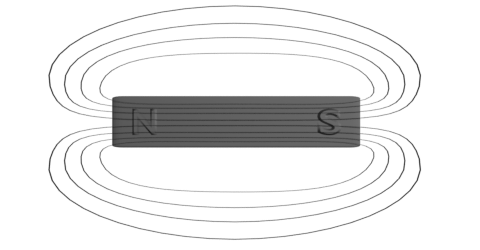
A magnetic field at any point has both magnitude and direction, so it is represented by a vector. It is used in devices like electric motors and generators. A current-carrying coil in a magnetic field experiences torque.
This principle of operation is utilized in electric motors, where the magnetic field exerts a rotating torque on the rotor. In generators, the magnetic field provides the medium for energy exchange between the stator and rotor via the induction principle.
In the case of a 3-phase motor, a rotating magnetic field is produced by the 3-phase windings displaced 120 degrees in space. A rotating magnetic field rotates with the synchronous speed in the air gap of machines, which is required for synchronous motor and induction motors to operate.
To provide this magnetic medium, the machine draws a magnetizing current, which degrades the power factor of the system. Poor power factor increases the burden on power system components like transformers and generators, yet the magnetic field remains an essential component of almost every electromechanical device.


