

- Rotating Magnetic Field Definition: A rotating magnetic field is created when a three-phase supply is applied to a three-phase distributed winding in a rotating machine.
- Three-Phase Supply: This supply involves three currents that are 120 degrees apart, creating a balanced system.
- Magnetic Flux Behavior: The magnetic flux produced in each phase is in phase with the currents and can be represented graphically.
- Rotation of Flux Vector: The resultant flux vector rotates with a constant value and completes a full cycle.
- Production of Rotating Magnetic Field: This rotating field is established due to the balanced supply applied to the stator winding.
A rotating magnetic field is the constant-magnitude flux wave that travels around a three-phase stator. Picture the stator of an electric motor with the three-phase winding placed so each phase is 120o from the others in space.
In a balanced three-phase system the three currents sum to zero at any instant. The magnetic fields produced by those currents add to a constant non-zero vector that rotates with time.
The magnetic flux from the current in each phase can be written as a sine wave. Those equations show that the flux is in phase with the current, as in a three-phase current system.
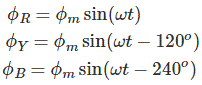
Where, φR, φY and φB are the instantaneous flux of corresponding Red, Yellow and Blue phase winding, φm amplitude of the flux wave. The flux wave in the space can be represented as shown below.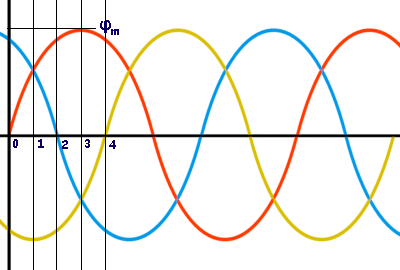
Now, on the above graphical representation of flux waves, we will first consider the point 0.
Here, the value of φR is 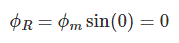
The value of φY is 
The value of φB is 
The resultant of these fluxes at that instant (φr) is 1.5φm which is shown in the figure below.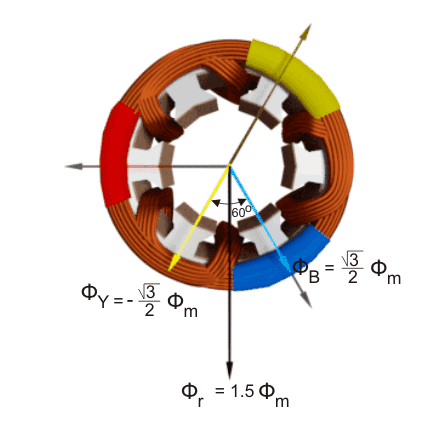
Now, on the above graphical representation of flux waves, we will consider the point 1, where ωt = π / 6 or 30o.
Here, the value of φR is 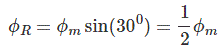
The value of φY is 
The value of φB is 
The resultant of these fluxes at that instant (φr) is 1.5φm which is shown in the figure below. the resultant flux vector has rotated 30o further clockwise at constant magnitude.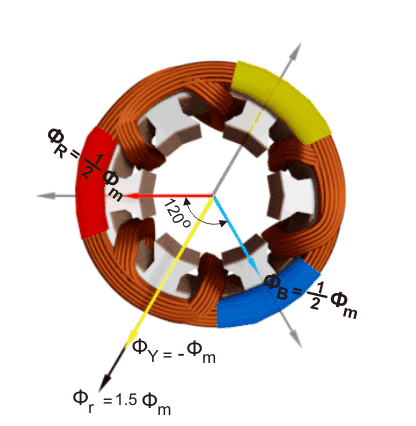
Now, on the graphical representation of flux waves, we will consider the point 2, where ωt = π / 3 or 60o.
Here, the value of φR is 
The value of φY is 
The value of φB is 
The resultant of these fluxes at that instant (φr) is 1.5φm which is shown in the figure below. the resultant flux vector has rotated 30° further clockwise at constant magnitude.
Now, on the graphical representation of flux waves, we will consider the point 3, where ωt = π / 2 or 90o.
Here, the value of φR is 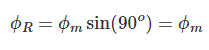
The value of φY is 
The value of φB is 
The resultant of these fluxes at that instant (φr) is 1.5φm which is shown in the figure below. the resultant flux vector has rotated 30o further clockwise at constant magnitude.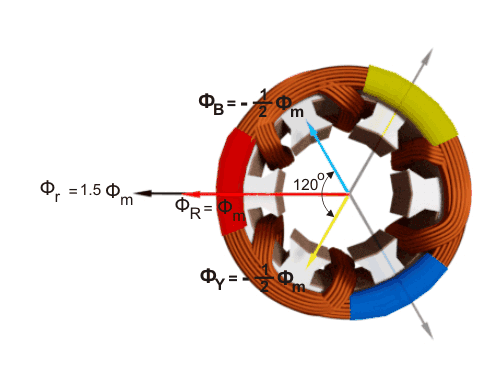
This shows that a balanced supply on a three-phase stator winding produces a rotating magnetic field in space.


