

- Low Power Factor Wattmeter Definition: A low power factor wattmeter is an instrument used to measure low values of power factor accurately.
- Why Standard Wattmeters Fail: Standard wattmeters give inaccurate results for low power factors due to low deflecting torque and errors from pressure coil inductance.
- Compensating Coil: Using a compensating coil helps neutralize errors caused by the pressure coil.
- Inductance Compensation: Modifications to the circuit compensate for the inductance of the pressure coil, ensuring accurate measurements.
- Modern Design: Modern low power factor wattmeters are designed for high accuracy, even with power factors lower than 0.1.
What is a Low Power Factor Wattmeter?
A low power factor meter measures power factor, while a low-power-factor wattmeter measures active power accurately when voltage and current are far out of phase. The low power factor wattmeter is a modified electrodynamometer instrument designed to retain useful torque and limit phase error under those conditions. This differs from a general-purpose electrodynamometer wattmeter.
At low power factor, true active power is small compared with apparent power, so a small phase or friction error can become a large percentage of the reading.
Two limitations make an ordinary dynamometer wattmeter not suitable for accurate measurement at very low power factor:
- Deflecting torque is proportional to VI cosφ, so it becomes small even when rated current and voltage excite the coils.
- Pressure-coil inductance shifts its current phase. The resulting error becomes large relative to the small true-power component.
A low-power-factor wattmeter addresses both limitations and compensates for its pressure-circuit current. It measures power; voltage, current and phase angle are separate quantities.
The design uses increased pressure-coil current, a small control torque and compensation networks to produce a readable indication with controlled error.
power factor correction changes the load itself. It must not be added solely to make a measurement easier because that would change the operating condition being measured.
The following sections explain the main design features.
(1) The total electrical resistance of the pressure circuit is lower than in an ordinary wattmeter, so pressure-coil current and operating torque are higher. This also makes connection loss more important. The diagrams show the two standard connection choices: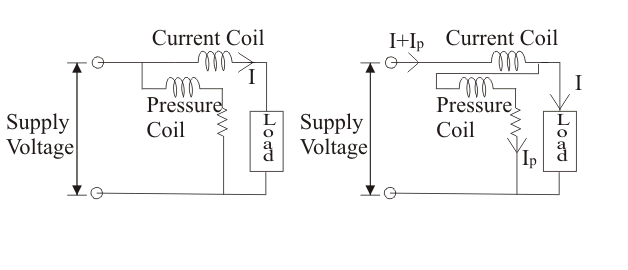
In the supply-side pressure-coil connection, the current coil carries load current and the pressure coil spans both the load and current coil. Its voltage therefore includes the current-coil drop. The first wattmeter reading includes load power plus current-coil loss, subject to phase effects.
In the load-side pressure-coil connection, the pressure coil sees load voltage, while the current coil carries both load current and pressure-circuit current.
The second wattmeter therefore indicates load power plus pressure-circuit power. For a low-power-factor load, that added loss may be large relative to the wanted reading.
Neither basic connection removes every connection loss, so a compensated design is used.
The modified circuit is shown below:
A compensating winding is connected in the pressure circuit and arranged relative to the current coil. The current coil carries the sum of load current and pressure-circuit current.
The compensating winding produces magnetomotive force opposite to the component caused by pressure-circuit current in the current coil.
The remaining fixed-coil field then represents load current I, reducing the pressure-circuit power error.
(2) The compensating coil is a defining feature of this electrodynamometer low-power-factor wattmeter. It should not be confused with a direct-reading power factor meter.
(3) Pressure-coil inductance makes its current lag the applied voltage. A capacitor connected across part of the series resistance can compensate this phase displacement at the design frequency.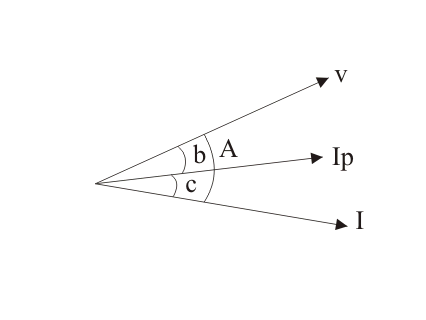
The following first-order derivation uses the symbols in the protected equations to show why the uncompensated phase error grows in relative importance at low power factor.
With pressure-coil inductance, its current lags the applied voltage; voltage itself remains the reference phasor.
Let b be the pressure-current lag angle: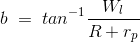
Here R is series resistance and rp is pressure-coil resistance. If A is the load phase angle, the angle between current-coil and pressure-coil currents is A – b. The voltage can be checked with a voltmeter, while the uncompensated wattmeter relation is: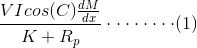
In this notation, Rp = rp + R. Setting b = 0 gives the ideal true-power relation: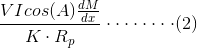
The ratio of the ideal and indicated relations gives the correction factor: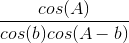
The corresponding error term is:
For small b, the absolute error is approximately VI sin(A) tan(b). Its ratio to true power VI cos(A) is approximately tan(A) tan(b).
As power factor decreases, A approaches 90 degrees and tan(A) rises. A small pressure-coil phase displacement can therefore cause a large percentage error.
The variable resistance and capacitor network is adjusted to minimise the pressure-circuit phase error at the rated frequency.
This modified electrodynamometer circuit is a low power factor wattmeter.
A low-power-factor wattmeter must be selected by its voltage, current, frequency, power range and stated accuracy at the intended power factor. The linked power factor meter is a different instrument that indicates the ratio itself.


