

- Permittivity Definition: Permittivity is defined as a measure of how an electric field affects and is affected by a dielectric medium.
- Relative Permittivity: Relative permittivity is the ratio of a medium’s permittivity to the permittivity of a vacuum.
- Coulomb’s Law and Medium: The force between charged bodies changes based on the permittivity of the medium they are in.
- Capacitance and Permittivity: The capacitance of a capacitor increases with higher permittivity of the dielectric medium between its plates.
- Energy Storage: The energy stored in a capacitor is directly proportional to the permittivity of the dielectric medium.
Two electric charges exert an attractive or repulsive force on each other. Like charges repel and opposite charges attract. For point charges at rest, Coulomb’s Law gives the force from the charge values, their separation and the surrounding medium. The familiar scalar-permittivity form assumes a uniform, linear and isotropic medium.
Under those assumptions, three quantities set the force magnitude.
- The charge values Q1 and Q2, whose product sets the charge factor.
- The centre-to-centre separation d. For point charges, force varies inversely with d squared.
- The permittivity of the uniform medium surrounding the charges.
Permittivity is the material property that relates electric displacement to electric field. For charges in a uniform linear isotropic dielectric, the force in Coulomb’s law is inversely proportional to εoεr. This product is the permittivity of the medium. Here εo is the absolute permittivity of vacuum, usually written ε₀, while εr is the dimensionless relative permittivity of the medium.
Relative Permittivity or Dielectric Constant
Relative permittivity εᵣ is the ratio of a material’s permittivity ε to vacuum permittivity ε₀. It therefore has no unit. The relationship is shown here. 
Air has a relative permittivity of about 1.0006 under normal laboratory conditions, but its precise value changes with pressure, temperature and humidity.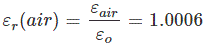 For the same point charges and separation in a uniform linear dielectric, electrostatic force is inversely proportional to permittivity. Under those conditions, εᵣ is also the ratio of the vacuum force to the force in the material.

electric field intensity E is force per unit positive test charge, as shown below.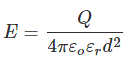
The corresponding electrical flux density, more often called electric displacement D, is shown here.
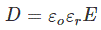
For a linear isotropic medium, the linked expressions for electrical field intensity and flux density give the scalar relation below.
In that model, the ratio of electric flux density to electric field intensity is the medium’s permittivity. Anisotropic media require a tensor relation, while lossy time-varying fields can require complex, frequency-dependent permittivity.
Consider a parallel plates capacitor with effective plate area A, plate separation d and a dielectric of permittivity ε filling the gap. The charge on the capacitor is Q when voltage V is applied across the capacitor.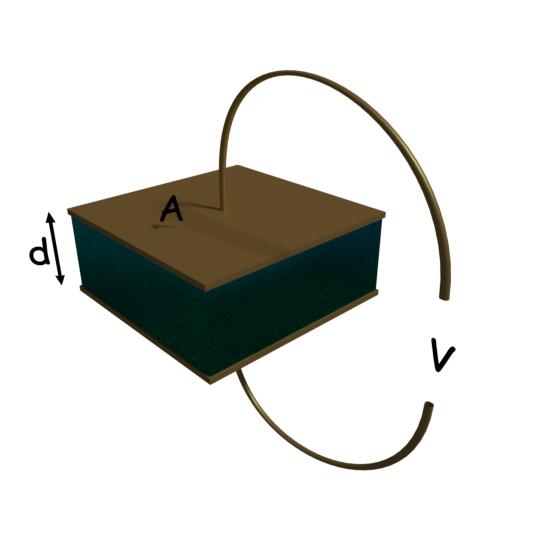
Ignoring fringing, the electric field is
The electric displacement is
The linear-dielectric relation is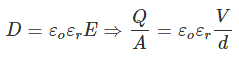
The resulting expression of capacitance shows that the capacitance of a capacitor with fixed geometry is proportional to ε.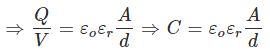
The general energy stored in the capacitor can be written in the equivalent forms below.
If voltage is held constant, the energy stored in the capacitor increases with ε because C increases.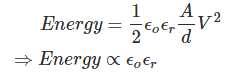
If charge is held constant in an isolated capacitor, higher capacitance reduces voltage and the energy stored in the capacitor. The energy result therefore depends on whether voltage or charge is fixed.
Permittivity helps determine capacitance and physical size for a selected geometry. Practical capacitor design must also account for dielectric strength, loss, temperature behaviour, frequency dependence, tolerances and ageing.
Absolute Permittivity
Absolute permittivity, usually called permittivity, relates electric displacement to electric field for the stated material model. In a linear isotropic medium it is ε = ε₀εᵣ. Relative permittivity compares that value with vacuum permittivity. Real materials can have permittivity that changes with frequency, temperature and field direction.
Unit of Permittivity
Unit of Absolute Permittivity
Coulomb’s law can be rearranged for permittivity as follows.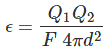
This form gives the equivalent SI unit C²/(N·m²).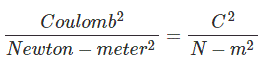
Another Unit of Absolute Permittivity
The parallel-plate capacitance relationship is shown below.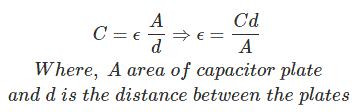
It gives the standard SI unit of permittivity, farad per metre (F/m).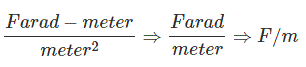
Unit of Relative Permittivity
Relative permittivity is a ratio of two permittivities expressed in the same unit, so it is dimensionless.
Permittivity of Free Space
Permittivity of free space is vacuum permittivity, ε₀. The 2022 CODATA value is 8.854 187 8188(14) × 10⁻¹² F/m. 


