
- Tuned Collector Oscillator Definition: A tuned collector oscillator is defined as an LC oscillator that uses a tank circuit and a transistor to generate a periodic signal.
- Circuit Diagram Explanation: The circuit includes a transformer and capacitor connected to the transistor’s collector, producing a sine wave output.
- Working Principle: The oscillator works by charging and discharging a capacitor through an inductor, creating oscillations through energy conversion between electrostatic and electromagnetic forms.
- Positive Feedback: Positive feedback, achieved by a 360-degree phase shift from the transformer and transistor, is necessary for continuous oscillations.
- Frequency of Oscillation: The frequency is determined by the values of the inductor (L1) and capacitor (C1) in the tank circuit.
A tuned collector oscillator is an LC oscillator with the frequency-setting tank on the collector. Wider background on what is an oscillator: an electronic circuit that generates a periodic signal, such as a sine or square wave, by converting DC to AC. Radios, clocks and similar gear use many oscillator types, not only this collector-tank form.
The tuned collector oscillator is a common LC oscillator. It includes a tank circuit with a capacitor and an inductor and a transistor to restore tank losses. The tank circuit, connected to the collector, looks like a high resistance at resonance and sets the oscillator frequency.
Circuit Diagram Explanation of Tuned Collector Oscillator
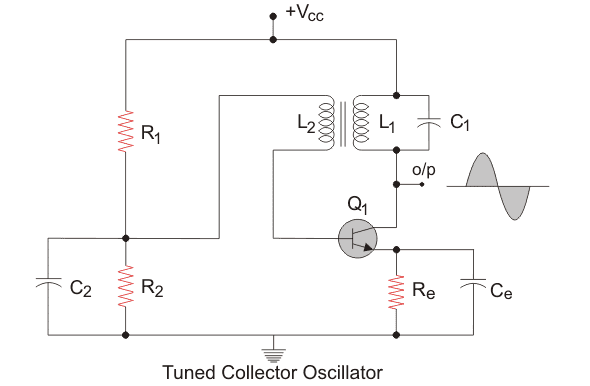
The circuit diagram shows the tuned collector oscillator. The transformer and capacitor are connected to the transistor’s collector, producing a sine wave.
R1 and R2 form the voltage divider bias for the transistor. Re refers to the emitter resistor and is there to provide thermal stability. Ce is used to bypass the amplified ac oscillations and is the emitter bypass capacitor. C2 is the bypass capacitor for resistor R2. The primary of the transformer, L1 along with capacitor C1 forms the tank circuit.
Working of Tuned Collector Oscillator
A common-emitter transistor stage inverts the input voltage by 180 degrees. L1 and C1 form the tank circuit that sets the oscillation frequency. The transformer winding sense supplies the other 180 degrees so the loop is regenerative. The transistor also restores energy lost in the tank.
When the power supply is switched on, a disturbance starts capacitor C1 charging. When it is charged, it starts to discharge through the inductor L1. The energy stored in the capacitor in the form of electrostatic energy gets converted to magnetic energy and gets stored in the inductor L1. Once the capacitor discharges completely, the inductor starts charging the capacitor again. This is because inductors do not let the current through them change quickly and hence it will change the polarity across itself and keep the current flowing in the same direction. The capacitor starts charging again and the cycle continues in this manner. Without the amplifier, tank losses would damp that ring. With feedback, the polarity across the inductor and capacitor still reverses each half-cycle and the output is a sustained sine wave near the tank frequency.
Coil L2 is driven by transformer action and feeds the transistor base (or gate on a FET build). The transistor amplifies the signal, producing the output. A portion of this output is fed back into the system as positive feedback.
Positive feedback is the feedback which is in phase with the input. The transformer introduces a phase shift of 180 degrees and the transistor also introduces a phase shift of 180 degrees too. So in total, we get a 360-degree phase shift and this is fed back to the tank circuit. Barkhausen also needs loop gain of one; extra gain is reduced by limiting so the amplitude stays bounded.
The frequency of oscillation depends on the value of the inductor and capacitor used in the tank circuit and is given by: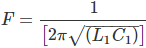
Where,
F = Frequency of the oscillation.
L1 = value of the inductance of primary of the transformer L1.
C1 = value of capacitance of capacitor C1.


