
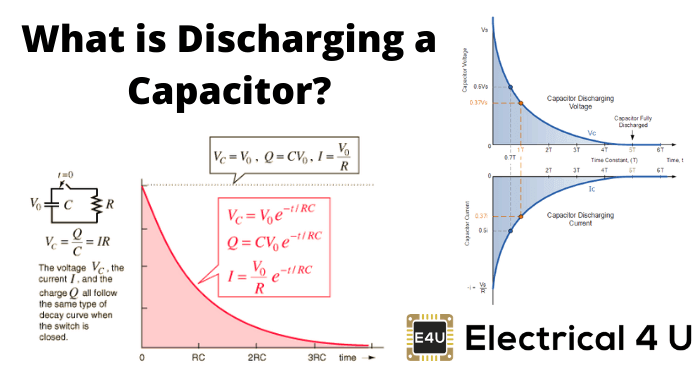
- Discharging a Capacitor Definition: Discharging a capacitor is defined as releasing the stored electrical charge within the capacitor.
- Circuit Setup: A charged capacitor is connected in series with a resistor, and the circuit is short-circuited by a switch to start discharging.
- Initial Current: At the moment the switch is closed, the initial current is given by the capacitor voltage divided by the resistance.
- Exponential Decay: The voltage and current in the circuit decrease exponentially as the capacitor discharges.
- Capacitor Discharge Graph: The capacitor discharge graph shows the exponential decay of voltage and current over time, eventually reaching zero.
What is Discharging a Capacitor?
Discharging a capacitor means releasing the stored electrical charge. Let’s look at an example of how a capacitor discharges.
We connect a charged capacitor with a capacitance of C farads in series with a resistor of resistance R ohms.
We then short-circuit this series combination by closing the switch.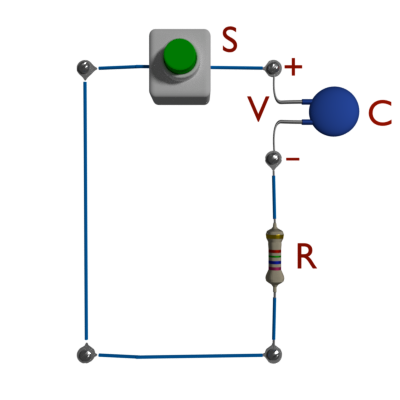
As soon as the capacitor is short-circuited, it starts discharging.
Let us assume, the voltage of the capacitor at fully charged condition is V volt. As soon as the capacitor is short-circuited, the discharging current of the circuit would be – V / R ampere.
But after the instant of switching on that is at t = +0, the current through the circuit is
As per Kirchhoff’s Voltage Law, we get,
Integrating both sides, we get,
Where, A is the constant of integration and, at t = 0, v = V,
After calculating the value of A, we get,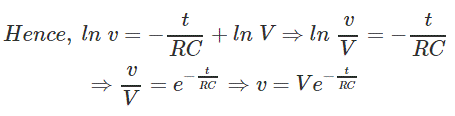
We know the form, KVL of the circuit,
If we plot the discharging current and voltage on a graph, we see:
Hence the capacitor current exponentially reaches zero from its initial value, and the capacitor voltage reaches exponentially to zero from its initial value during discharging.


