- Temperature Transducer Definition: A temperature transducer is defined as a device that converts thermal energy into measurable physical quantities like electrical signals.
- Sensing Element: The sensing element changes its properties with temperature, enabling the transducer to detect temperature variations.
- Transduction Element: It converts the changes from the sensing element into electrical signals for measurement.
- Types of Sensors: There are contact sensors that need to touch the heat source and non-contact sensors that measure temperature from a distance.
- Examples of Temperature Transducers: Common examples include thermistors, RTDs, thermocouples, and integrated circuit temperature transducers.
What is a Temperature Transducer?
A Temperature Transducer uses a temperature-dependent physical property to produce a measurable output, usually resistance, voltage, current or digital data. In a thermocouple, an electrical potential difference depends on the measuring and reference-junction temperatures. Calibration and the full readout circuit convert that signal into a temperature estimate.
Main Features of Temperature Transducers
- The measurand is temperature; a heat-flow transducer measures a different thermal quantity.
- The sensing element produces an electrical property change or signal that the instrument can condition and read.
- Accuracy depends on calibration, thermal contact, immersion or field of view, response time, self-heating, wiring and environmental conditions.
Basic Scheme of Temperature Transducers
A temperature measurement chain has a sensing element, signal conditioning, a calibrated conversion model and a readout or controller.
Sensing Element.
The sensing element in a temperature transducer changes resistance, voltage, current, optical radiation or another measurable property with temperature. Its response must be stable and characterized over the intended range.
For example, a platinum Resistance Temperture Detector (RTD) uses the repeatable resistance-temperature relationship of its sensing element.
Choose the sensing element by matching these conditions to the application:
- The change in resistance or output per degree should be large enough for the required resolution and noise level.
- Element resistivity, geometry and readout current should provide a measurable signal without unacceptable self-heating.
- The response should remain stable, repeatable and calibrated across the required temperature, time and environment.
- Transduction Element
Signal conditioning converts the sensor response into a usable electrical output. It can supply excitation, measure resistance or voltage, linearize the response, compensate a reference junction and apply calibration coefficients.
In a thermocouple circuit, the potential difference is measured by a sensitive voltmeter. The measured voltage, thermocouple type and reference-junction temperature are then used to calculate the measuring-junction temperature.
Types of Temperature Transducers
Contact Temperature Sensor Types
A contact sensor touches or is immersed in the measured object or medium. Heat transfer by conduction, convection and radiation drives the sensor towards thermal equilibrium, while stem conduction, immersion depth and response time can create error.
Non-contact Temperature Sensor Types
A non-contact temperature sensor does not touch the target, unlike the electrical-field detection analogy of a non contact voltage tester or voltage pen. Radiation thermometers infer surface temperature from measured thermal radiation. Their accuracy depends on emissivity, reflected radiation, atmosphere, optics, wavelength band, focus, spot size and calibration.
Thermistor
A thermistor is a temperature-sensitive resistor, usually made from ceramic or polymer semiconductor material. Most commercial temperature-measurement thermistors are NTC devices whose resistance falls as temperature rises, but PTC thermistors also exist. Their high sensitivity comes with a nonlinear response and a model-specific range.
Properties of Thermistors
- NTC resistance decreases with temperature, while PTC resistance increases over its specified operating region.
- Common sensing elements use ceramic or polymer semiconductor materials.
- NTC thermistors often have greater resistance change per degree than a platinum RTD, but sensitivity alone does not determine accuracy.
- Nominal resistance, tolerance, beta value, dissipation constant and self-heating limit are data-sheet properties.
- Many thermistors perform best from about -50oC to 100oC, although the exact range depends on construction and calibration.
Resistance Thermometers
Another temperature transducer is the Resistance Temperature Detector or RTD. Platinum temperature sensors can use a wire winding or thin film whose electrical resistance follows a characterized temperature relationship.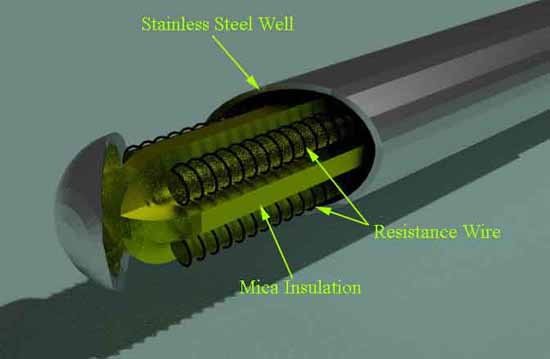
A simple linear approximation over a limited range is shown below.
R is the element resistance at the measured temperature.
α is the reference temperature coefficient for the stated approximation.
Ro is the element resistance at 0oC. Wider-range work uses a specified polynomial, wiring method and calibration.
Main Features of RTD’s
- Platinum RTDs offer a well-characterized, stable resistance-temperature relationship; cost, sensitivity and uncertainty depend on probe class and readout.
- NIST calibrates industrial platinum RTDs from -196oC to 550oC; an individual probe may have a narrower manufacturer-rated range.
Thermocouples
A thermocouple circuit uses two dissimilar conductor materials and responds to the temperature difference between its measuring and reference junctions. The readout measures a small electromotive force and uses type-specific reference data plus cold-junction compensation to estimate temperature.
Principle of Thermocouple

Joining two conductors does not by itself create a useful measurement voltage. The Seebeck effect produces a net electromotive force when the thermocouple circuit spans a temperature gradient. The output depends on both junction temperatures and the conductor pair.
Main Features of Thermocouples
- Type-specific thermocouples cover different ranges, from cryogenic service near -200oC to high-temperature service above 1700oC. No single type covers every condition.
- The sensing circuit generates its own thermoelectric emf, but the readout and cold-junction compensation still need instrumentation and usually electrical power.
- Probe cost depends on conductor type, sheath, junction construction, range and required calibration.
- Accuracy depends on thermocouple type, wire tolerance, reference-junction measurement, homogeneity, installation, drift and calibration.
Integrated Circuit Temperature Transducers
Integrated temperature sensors combine a semiconductor sensing element with monolithic circuits that provide an analogue or digital output. Analogue versions use voltage or current.
Each device has its own supply, scale factor, operating range, accuracy, package and thermal-coupling requirements.
- LM335 – nominal output is 10 mV/oK, conventionally written 10 mV/K.
- LM34 – nominal output is 10 mV/oF.
- AD592 – nominal current output is 1 µA/oK, conventionally written 1 µA/K.
Description of LM 335 Series
The LM335 is an integrated temperature sensor that operates electrically like a two-terminal zener diode. A bias current is required, and the sensor produces about 10 mV per kelvin of absolute temperature.
For a Celsius display, θ is the temperature in oC after the circuit subtracts the 273.15 K offset or applies the equivalent calibrated conversion.
Main Features of Integrated Temperature Transducers
- Many devices provide a near-linear temperature transducers output over their rated range.
- Cost, accuracy and interface vary by device, package and grade.
- Operating range is model-specific. For example, TI rates the LM335 from -40 to 100oC, while other IC sensors use different limits.