

- Resistances in Series Definition: A series connection is defined as connecting resistors end to end, so the current flows through each one in turn.
- Series Connection Formula: The total resistance in a series circuit is the sum of all individual resistances.
- Resistances in Parallel Definition: A parallel connection is defined as connecting resistors where each resistor is connected to the same two points, providing multiple paths for the current.
- Parallel Connection Formula: The equivalent resistance in a parallel circuit is found using the formula 1/R = 1/R1 + 1/R2 + 1/R3.
- Resistance Connection Impact: How resistors are connected (series or parallel) affects the total resistance and current flow in a circuit.
Two or more pieces of electrical resistance can sit in series, in parallel or in a mix of both. This page covers the series case and the parallel case.
Resistances in Series
Take three types of resistors – R1, R2 and R3 – and join them end to end as in the figure. That chain is called resistances in series. The equivalent resistance of the chain is the sum of those three resistances.
The resistance from A to D is therefore that sum. The current enters at A and leaves at D because the chain has no parallel path.
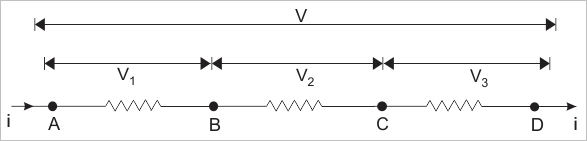
Call that current I. It flows through R1, R2 and R3. From Ohm’s law, the voltage drops are V1 = IR1, V2 = IR2 and V3 = IR3. If the total voltage across the chain is V, then
because the individual drops add up to the voltage applied across the chain.
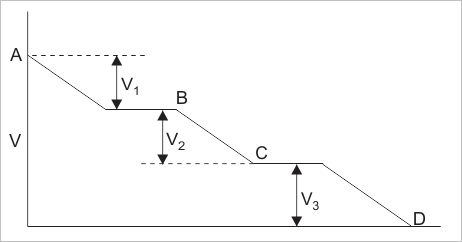
Treat the whole chain as one resistor of value R. Ohm’s law then gives
V = IR ………….(2)
Equate (1) and (2).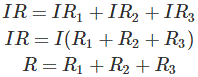
That is the series rule: equivalent resistance equals the sum of the individual resistances. For n resistances instead of three, the equivalent is 
Resistances in Parallel

Now take three resistors R1, R2 and R3 with matching terminals joined so each resistor sits between the same two nodes.
That arrangement is called resistances in parallel. Apply an electric potential difference across the pair of nodes and the group draws a current I.
That current has three paths through the three electrical resistances, so it splits. Call the branch currents I1, I1 and I1 through R1, R2 and R3.
The source current is
Each of the resistances in parallel sits across the same voltage source, so the voltage drops are equal and each equals the supply V.
From Ohm’s law,
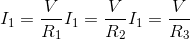
Let the equivalent resistance of the group be R.
Then 
Substitute I, I1, I2 and I3 into (1):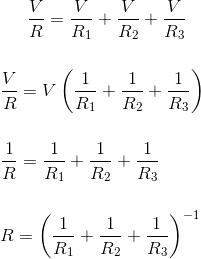
That is the parallel equivalent. For n resistances in parallel instead of three, the same form is


