

- Power Diode Definition: A power diode is defined as a diode used in power electronics circuits, designed to handle higher currents than regular diodes.
- N- Layer Importance: The N- layer in power diodes is lightly doped, increasing the space charge region thickness and allowing higher reverse-biased voltages.
- V-I Characteristics: Power diodes show a linear increase in forward current due to higher ohmic resistance, differing from the exponential increase in regular diodes.
- Reverse Recovery Time: Reverse recovery time is the time it takes for the reverse current to decay to 25% of its peak value after the diode is switched off.
- Softness Factor: The softness factor of power diodes is the ratio of charge removal times from the semiconductor and depletion regions, indicating voltage transients upon turn-off.
What is a Power Diode?
A power diode is a diode built for power electronics circuits, where it carries currents that ordinary signal diodes cannot survive. It keeps the familiar two terminals and one-way conduction, while its construction targets high-power duty.
A standard semiconductor diode is the simplest such device: two layers, two terminals and one junction.
Ordinary signal diodes have a junction formed by a p type semiconductor and n type semiconductor. The lead joining the p-type is called the anode, and the lead joining the n-type is called the cathode.
The figure below depicts the structure of an ordinary diode and its symbol.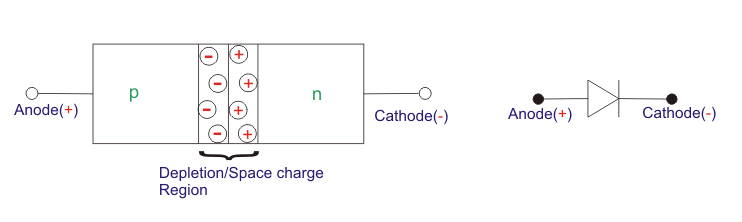
Power diodes resemble ordinary diodes but differ in construction.
In regular diodes (also called “signal diodes”) both the P and N sides share the same doping level, giving a plain PN junction. A power diode instead forms its junction between a heavily doped P+ layer and a lightly doped N– layer grown epitaxially on a heavily doped N+ substrate. The structure looks as shown below.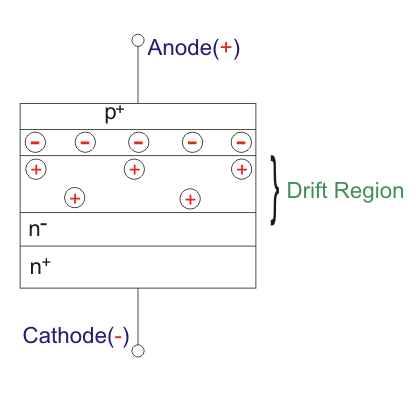
The N– layer is what adapts the power diode to high-power work. Because this layer is so lightly doped that it is almost intrinsic, the device also goes by the name PIN diode, where i stands for intrinsic.
The figure above shows that the space charge region stays charge-neutral as in a signal diode, yet it is much thicker and reaches deep into the N– region.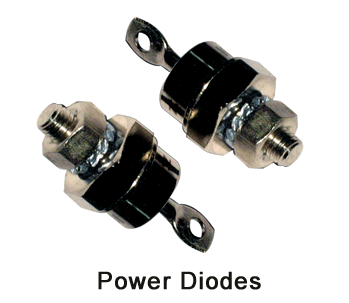
Light doping causes this growth: the lower the doping concentration, the thicker the space charge region becomes.
That added thickness lets the diode block larger reverse voltages, so its breakdown voltage rises.
The N– layer does have a cost: it greatly raises the ohmic resistance, so the diode generates more heat during forward conduction. Power diodes therefore ship with mountings that dissipate this heat properly.
V-I Characteristics of Power Diodes
The figure below shows the v-i characteristics of a power diode which is almost similar to that of a signal diode.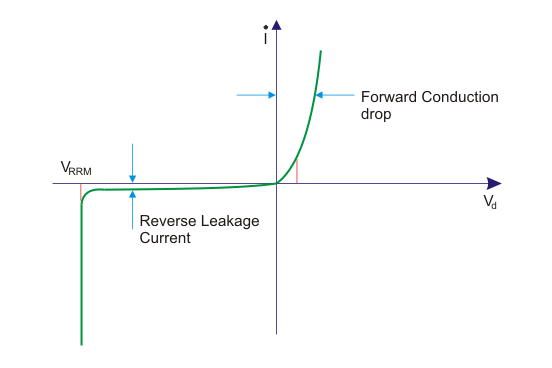
In forward bias a signal diode’s current grows exponentially, but in power diodes the high forward current creates an ohmic drop that dominates the exponential term, so the curve climbs almost linearly.
VRRM, the repetitive peak reverse voltage, marks the highest reverse voltage the diode can withstand.
Beyond this voltage the reverse current jumps abruptly, and because the diode cannot dissipate that much heat it may be destroyed. The same rating is often quoted as peak inverse voltage (PIV).
Reverse Recovery Characteristics of Power Diodes
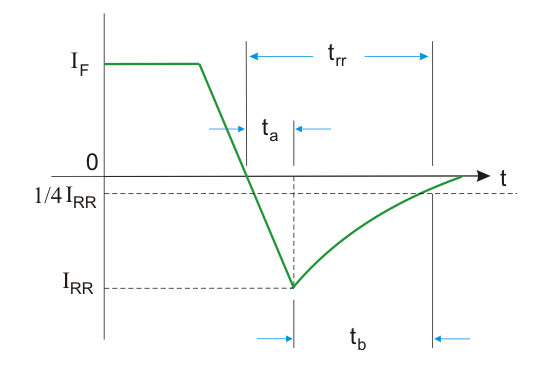
The figure shows the reverse recovery characteristic of a power diode. When the diode switches off, current decays from IF through zero and briefly reverses, because the charge stored in the space charge region and the semiconductor region must first be removed.
The reverse current peaks at IRR, then falls back toward zero, and the diode is fully off after time trr.
Reverse recovery time spans the instant the forward current reaches zero to the instant the reverse current decays to 25% of IRR. Past that point the diode has regained its reverse blocking capability.
From the figure above, we see that
ta → time when charge from depletion region is removed
tb → time when charge from semiconductor region is removed
Also from the figure, we can say that
Here  is the rate of change of reverse current.
The area bounded by the triangular region in the above figure represents the total charge stored or reverse recovery charge, QR. Hence we can write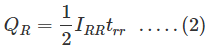
Now, for  , putting in eq.1 and combining with eq.2, we get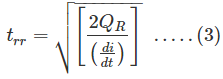
Putting eq.3 in eq.1 for , we get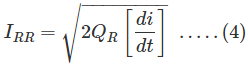
Equations 3 and 4 show that trr and IRR depend on QR, which in turn depends on the initial forward current IF.
Turn-off behaviour yields one more parameter for power diodes: the softness factor (S-factor), the ratio of times tb and ta.
Hence,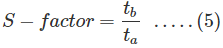
An S-factor equal to unity marks a soft-recovery diode; an S-factor below unity marks fast or snappy-recovery types.
S-factor indirectly signals the voltage transient at turn-off. A low S-factor brings an abrupt current cutoff and a high transient overvoltage, while a high S-factor gives a gentler, low oscillatory reverse voltage.
Total turn-off power loss is the product of diode current and voltage across trr, and most of it occurs during tb.
A typical power-diode datasheet lists the most important parameters: IF avg, IF RMS, VRRM, I2t rating, junction temperature TJ, trr, S-factor and IRR, plus further parameters and graphs.
By their properties, power diodes fall into the following categories, summarised in the table below:
| Type | Voltage ratings (VRRM) | Current ratings (IF) | Reverse recovery time (trr) | Applications | Remarks |
| General Purpose Diodes | 50-5000 V | 1A to several thousand Amps | ~25µs | UPS, battery chargers, welding, traction, etc. | – |
| Fast Recovery Diode | 50-3000 V | 1A to several thousand Amps | <5µs | SMPS, commutation circuits, choppers, induction heating | Doping is done using platinum or gold |
| Schottky Diodes | Up to 100V | 1-300 A | ~ns | Very high frequency switching power supplies and instrumentation | Metal-semiconductor junction, usually Al-Si(n-type), majority carrier device, hence very low turn off time |


