

- Maxwell Bridge Definition: A Maxwell Bridge measures the self-inductance of a circuit using components that balance inductive and capacitive impedances.
- Diagram Understanding: Diagrams of Maxwell Bridge show the configuration of resistors and capacitors or inductors necessary to balance the bridge.
- Resonance Principle: Resonance occurs when the bridge balances, eliminating current through the detector, a crucial aspect in understanding how Maxwell Bridge functions.
- Application Range: Maxwell Bridge is especially useful in measuring inductors at audio frequencies due to its frequency independence.
- Limitations and Alternatives: While effective for medium quality coils, the Maxwell Bridge has limitations for low-quality coils, prompting the use of alternatives like Hay’s bridge.
What is Maxwell Bridge
A Maxwell Inductance Capacitance Bridge is a four-arm AC Wheatstone bridge used to measure self-inductance by a null. The unknown coil sits in one arm. A parallel resistor and capacitor in the opposite arm make the Maxwell-Wien form.
The inductive arm has a lagging phase. The capacitive arm has a leading phase. At null those phases cancel. Detector voltage is zero and detector current is zero. That null is a balance, not a tank-circuit resonance. The unknown L then follows from the standard C.
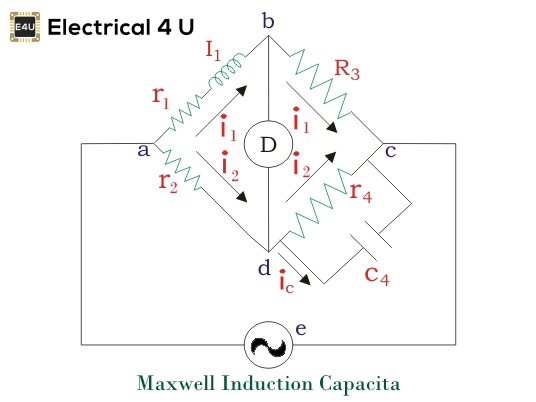
Two Maxwell layouts are common. The inductance-inductance form uses only inductors and resistors. The inductance-capacitance form adds a capacitor in the comparison arm.
Both are AC bridges. The next section is the AC-bridge null, then each Maxwell form.
AC Bridges
An AC bridge has an AC source, a null detector and four impedance arms. It is a Wheatstone layout with the DC battery swapped for AC and the galvanometer swapped for an AC detector.
Labs use them for inductance, capacitance, storage factor and dissipation factor.

The general AC null is below. The figure is the four-arm network:
Z1, Z2, Z3 and Z4 are the four arms.
At null the potential difference from b to d is zero. That means the voltage drop from a to d matches the drop from a to b in magnitude and in phase.
From the figure, e1 = e2
Equations 1, 2 and 3 give Z1.Z4 = Z2.Z3. In admittance form that is Y1.Y4 = Y2.Y3.
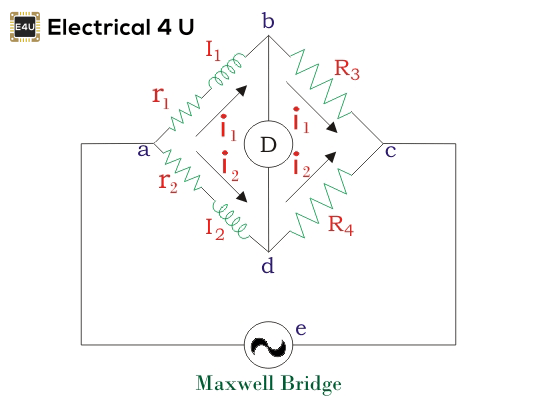
Take the simple AC bridge below. R3 and R4 are pure electrical resistances. Substitute Z1, Z2, Z3 and Z4 in the AC-bridge null derived above.
Split real and imaginary parts to get:
Those two equations lead to the points below:
- Equating real and imaginary parts gives two null equations. Magnitude and phase must both match. The two equations are independent when each contains only one adjustable element, an inductor or a resistor.
- Those balance equations contain no frequency term, so the source frequency need not be known exactly and the waveform need not be a pure sinusoid.
Maxwell’s Bridge
Maxwell bridges come in two main layouts:
- Maxwell’s inductor bridge
- Maxwell’s inductor capacitance bridge
Maxwell’s Inductance Bridge
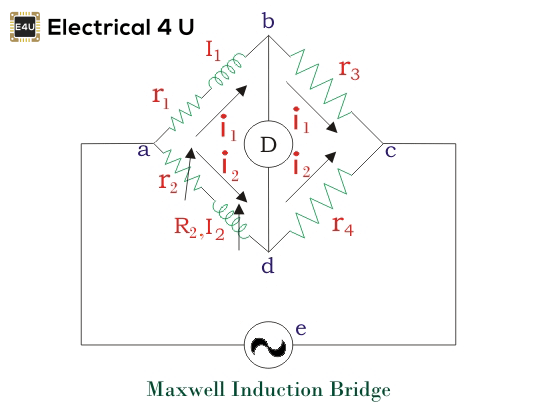
Start with Maxwell’s inductance bridge. The figure is the inductance-inductance network.
Arms bc and cd are resistors. Phase balance is set on ab and ad.
Here l1 is the unknown inductor with series r1.
l2 is a variable inductor with resistance R2.
r2 is a variable resistor.
The AC-bridge null at balance is:
A typical resistance box sets R3 and R4 from 10 ohms to 10,000 ohms.
Maxwell’s Inductance Capacitance Bridge
In this Maxwell Bridge the comparison arm is a standard variable capacitor, used to measure the unknown inductor. The circuit is below.
l1 is the unknown inductance. C4 is the standard capacitor.
At null, Z1.Z4 = Z2.Z3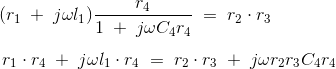
Split real and imaginary parts:
The quality factor is then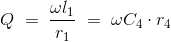
Advantages of Maxwell’s Bridge
Useful points of this Maxwell layout:
- Frequency does not appear in the L and R balance equations, so those two results do not depend on frequency.
- Maxwell’s inductor capacitance bridge is a common audio-frequency method for medium-Q coils.
Disadvantages of Maxwell’s Bridge
Limits of this Maxwell layout:
- A variable standard capacitor costs more than a fixed one.
- The Maxwell-Wien form suits medium-Q coils (about 1 < Q < 10). Coils with Q < 1 give a poor null. Hay is the usual choice for high Q.
High-Q coils are usually measured on Hay’s bridge, which puts the electrical resistance in series with the capacitor instead of in parallel. Very low Q still wants Anderson, not Hay.


