

- Wheatstone Bridge Definition: A Wheatstone Bridge is defined as a circuit used to measure unknown electrical resistance by balancing two legs of a bridge circuit.
- Components: The bridge circuit includes two known resistors, one variable resistor, and one unknown resistor.
- Balancing the Bridge: By adjusting the variable resistor until the galvanometer shows zero current, the bridge is balanced.
- Ratio Arms: The known resistors, P and Q, are fixed and form the ratio arms of the bridge.
- Calculating Resistance: Using the balance equation P/Q = S/R, the unknown resistor R can be calculated.
Wheatstone Bridge
A Wheatstone Bridge measures unknown resistance by balancing two legs of a four-arm circuit. It has two known resistors, one variable resistor and one unknown resistor. Adjust the variable arm until the galvanometer reads zero current. The known-arm ratio then matches the ratio of the variable arm to the unknown electrical resistance.
Wheatstone Bridge Theory
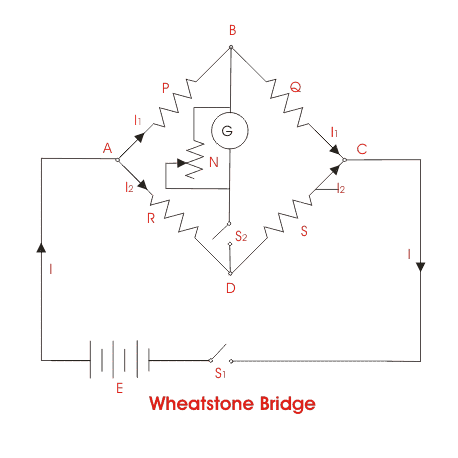
The circuit has four arms AB, BC, CD and AD. Those arms hold resistors P, Q, S and R and form the measuring diamond.
P and Q are known fixed resistances and serve as the ratio arms. A sensitive galvanometer sits between B and D through switch S2.
The Wheatstone bridge’s voltage source feeds A and C through switch S1. A variable resistor S sits between C and D. Changing S moves the potential at D. Currents I1 and I2 take paths ABC and ADC.
Change the electrical resistance of arm CD and I2 changes, because the voltage from A to C is fixed. Keep adjusting S until the drop across resistor S, I2.S, equals the voltage drop across Q, I1.Q. Points B and D then sit at the same potential, so the potential difference between them is zero and the galvanometer current is zero. Close S2 and the needle stays at rest.
From the Wheatstone bridge circuit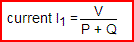
and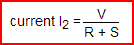
The potential of B relative to C is the drop across Q: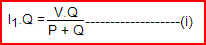
The potential of D relative to C is the voltage drop across resistor S:
Set (i) equal to (ii):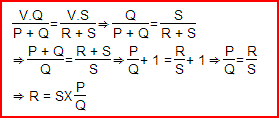
S and P⁄Q are known, so R follows at once.
The electrical resistances P and Q of the Wheatstone bridge are built in fixed ratios such as 1:1, 10:1 or 100:1. Those are the ratio arms. S, the rheostat arm, is continuously variable from 1 to 1,000 Ω or from 1 to 10,000 Ω.
That is the basic Wheatstone bridge theory.


