

- Admittance Defined: Admittance measures how easily current flows through a circuit and is measured in siemens.
- Impedance Relation: Admittance is the inverse of impedance, demonstrating opposite functionality in allowing current flow.
- Admittance Components: It includes conductance, which facilitates current flow, and susceptance, which affects the circuit’s response to AC signals.
- Series and Parallel Circuits: Understanding admittance in these configurations helps predict how circuits will behave under different setups.
- Practical Use: Knowing admittance allows engineers to calculate the necessary parameters like total current and the circuit’s power factor.
What is Admittance?
Admittance is how readily a circuit lets current through. It is the reciprocal of impedance, in the same way conductance is the reciprocal of resistance. The SI unit is the siemens (S).
To reiterate the above definition: let us first go through some important terms which associated with the topic admittance. We all know that resistance (R) has only magnitude but no phase. We can say that it is the measure of opposition for the flow of current.
In an AC circuit, besides resistance, we must also consider inductance and capacitance. Impedance, like resistance, hinders current flow but includes both size and direction aspects. It consists of resistance (the real part) and reactance (the imaginary part, arising from the circuit’s inductance and capacitance).
When looking at admittance vs impedance, admittance is the inverse (i.e. the reciprocal) of impedance. Therefore it has the opposite function of impedance. That is, we can say it is the measure of the flow of current which is allowed by a device or a circuit. Admittance also measures the dynamic effects of susceptance of a material to polarization and is measured in Siemens or Mho. Oliver Heaviside introduced this in December 1887.
Derivation of Admittance from Impedance
Impedance includes resistance (real part) and reactance (imaginary part). The symbol for impedance is Z, and for admittance, it’s Y.
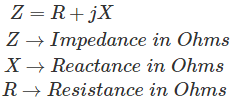
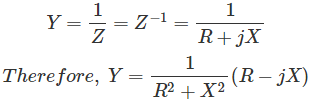
Admittance is also a complex number as impedance which is having a real part, Conductance (G) and imaginary part, Susceptance (B).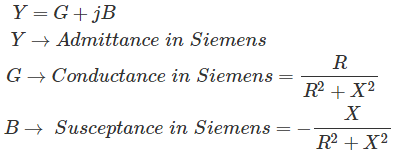
(it is negative for capacitive susceptance and positive for inductive susceptance)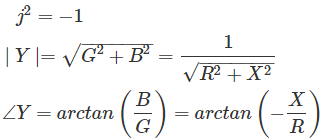
Admittance Triangle
It is formed by admittance (Y), susceptance (B) and conductance (G) as shown below.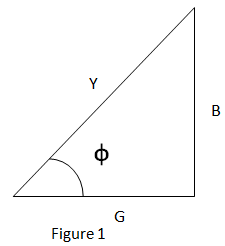
From admittance triangle,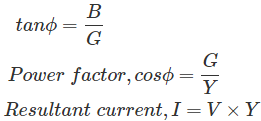
Admittance of a Series Circuit
When a circuit consist of Resistance and Inductance reactance in series is considered as shown below.
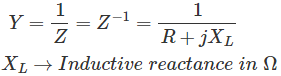
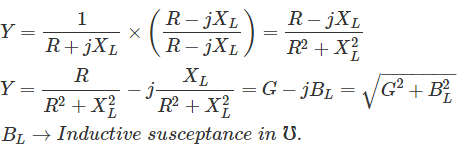
When the circuit consist of Resistance and Capacitive reactance in series is considered as shown below.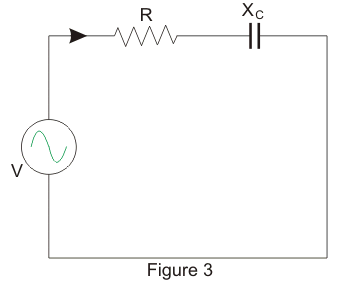
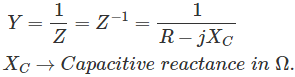

Admittance of a Parallel Circuit
Consider a parallel circuit with two branches, A and B. Branch A includes an inductive reactance (XL) and a resistance (R1), while B includes a capacitive reactance (XC) and another resistance (R2). A voltage (V) is applied across the circuit.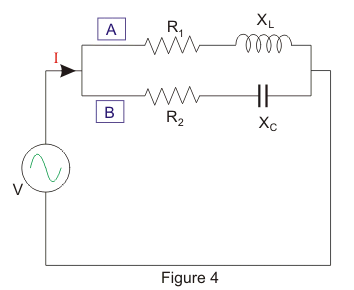
For Branch A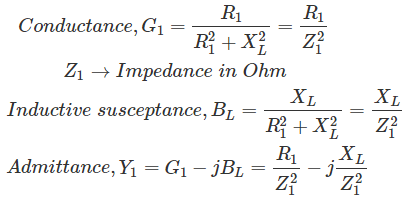
For Branch B
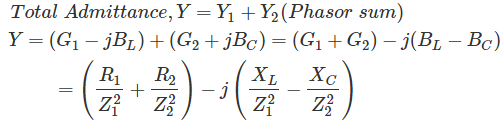
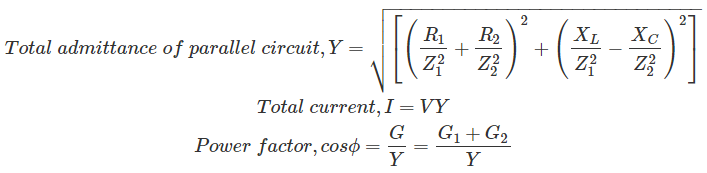
So, if the admittance of a circuit is known, then the total current and power factor can be obtained easily.


