

- Hay’s Bridge Definition: Hay’s bridge is defined as an AC bridge circuit used to measure the self-inductance of high Q factor coils.
- Self-Inductance Measurement: Hay’s bridge measures self-inductance by balancing voltage drops across its arms, making calculations based on the bridge’s balance condition.
- Construction of Hay’s Bridge: The bridge consists of four arms: an unknown inductor and resistor, a standard capacitor and resistor, and two pure resistors.
- Advantages of Hay’s Bridge: It simplifies calculations, requires low values of R4, and measures Q factor over a wide range.
- Disadvantages of Hay’s Bridge: It is unsuitable for low Q factor coils, requires a high-accuracy capacitor, and needs a frequency meter for precise measurements.
Hay’s bridge is an AC bridge circuit used to measure the self-inductance of a high-quality factor coil (Q > 10). It modifies Maxwell’s bridge, which measures coils with a medium quality factor (1 < Q < 10). This article covers the construction, theory, phasor diagram, advantages, and disadvantages of Hay’s bridge.
What is Self-Inductance?
Self-inductance is defined as the property of a coil or circuit that opposes changes in the current flowing through it. It is measured in henries (H) and depends on the number of turns, the coil’s area and shape, and the core material’s permeability. Self-inductance creates a self-induced electromotive force (emf) that opposes current changes, following Lenz’s law.
What is Quality Factor?
The quality factor is a dimensionless parameter showing how well a coil or circuit resonates at a given frequency. Also known as the Q factor or figure of merit, it is calculated by dividing the coil’s reactance by its resistance at the resonant frequency. A higher Q factor means lower energy losses and sharper resonance. It can also be seen as the ratio of stored energy to dissipated energy per cycle.
Construction of Hay’s Bridge
The schematic diagram of Hay’s bridge is shown below:

Hay’s bridge has four arms: AB, BC, CD, and DA. Arm AB has an unknown inductor L1 in series with a resistor R1. Arm CD has a standard capacitor C4 in series with a resistor R4. Arms BC and DA have pure resistors R3 and R2. A detector or galvanometer connects between points B and D to show the balance condition. An AC source connects between points A and C to supply the bridge.
Theory of Hay’s Bridge
The balance condition of Hay’s bridge is achieved when the voltage drops across AB and CD are equal and opposite, and the voltage drops across BC and DA are equal and opposite. This means that no current flows through the detector, and its deflection is zero.
Using Kirchhoff’s voltage law, we can write the balance condition as:
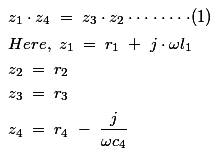
Z1Z4 = Z2Z3
where Z1, Z2, Z3, and Z4 are the impedances of the four arms.
Substituting the values of impedances, we get:
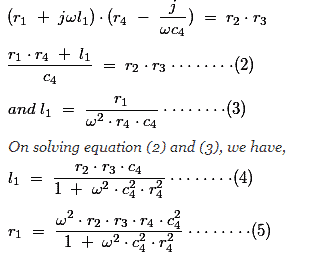
(R1 – jX1)(R4 + jX4) = R2R3
where X1 = 1/ωC1 and X4 = ωL4 are the reactances of the inductor and capacitor, respectively.
Expanding and equating the real and imaginary parts, we get:
R1R4 – X1X4 = R2R3
R1X4 + R4X1 = 0
Solving for L1 and R1, we get:
L1 = R2R3C4/(1 + ω2R42C4^2)
R1 = ω2R2R3R4C42/(1 + ω2R42C4^2)
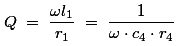
The quality factor of the coil is given by:
Q = ωL1/R1 = 1/ωR4C4
These equations show that L1 and R1 depend on the frequency of the source ω. Therefore, to measure them accurately, we need to know the exact value of ω. However, for high Q factor coils, we can neglect the term 1/ω2R42C4^2 in the denominators and simplify the equations as:

L1 ≈ R2R3C4
R1 ≈ ω2R2R3R4C42
Q ≈ 1/ωR4C4
Phasor Diagram of Hay’s Bridge
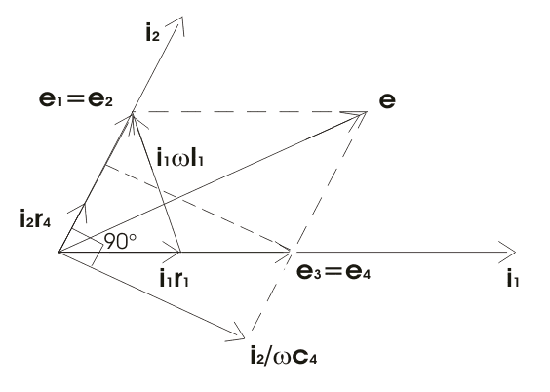
The currents I1 and I2 are not in phase because of the presence of capacitor C4 in arm CD. The current I2 leads I1 by an angle φ, as shown. The voltage drops E1 and E2 are equal in magnitude and phase because they are across pure resistors R1 and R2, respectively. The voltage drops E3, and E4 are also equal in magnitude and phase because they are across pure resistors R3 and R4, respectively. The voltage drop E5 is perpendicular to E4 because it is across capacitor C4. The voltage drop E6 is perpendicular to E1 because it is across inductor L1. The phasor diagram shows that E6 + E5 = E3 + E4 = E.
Advantages of Hay’s Bridge

-
- Hay’s bridge provides simple expressions for calculating unknown inductance and resistance of high Q factor coils.
-
- Hay’s bridge requires a low value of R4 compared to Maxwell’s bridge. This reduces the error due to stray capacitance and leakage resistance.
-
- Hay’s bridge can measure the Q factor over a wide range by varying C4.
Disadvantages of Hay’s Bridge
-
- Hay’s bridge is not suitable for measuring low Q factor coils (Q < 10). For such coils, Maxwell’s bridge or other bridges are preferred.
-
- Hay’s bridge requires a standard capacitor with high accuracy and stability.
-
- Hay’s bridge requires a frequency meter to measure L1 and R1 accurately.
Applications of Hay’s Bridge
Hay’s bridge can be used for various applications, such as:
-
- Measuring self-inductance of coils with high Q factor in laboratories or industries.
-
- Calibrating other bridges or instruments that measure self-inductance or Q factor.
-
- Studying the effects of frequency on self-inductance or Q factor.
-
- Designing filters or oscillators that use high Q factor coils.
Conclusion
Hay’s bridge is a useful method for measuring the self-inductance and resistance of coils with high-quality factors. It is a modification of Maxwell’s bridge that uses a capacitor in series with a resistor in one arm of the bridge.
The balance condition of Hay’s bridge is achieved when the voltage drops across the opposite arms are equal and opposite. The unknown inductance and resistance can be calculated from simple equations that depend on the frequency of the source. Hay’s bridge has some advantages and disadvantages over other bridges and can be used for various applications in electrical engineering.


