

- Heaviside Bridge Definition: The Heaviside bridge circuit is defined as a bridge circuit that measures mutual inductance using four non-inductive resistors and an unknown mutual inductor.
- Uses of Mutual Inductor: Mutual inductors are used in bridge circuits to find the value of unknown mutual inductance and self-inductance in various circuits.
- Mathematical Derivation: The mutual inductance of two coils in series is calculated by finding the difference between the self-inductances when fields are additive and when reversed.
- Heaviside Bridge Applications: The main application of the Heaviside bridge is to measure mutual inductance in terms of self-inductance in industrial settings.
- Modified Heaviside Bridge: Campbell’s modified Heaviside bridge includes a balancing coil and resistor to measure unknown self-inductance more accurately.
A mutual inductor is a pair of magnetically coupled coils. AC bridges use a calibrated or unknown mutual inductance as one circuit quantity. The Heaviside bridge circuit compares mutual inductance with known self-inductance and resistance values. Related bridge arrangements can determine self inductance, capacitance or frequency.
These classical null methods require stable standards and careful control of stray coupling. Modern impedance analysers and LCR meters are usually more convenient, while a standard capacitor often provides a traceable reference in other inductance bridges.
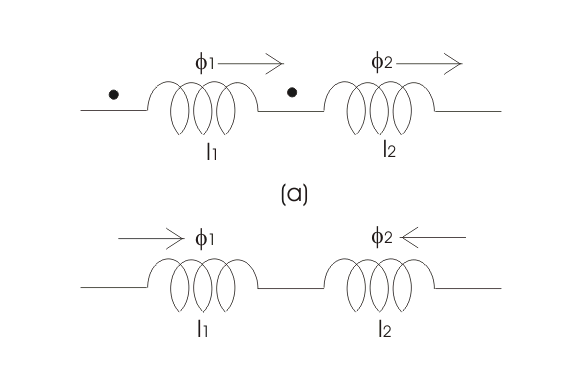
The Heaviside bridge uses the relationship between self inductance and mutual inductance in two coupled coils. Before analysing the bridge, the series-aiding and series-opposing measurements show how mutual inductance contributes to total inductance.
Consider two coupled coils connected in series as shown below.
When the coil connections make their magnetic fields aid, the measured series inductance is:
Here, L1 is the self-inductance of the first coil,
L2 is the self-inductance of the second coil,
M is their mutual inductance.
Reversing one coil makes the fields oppose, giving:
Solving the series-aiding and series-opposing equations gives: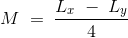
Mutual inductance is one quarter of the difference between the two measured series inductances. Coil position, orientation and surrounding magnetic material must remain unchanged between measurements.

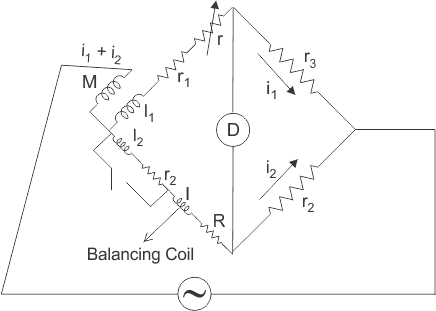
Coaxial alignment and strong, stable coupling make the aiding-opposing difference easier to measure accurately. The Heaviside mutual inductor bridge below instead obtains mutual inductance from AC bridge balance.
The bridge measures unknown mutual inductance using a known self inductance and resistance ratios. Its four non-inductive resistors are r1, r2, r3 and r4. The coupled coils and known inductive arm complete the measurement network. An AC voltage excites terminals 1 and 3. At balance, detector electric current between nodes 2 and 4 is zero, so the node potentials are equal. The voltage drop from 2 to 3 therefore equals the drop from 4 to 3.
The other loop relation is: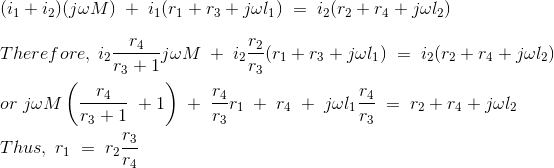
Combining the real and imaginary balance conditions gives the mutual inductance:
For the special equal-ratio case:
The mutual-inductance expression reduces to:
Campbell’s modification of the Heaviside bridge is shown next.
This modified Heaviside bridge measures an unknown self-inductance in terms of calibrated mutual inductance. A balancing coil and resistance are added to one arm, and an adjustable electrical resistance r is added to another. The switch across r2 and l2 provides two balance readings: one with r2 and l2 included, and one with r2 and l2 short-circuited.
The two Campbell-bridge balances allow the unknown self-inductance and resistance to be found from differences in the settings. Let the open-switch balance settings be M1 and r1, and the closed-switch settings be M2 and r2.
With the switch open, the balance relation is:
With the switch closed, it is: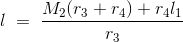
Subtracting the two relations gives the final self-inductance expression: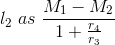


Great just love this ,it has really helped me
Very happy to hear that Bella. Thank you for your kind words.