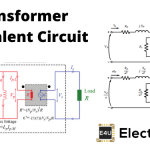
- Equivalent Circuit Definition: The equivalent circuit of an induction motor shows its internal parameters like losses using inductors and resistors.
- Components of Equivalent Circuit: Includes elements like winding resistance (R1, R2), inductance (X1, X2), core loss (Rc), and magnetizing reactance (XM).
- Exact Equivalent Circuit: Provides detailed parameters, showing power and losses in the motor.
- Approximate Equivalent Circuit: Simplifies analysis by shifting the shunt branch but is less accurate for smaller motors.
- Single-Phase Induction Motor: Uses the double revolving field theory to explain its equivalent circuit, accounting for forward and backward rotating fields.
An induction motor transfers power from its stator to its rotor through a rotating magnetic field. The stator supply produces rotor voltage and current by electromagnetic induction. This makes the steady-state model similar to a transformer, with the stator as the primary and the moving rotor as a short-circuited secondary.
During motoring operation, the rotor runs below synchronous speed. Slip, s, is the difference between synchronous speed and rotor speed divided by synchronous speed. This definition uses the actual rotor speed rather than a fixed full-load value.

Here, Ns is the synchronous speed, calculated as
where f is the supply frequency.
P is the machine’s number of poles.
Equivalent Circuit of an Induction Motor
An equivalent circuit is an electrical model used to calculate current, power factor, losses, air-gap power and torque from the machine parameters.
Each per-phase model uses an inductor and a resistor to represent different effects. Winding resistance accounts for copper loss. Leakage inductance produces a voltage drop through inductive reactance and affects the power factor. The shunt branch represents magnetising current and core loss. The following exact and approximate circuits apply to a balanced three-phase motor on a per-phase basis.
Exact Equivalent Circuit

Here, R1 is the stator winding resistance.
X1 is the stator leakage reactance.
Rc is the resistance that represents core loss.
XM is the magnetising reactance.
R2/s is the slip-dependent rotor resistance term. Its absorbed power represents the air-gap power transferred to the rotor.
The circuit below refers the rotor quantities to the stator side.

The remaining parameters keep the same meaning, except that
R2’ is the rotor resistance referred to the stator.
X2’ is the rotor leakage reactance referred to the stator.
R2(1 – s) / s represents converted mechanical power in the split rotor branch. This is gross converted power, not shaft output; friction, windage and other rotational losses must still be subtracted.
Approximate Equivalent Circuit
The approximate circuit moves the shunt magnetising branch to the supply terminals. It then treats the voltage across that branch as approximately equal to the supply voltage, avoiding one internal node in the calculation. The error depends on the stator impedance, magnetising current, motor size and operating point.
- The induction-motor magnetic circuit includes an air gap, so its excitation current is often larger than in a comparable transformer.
- Stator and rotor leakage reactances create voltage drops that the approximation does not place exactly.
- Distributed windings, saturation and parameter variation limit the accuracy of any simple steady-state model.
The approximate model is useful when its expected error is acceptable. It often gives lower relative error for larger machines. Motor size alone cannot establish accuracy, so use the exact circuit when parameter accuracy matters.
Power Relation of Equivalent Circuit
- Three-phase stator input power = 3 V1I1cos(θ).
Here, V1 is the per-phase stator voltage.
I1 is the per-phase stator current.
cos(θ) is the input power factor. - Air-gap power =
stator input power – stator copper loss – core loss. - Rotor copper loss = slip × air-gap power.
- Converted mechanical power = (1 – s) × air-gap power.
Equivalent Circuit of a Single Phase Induction Motor
A single-phase motor needs a different equivalent circuit. Double-revolving-field theory represents the pulsating field of a single phase induction motor as two fields of equal magnitude rotating in opposite directions.
At standstill, the forward and backward magnetic field components produce equal opposing torques, so their net starting torque is zero. At rotor slip s relative to the forward field, slip relative to the backward field is (2 – s). The equivalent circuit is
The core-loss branch r0 is sometimes neglected when its effect is small enough for the required accuracy.
Here, Zf is the forward-field impedance and Zb is the backward-field impedance.
The forward and backward slips sum to 2, which gives the backward slip (2 – s).
R1 = stator winding resistance.
X1 = stator leakage reactance.
Xm = magnetising reactance.
R2’ = rotor resistance referred to the stator.
X2’ = rotor leakage reactance referred to the stator.
Calculation of Power of Equivalent Circuit
- Calculate Zf and Zb.
- Calculate stator current as stator voltage divided by total circuit impedance.
- Calculate input power from
stator voltage × stator current × cos(θ).
Here, θ is the phase angle between stator voltage and current. - Developed air-gap power (Pg) is the forward-field power minus the backward-field power. Calculate each component from the corresponding equivalent resistance and current.
- Calculate forward and backward rotor copper losses with their respective slips and air-gap powers; do not apply one slip to the net Pg.
- Shaft output power is
converted mechanical power – rotational losses. Use the forward and backward components of Pg; a single s × Pg term applies only to a one-field model.
Rotational losses include friction and windage. Account for core loss consistently in either the equivalent circuit or the loss total, without counting it twice. - Efficiency equals shaft output power divided by input power.