

- Wien Bridge Oscillator Definition: A Wien Bridge Oscillator is defined as a phase-shift oscillator that uses a specific arrangement of resistors and capacitors to create sustained oscillations at certain frequencies.
- Circuit Behavior: The oscillator circuit behaves differently at various frequencies, producing zero output at both high and low frequencies due to the specific reactance values of capacitors.
- Resonant Frequency: The resonant frequency occurs where the capacitive reactance and resistance are equal, maximizing the output voltage and balancing the circuit.
- Design Variations: Wien Bridge Oscillators can be designed using either bipolar junction transistors or operational amplifiers, affecting their performance and frequency limits.
- Frequency Adjustment: The frequency of oscillation can be easily altered by varying the capacitors in the circuit, offering flexibility in tuning the oscillator’s output.
What is a Wien Bridge Oscillator?
A Wien-bridge oscillator is a phase-shift oscillator built around a Wien-bridge network (Figure 1a) with four arms. Two arms are only resistive. The other two mix resistors and capacitors.
One arm is a resistor and capacitor in series (R1 and C1). The other is the same pair in parallel (R2 and C2).
Those two arms act like a high pass filter or a low pass filter, matching the circuit in Figure 1b.
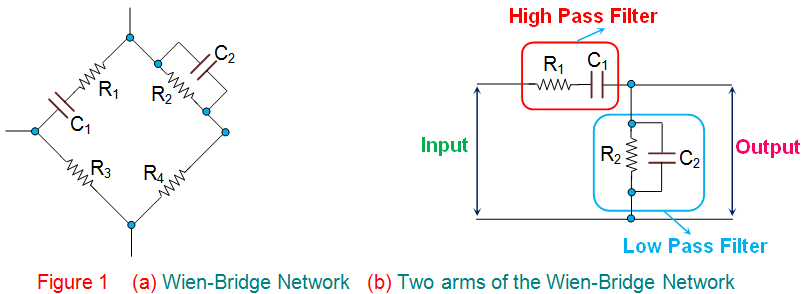
At high frequencies, the low reactance of capacitors C1 and C2 short-circuits resistor R2, resulting in zero output voltage, V0.
At low frequencies, capacitors C1 and C2 exhibit high reactance.
Even with high reactance at low frequencies, the output voltage V0 remains zero because capacitor C1 acts as an open circuit.
This kind of behavior exhibited by the Wien-Bridge network makes it a lead-lag circuit in the case of low and high frequencies, respectively.
Wien Bridge Oscillator Frequency Calculation
Between these extremes, there is a specific frequency where the resistance and capacitive reactance equalize, maximizing the output voltage.
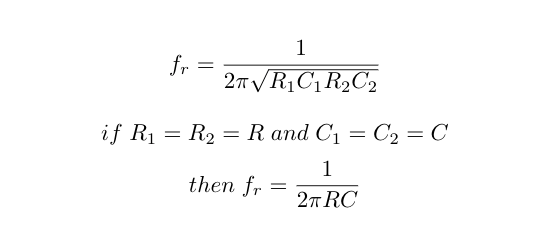
This frequency is referred to as resonant frequency. The resonant frequency for a Wein Bridge Oscillator is calculated using the following formula:
Further, at this frequency, the phase-shift between the input and the output will become zero and the magnitude of the output voltage will become equal to one-third of the input value. In addition, it is seen that the Wien-Bridge will be balanced only at this particular frequency.
In the case of Wien-Bridge oscillator, the Wien-Bridge network of Figure 1 will be used in the feedback path as shown in Figure 2. The circuit diagram for a Wein Oscillator using a BJT (Bipolar Junction Transistor) is shown below:
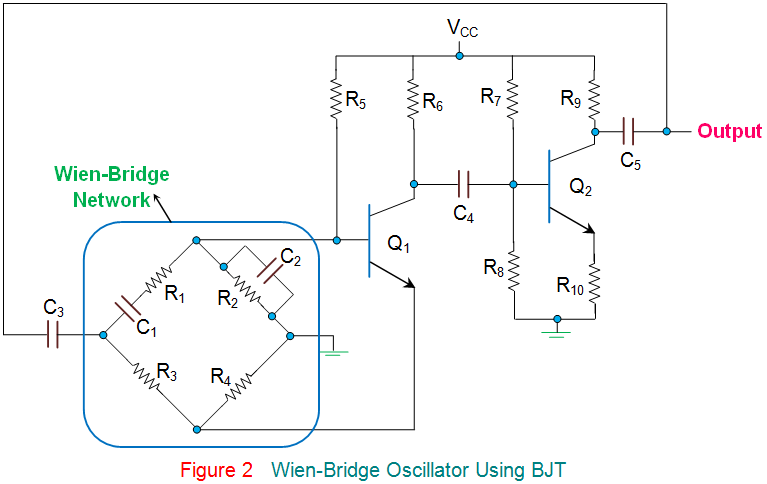
In these oscillators, the amplifier section will comprise of two-stage amplifier formed by the transistors, Q1 and Q2, wherein the output of Q2 is back-fed as an input to Q1 via Wien-Bridge network (shown within the blue enclosure in the figure).
Here, the noise inherent in the circuit will cause a change in the base current of Q1 which will appear at its collector point after being amplified with a phase-shift of 180o.
This is fed as an input to Q2 via C4 and gets further amplified and appears with an additional phase-shift of 180o.
This makes the net phase-difference of the signal fed back to the Wien-Bridge network to be 360o, satisfying phase-shift criterion to obtain sustained oscillations.
However, this condition will be satisfied only in the case of resonant frequency, due to which the Wien-Bridge oscillators will be highly selective in terms of frequency, leading to a frequency-stabilized design.
Wien-bridge oscillators can even be designed using Op-Amps as a part of their amplifier section, as shown by Figure 3.
However it is to be noted that, here, the Op-Amp is required to act as a non-inverting amplifier as the Wien-Bridge network offers zero phase-shift.
Further, from the circuit, it is evident that the output voltage is fed back to both inverting and non-inverting input terminals.
At resonant frequency, the voltages applied to the inverting and non-inverting terminals will be equal and in-phase with each other.
However, even here, the voltage gain of the amplifier needs to be greater than 3 to start oscillations and equal to 3 to sustain them. In general, these kind of Op-Amp-based Wien Bridge Oscillators cannot operate above 1 MHz due to the limitations imposed on them by their open-loop gain.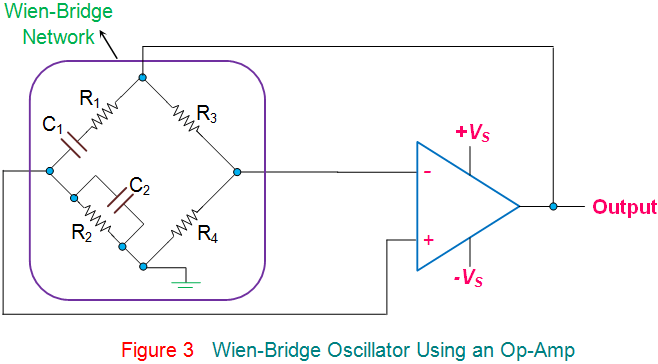
Wien-Bridge networks are low frequency oscillators which are used to generate audio and sub-audio frequencies ranging between 20 Hz to 20 KHz.
Further, they provide stabilized, low distorted sinusoidal output over a wide range of frequency which can be selected using decade resistance boxes.
In addition, the oscillation frequency in this kind of circuit can be varied quite easily as it just needs variation of the capacitors C1 and C2.
These oscillators require many circuit components and have a maximum operational frequency limit.


hi!
i think i saw a mistake on this page.
if f = 1/(2π√(R1*C1*R2*C2))
and if R1 = R2 = R and C1 = C2 = C
then f = 1/(2π√(R²C²)) = f = 1/(2π√(RC)²)
so f = 1/(2πRC) ; and not 1/(2π√(RC))
right?